Download the free toolbox talk
The one-page talk, editable Word version, and guidance below are open to everyone. No account required.
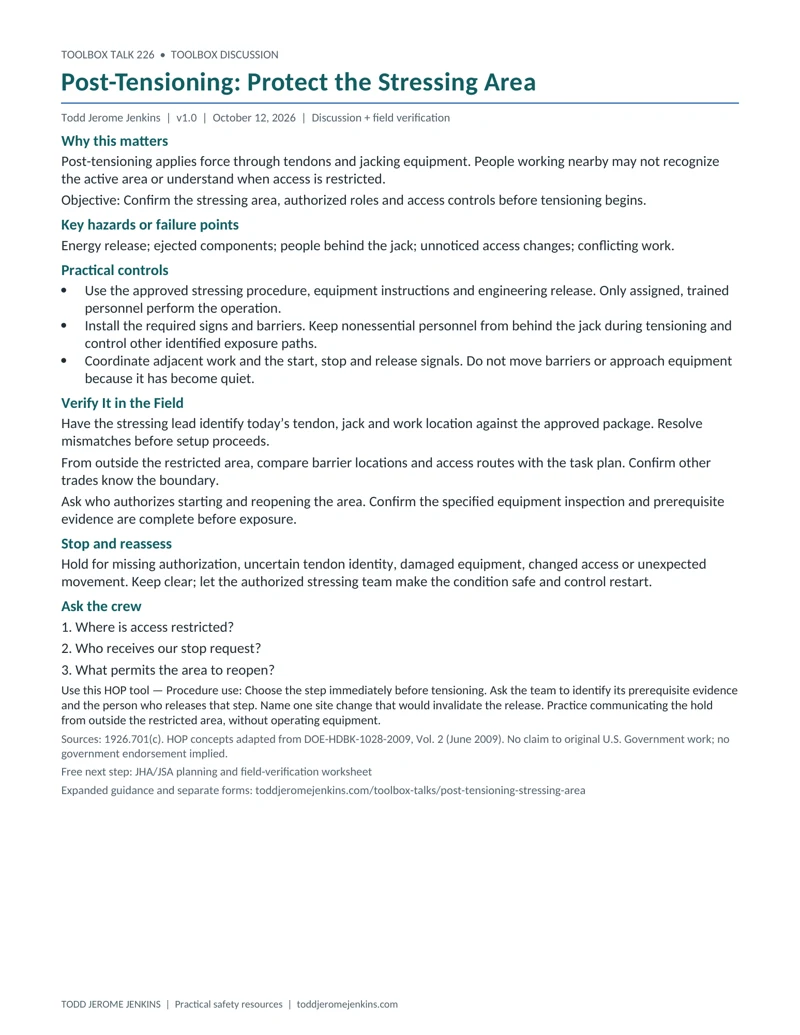
One-page toolbox talk
Download one-page toolbox talk (PDF, 1 page)Editable one-page toolbox talk (Word)Preview the one-page toolbox talk
Supporting documents
Included with free Safety & Systems membership.
Supervisor field check
A separate check to verify conditions and controls before work. Includes a one-page PDF and editable Word file.
Attendance sheet
A separate sign-in sheet to record the crew discussion. Includes a one-page PDF and editable Word file.
Need the crew records? Join free to use these supporting documents and the Safety & Systems Academy. No payment details. Email updates are optional.
Get supporting documents — free membershipAlready a member? Use the same link to sign in.
Hazard-based toolbox talk 51 of 52, with a practical HOP exercise.
Plan a 5–10 minute toolbox discussion, plus time to verify the actual controls. The one-page toolbox talk and editable Word version are public. Separate supervisor and attendance records are included with free Safety & Systems membership.
Why this matters
Post-tensioning applies force through tendons and jacking equipment. People working nearby may not recognize the active area or understand when access is restricted.
Learning objective
Confirm the stressing area, authorized roles and access controls before tensioning begins.
Key hazards or failure points
Energy release; ejected components; people behind the jack; unnoticed access changes; conflicting work.
Practical controls
- Use the approved stressing procedure, equipment instructions and engineering release. Only assigned, trained personnel perform the operation.
- Install the required signs and barriers. Keep nonessential personnel from behind the jack during tensioning and control other identified exposure paths.
- Coordinate adjacent work and the start, stop and release signals. Do not move barriers or approach equipment because it has become quiet.
Verify It in the Field
- Have the stressing lead identify today’s tendon, jack and work location against the approved package. Resolve mismatches before setup proceeds.
- From outside the restricted area, compare barrier locations and access routes with the task plan. Confirm other trades know the boundary.
- Ask who authorizes starting and reopening the area. Confirm the specified equipment inspection and prerequisite evidence are complete before exposure.
Stop and reassess
Hold for missing authorization, uncertain tendon identity, damaged equipment, changed access or unexpected movement. Keep clear; let the authorized stressing team make the condition safe and control restart.
Crew discussion questions
- Where is access restricted?
- Who receives our stop request?
- What permits the area to reopen?
For each required control, record its acceptance source and criterion, safe verification method, responsible verifier, actual result and time. Mark VERIFIED, HOLD/NOT VERIFIED, or N/A with a reason. Complete all required inspections; never enter danger or improvise a test to fill out a form.
Use this HOP tool
Procedure use
Choose the step immediately before tensioning. Ask the team to identify its prerequisite evidence and the person who releases that step. Name one site change that would invalidate the release. Practice communicating the hold from outside the restricted area, without operating equipment.
This exercise supports hazard identification or control verification. It does not replace safeguards, required training, specialist decisions or work authorization.
Leader preparation and practical detail
The shortcut crosses the boundary
Illustrative situation: a delivery crew wants to pass behind the jack to reach stored material. Discuss the alternative route before tensioning begins. The stressing lead and adjacent supervisor should resolve access together. A warning delivered only to the stressing crew leaves other workers without the information needed to stay clear.
Apply the construction requirement precisely
Under 1926.701(c), only personnel essential to post-tensioning operations may be behind the jack during tensioning, and signs and barriers must limit access to the area. The essential-person exception is not blanket permission to stand in a hazardous position. The approved operation and equipment instructions must define protected work arrangements for those personnel.
This briefing does not authorize tendon disturbance
This topic concerns active stressing. Cutting, drilling, repair or demolition of existing post-tensioned concrete requires its own structural assessment and authorized method. A scan, a quiet jack or a completed briefing does not release stored energy. Use the existing concrete-drilling resource for planning the hole and breakthrough, while obtaining the project-specific engineering direction for tendons.
Short supervisor field check
- Stressing package matches work
- Prerequisite release recorded
- Equipment inspection complete
- Signs and barriers effective
- Start and release authority clear
Use the separate sheet to document evidence, unresolved restrictions, correction owner, recheck and required release authority. Rebrief affected workers. This record does not replace specialist inspections, permits or engineering determinations.
Attendance and follow-through
Use the separate attendance record for participants, roles, questions, actions and late-arrival rebriefs. Attendance does not prove competence, functioning controls or authorization. Keep completed records private under employer procedures.
Source acknowledgment
HOP concepts are adapted from DOE-HDBK-1028-2009, Human Performance Improvement Handbook, Volume 2 (June 2009). Todd Jerome Jenkins makes no claim to authorship or copyright ownership of original U.S. Government work. The explanations and exercises are original adaptations; no endorsement by DOE or the U.S. Government is implied. Third-party material credited in the handbook retains its separate ownership.
HOP source: Volume 2/VOLUME 2 PROCEDURE USE AND ADHERENCE.pdf; Printed pp. 20–21. The handbook supplies concepts; task-specific technical references are listed below.
Technical scope and references
Technical sources inspected October 12, 2026; resource edition October 12, 2026. Apply current jurisdictional requirements, the actual task procedure, manufacturer instructions, permits and required competent or qualified decisions. This resource supplies no equipment-specific acceptance criteria.
- OSHA 29 CFR 1926.701(c) — Construction post-tensioning: personnel behind the jack, signs and barriers.
- DOE-HDBK-1028-2009 Volume 2 — Procedure use — Printed pp. 20–21; historical HOP concepts adapted into an original exercise.
Connect this discussion to your JHA/JSA
Use the JHA/JSA planning and field-verification worksheet to connect this discussion to the actual task, controls and responsible people.
Related Todd Jerome Jenkins articles: How to Conduct a Job Safety Analysis and What Is Human and Organizational Performance?.
Related toolbox talks
- Concrete Drilling: Verify the Hole and Breakthrough
- Barricades: What Does This Boundary Keep Out?
- Procedure Use: Stop When the Instructions Do Not Fit
Continue the hazard series
Put one verification into practice
Record today’s change and evidence using the free JHA/JSA planning and field-verification worksheet.