

 Free toolbox talk · TBT-136
Download the free toolbox talk
The one-page talk, editable Word version, and guidance below are open to everyone. No account required.
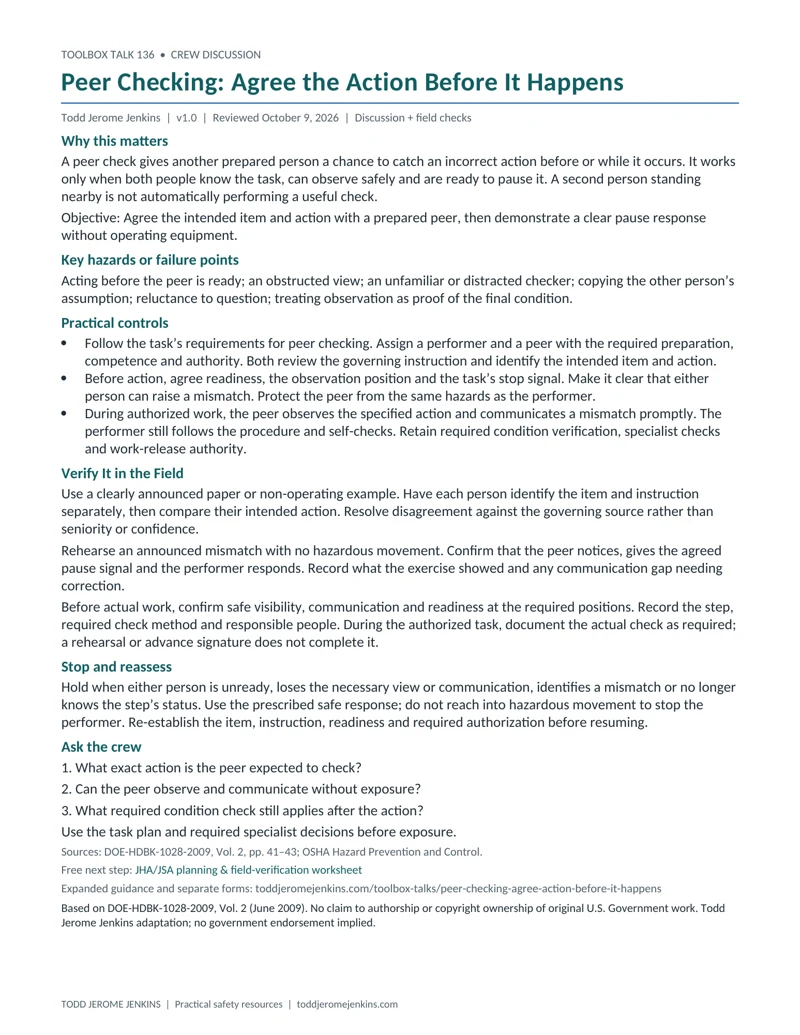
One-page toolbox talk
Download one-page toolbox talk (PDF, 1 page)Editable one-page toolbox talk (Word)Preview the one-page toolbox talk
Supporting documents
Supervisor field checks and attendance records are included with a free account. No payment is required.
Supervisor field check
A separate check to verify conditions and controls before work. Includes a one-page PDF and editable Word file.
Attendance sheet
A separate sign-in sheet to record the toolbox talk. Includes a one-page PDF and editable Word file.
Need the crew records? Create a free account to use these supporting documents and Jenkins Academy of Applied Technology. No payment is required. Email updates are optional.
Create Free AccountAlready have an account? Sign in
HOP skills practice • Batch 1, topic 2 of 5. A 5–10 minute toolbox talk plus time for actual field verification. One-page PDF and editable Word talk; separate supervisor and attendance forms.
What is this skill?
Peer checking pairs a performer with a prepared peer before and during a specific action. Each checks the item and instruction, they agree on the action, and the peer observes and raises a mismatch.
Why use it?
A prepared second person can notice something the performer missed. This requires task understanding, a usable view, attention and freedom to speak up; being nearby is not enough.
When should we use it?
Use it where the task process requires it, or where a prepared peer can help catch a consequential selection or action error. Agree on the exact step before starting.
Where does it apply?
At the same action point, where both people can safely identify the item and the peer can observe the step. An after-the-fact signature is not a peer check.
Learning objective
Demonstrate separate self-checks, agreement and an effective pause response before a simulated action.
Key hazards or failure points
Unprepared peer; blocked view; acting too soon; shared assumptions; reluctance to challenge; observation mistaken for condition verification.
How to use it — practical controls
- Assign a performer and prepared peer. Each checks the item and instruction before comparing conclusions. Retain the performer's self-check.
- Agree on the action, safe positions, readiness and stop signal. The peer observes the specified action and communicates any mismatch promptly.
- Confirm the action taken. Complete any separately required condition verification; peer checking does not replace independent verification or work authorization.
Verify It in the Field
- Before real work, confirm both people can see, communicate and perform their assigned roles safely. Record the actual check as required by the task.
- Practice with paper cards marked Order 31 and Order 13. Each person checks a mock instruction selecting Order 31, then agrees on the selection.
- Announce a second round with a simulated wrong selection. The peer calls the agreed pause before selection is completed; the performer stops. Discuss any missed cue.
For real work, record the control, governing source and criterion, safe method, authorized checker, actual result and time. Mark VERIFIED, HOLD/NOT VERIFIED, or N/A with a reason. A practiced skill or matching label does not demonstrate that a physical safeguard functions. Do not create exposure to complete a check.
Stop and reassess
Hold if either person is unready, loses the view or communication, or identifies a mismatch. Follow the safe response; never reach into hazardous movement to stop someone.
Toolbox talk questions
- Which exact action needs the peer's attention?
- Can either person challenge without being rushed?
- What condition still needs separate verification?
Examples across different work settings
These are original teaching examples, not operating instructions. Use paper, photographs or inert training items for practice. Change the setting to fit your team while retaining the skill steps and the applicable task requirements.
Distribution
Two prepared workers compare an order with the carton identifier before the selection is finalized. The peer watches the agreed selection. Product acceptance, loading and transport requirements remain separate.
Laboratory support
Using an inert training kit, each participant compares a supply label with a mock requisition before one selects the item. This exercise involves no chemicals, samples or clinical decisions; real technical requirements still govern.
Maintenance
Before a specified action, the performer and peer separately identify the item from the current instruction. The peer observes safely. Seeing the action occur does not establish isolation or prove the resulting condition.
Leader follow-through — improve the conditions
Give the peer enough time and task information to check. If visibility is poor or the peer is also expected to do another task, change the work arrangement before relying on the check. Thank people for identifying a mismatch, regardless of rank.
Short supervisor field check
- Performer and peer have task-specific preparation and role authority.
- Each checks the item and instruction before agreeing on the action.
- Safe view, reliable communication and readiness are demonstrated.
- Paper mismatch is caught and the performer responds to the pause signal.
- Actual check is recorded when performed; required condition verification remains.
Use the separate supervisor sheet to retain evidence, open items, correction owner, recheck result and required restart authority. Keep task-specific permits, inspections and technical decisions in their established process.
Attendance and follow-through
Use the separate attendance sheet for participants, roles, questions, actions and rebriefs. Attendance does not establish competence, verify a control or authorize work. Keep completed records private under employer procedures.
Source acknowledgment
Based on DOE-HDBK-1028-2009, Vol. 2 (June 2009). No claim to authorship or copyright ownership of original U.S. Government work. Todd Jerome Jenkins adaptation; no government endorsement implied. Explanations, examples, practice exercises and layouts are original adaptations. Third-party material credited in the handbook retains its original attribution; this notice does not claim rights in that material.
Source file inspected: Volume 2/VOLUME 2 CHECKING AND VERIFICATION PRACTICES Peer-Checking.pdf; printed pages 41–43. Printed page 41 supplies the distinction among checking and verification practices. No universal requirement, qualification rule or reliability ranking is imported. No INPO wording or illustrations are reproduced.
Technical scope and references
References reviewed October 13, 2026. DOE human-performance tools and OSHA recommended practices support preparation and discussion; they do not establish universal technical acceptance criteria. Apply the current task procedure, manufacturer instructions, permit and required competent or qualified decisions. A successful exercise does not replace required training, technical verification or work authorization.
- DOE-HDBK-1028-2009, Volume 2 — Checking and Verification; Peer-Checking — June 2009 guidance, printed pages 41–43: action-focused checking before and during work, separate self-checks, readiness, observation and intervention. Shared introduction counted once; source distinctions retained without ranking reliability or imposing a universal requirement.
- OSHA — Hazard Prevention and Control — Recommended practices, action items 3 and 6: assign responsible people and verify implementation. Does not establish a generic peer-check mandate.
The DOE handbook is June 2009 illustrative guidance, not a current requirements document. Availability of the official edition and the linked supporting guidance was checked October 13, 2026. Apply current task-specific requirements, manufacturer instructions, permits and required competent or qualified decisions; this talk supplies no universal technical acceptance criteria.
Connect this discussion to your JHA/JSA
Use the JHA/JSA planning and field-verification worksheet to record the actual task steps, hazards, responsible roles and controls. Return to What Changed Today? when the plan or conditions change.
Related Todd Jerome Jenkins articles: How to Conduct a Job Safety Analysis and What Is Human and Organizational Performance?.
Related toolbox talks
- Self-Checking: Confirm the Item, Action and Result
- Three-Way Communication: Close the Loop Before Acting
Practice another HOP skill
- STAR Self-Checking: Stop, Think, Act, Review
- Three-Way Communication: Close the Loop
- Pause When Unsure: Resolve Before Restart
- Validate Assumptions: Find the Evidence
One next step
Use the free JHA/JSA planning and field-verification worksheet linked above to apply this skill to one actual task step. Record what must be checked before exposure and who will check it.