

 Free toolbox talk · TBT-159
Download the free toolbox talk
The one-page talk, editable Word version, and guidance below are open to everyone. No account required.
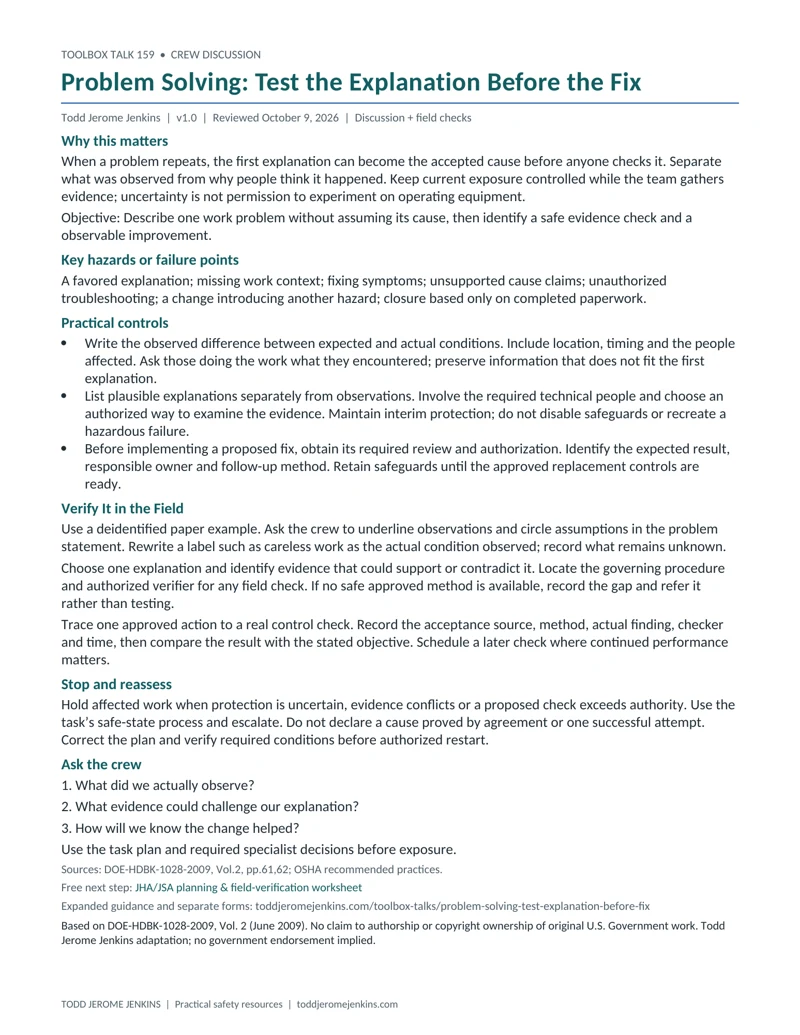
Toolbox Talk - Problem Solving with PACTS
Download toolbox talk - problem solving with pacts (PDF, 1 page)Editable toolbox talk - problem solving with pacts (Word)Preview the one-page toolbox talk
Supporting documents
Supervisor field checks and attendance records are included with a free account. No payment is required.
Supervisor Field Check - Problem Solving with PACTS
A separate check to verify conditions and controls before work. Includes a one-page PDF and editable Word file.
Attendance Sheet - Problem Solving with PACTS
A separate sign-in sheet to record the toolbox talk. Includes a one-page PDF and editable Word file.
Need the crew records? Create a free account to use these supporting documents and Jenkins Academy of Applied Technology. No payment is required. Email updates are optional.
Create Free AccountAlready have an account? Sign in
HOP skills practice • Batch 5, topic 35 of 52. A 5–10 minute toolbox talk plus time for actual field verification. One-page PDF and editable Word talk; separate supervisor and attendance forms.
What is this skill?
PACTS organizes problem solving around Problem statement, Analysis, Causes, Testing and Solution.
Why use it?
A quick fix can miss the cause or introduce a new hazard when the explanation has not been tested.
When should we use it?
For recurring problems, unfamiliar conditions or troubleshooting within an authorized process.
Where does it apply?
With affected workers and appropriate technical expertise, using safe evidence review.
Learning objective
Separate a problem description from a suspected cause and identify a safe way to test it.
Key hazards or failure points
Naming a cause too early; repeated trial-and-error; treating retraining as the automatic solution.
How to use it — practical controls
- Describe the gap without embedding a blame label or assumed cause. Protect people from ongoing exposure.
- Analyze evidence and compare possible causes, including facts that contradict each explanation.
- Test the explanation through approved methods, then choose and verify an authorized solution.
Verify It in the Field
- For any physical test or change, confirm required authority, safeguards, method and acceptance criteria first.
- Paper practice: deliveries are delayed; someone says staff need training. List other explanations and evidence needed.
- State what result would weaken your preferred explanation. Do not perform a live trial for this exercise.
For real work, record the control, governing source and criterion, safe method, authorized checker, actual result and time. Mark VERIFIED, HOLD/NOT VERIFIED, or N/A with a reason. A practiced skill or matching label does not demonstrate that a physical safeguard functions. Do not create exposure to complete a check.
Stop and reassess
Stop unapproved testing, repeated resets or changes with uncertain consequences. Keep the affected task on hold when protection is not verified.
Toolbox talk questions
- Have we described the problem or guessed a cause?
- What evidence could disprove our explanation?
- How will we verify the solution?
Examples across different work settings
These are original teaching examples, not operating instructions. Use paper, photographs or inert training items for practice. Change the setting to fit your team while retaining the skill steps and the applicable task requirements.
Office workflow
Documents repeatedly go to the wrong queue. The team studies routing rules, labels and workload before deciding training is the answer.
Food distribution
Orders arrive late at one handoff. A review compares dispatch timing, access and information availability using records before changing the process.
Equipment support
An intermittent fault prompts requests to reset repeatedly. The team follows the authorized diagnostic process and retains fault information instead of experimenting.
Practice the skill and understand its limits
Write PACTS across a sheet and place a fictional observation under the correct heading. Keep “cause not established” available as a valid finding. Testing may mean comparing records or qualified independent review; it never authorizes an improvised equipment test.
Leader follow-through — improve the conditions
Retain what was learned, including rejected explanations. Revisit recurring problems when corrections have not changed the conditions.
Short supervisor field check
- Problem statement describes a factual gap.
- Ongoing exposure is controlled or held.
- Competing explanations and contrary evidence are considered.
- Any test has approved methods and protection.
- Solution includes an effectiveness check and owner.
Use the separate supervisor sheet to retain evidence, open items, correction owner, recheck result and required restart authority. Keep task-specific permits, inspections and technical decisions in their established process.
Attendance and follow-through
Use the separate attendance sheet for participants, roles, questions, actions and rebriefs. Attendance does not establish competence, verify a control or authorize work. Keep completed records private under employer procedures.
Source acknowledgment
Based on DOE-HDBK-1028-2009, Vol. 2 (June 2009). No claim to authorship or copyright ownership of original U.S. Government work. Todd Jerome Jenkins adaptation; no government endorsement implied. Explanations, examples, practice exercises and layouts are original adaptations. Third-party material credited in the handbook retains its original attribution; this notice does not claim rights in that material.
Source file inspected: Volume 2/VOLUME 2 PROBLEM SOLVING – WITH PACTS.pdf; printed pages 61–62. Historical numerical error probabilities and unsupported certainty about causes are excluded. PACTS is attributed; explanations and exercises are original.
Technical scope and references
References reviewed October 13, 2026. DOE human-performance tools and OSHA recommended practices support preparation and discussion; they do not establish universal technical acceptance criteria. Apply the current task procedure, manufacturer instructions, permit and required competent or qualified decisions. A successful exercise does not replace required training, technical verification or work authorization.
- DOE-HDBK-1028-2009, Volume 2 — Structured problem solving — June 2009 illustrative guidance; printed pages 61, 62. Historical concepts, not universal mandates.
- OSHA Recommended Practices — Hazard Prevention and Control — Current recommended practices; supports assigned responsibilities, worker input and evidence-based follow-through. Not a technical acceptance standard.
The DOE handbook is June 2009 illustrative guidance, not a current requirements document. Availability of the official edition and the linked supporting guidance was checked October 13, 2026. Apply current task-specific requirements, manufacturer instructions, permits and required competent or qualified decisions; this talk supplies no universal technical acceptance criteria.
Connect this discussion to your JHA/JSA
Use the JHA/JSA planning and field-verification worksheet to record the actual task steps, hazards, responsible roles and controls. Return to What Changed Today? when the plan or conditions change.
Related Todd Jerome Jenkins articles: How to Conduct a Job Safety Analysis and What Is Human and Organizational Performance?.
Related toolbox talks
Practice another HOP skill
- Toolbox Talk - Project Reviews That Resolve Interfaces
- Toolbox Talk - Decisions Under Uncertainty
- Toolbox Talk - Peer Review Before Release
One next step
Use the free JHA/JSA planning and field-verification worksheet linked above to apply this skill to one actual task step. Record what must be checked before exposure and who will check it.