

 Free toolbox talk · TBT-167
Download the free toolbox talk
The one-page talk, editable Word version, and guidance below are open to everyone. No account required.
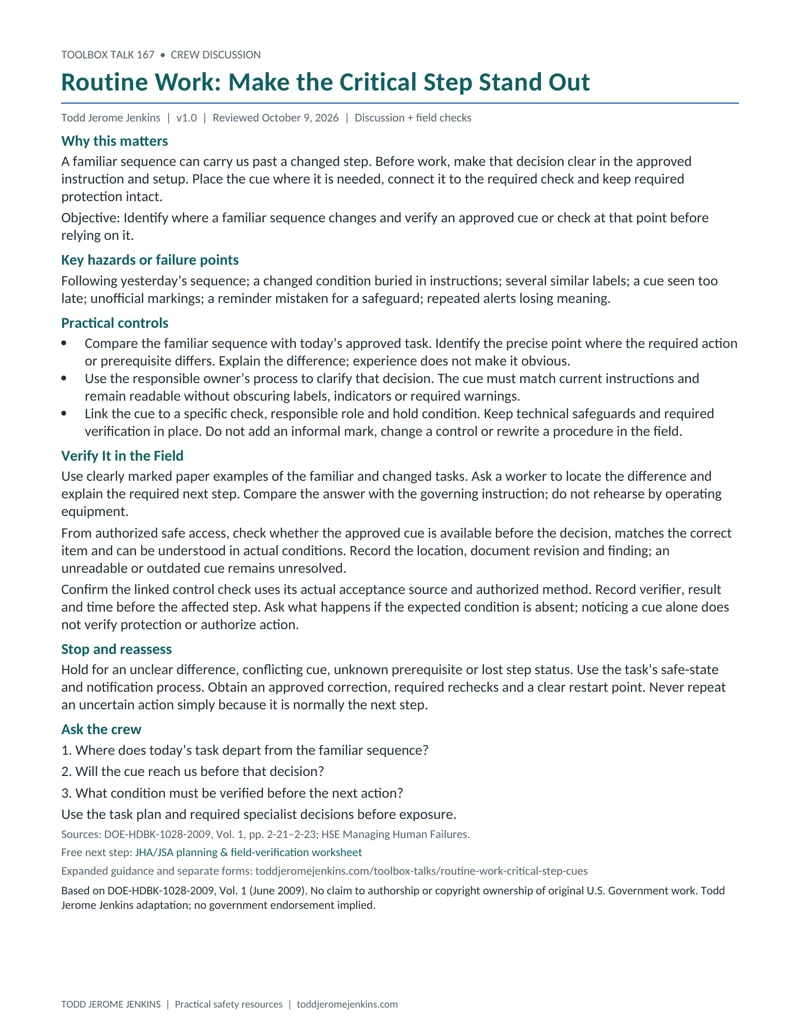
Toolbox Talk - Routine Work and Critical Steps
Download toolbox talk - routine work and critical steps (PDF, 1 page)Editable toolbox talk - routine work and critical steps (Word)Preview the one-page toolbox talk
Supporting documents
Supervisor field checks and attendance records are included with a free account. No payment is required.
Supervisor Field Check - Routine Work and Critical Steps
A separate check to verify conditions and controls before work. Includes a one-page PDF and editable Word file.
Attendance Sheet - Routine Work and Critical Steps
A separate sign-in sheet to record the toolbox talk. Includes a one-page PDF and editable Word file.
Need the crew records? Create a free account to use these supporting documents and Jenkins Academy of Applied Technology. No payment is required. Email updates are optional.
Create Free AccountAlready have an account? Sign in
HOP skills practice • Batch 6, topic 44 of 52. A 5–10 minute toolbox talk plus time for actual field verification. One-page PDF and editable Word talk; separate supervisor and attendance forms.
What is this skill?
This skill makes a consequential change in familiar work visible before the next action.
Why use it?
A familiar sequence can carry us past a changed step. Before work, make that decision clear in the approved instruction and setup. Place the cue where it is needed, connect it to the required check and keep required protection intact.
When should we use it?
When today’s sequence, item or prerequisite differs from the familiar task, especially after interruptions.
Where does it apply?
At the decision point in any repeated physical or administrative task.
Learning objective
Identify where a familiar sequence changes and verify an approved cue or check at that point before relying on it.
Key hazards or failure points
Following yesterday’s sequence; a changed condition buried in instructions; several similar labels; a cue seen too late; unofficial markings; a reminder mistaken for a safeguard; repeated alerts losing meaning.
How to use it — practical controls
- Compare today’s approved instruction with the familiar sequence. Name the precise difference and the affected step.
- Use approved cues and place-keeping that appear before the decision. Do not add unofficial markings or alter instructions.
- Link the cue to a required check and hold condition. Keep safeguards effective even when the cue is noticed.
Verify It in the Field
- Use two paper task cards differing in one prerequisite. Ask participants to identify the change before choosing the next step.
- Check that the real approved cue is current, readable and available before the action. Record conflicting or missing information.
- Verify the actual prerequisite with the governing criterion and safe method. Record the result; recognizing a cue is not a control test.
For real work, record the control, governing source and criterion, safe method, authorized checker, actual result and time. Mark VERIFIED, HOLD/NOT VERIFIED, or N/A with a reason. A practiced skill or matching label does not demonstrate that a physical safeguard functions. Do not create exposure to complete a check.
Stop and reassess
Hold for an unclear difference, conflicting cue, unknown prerequisite or lost step status. Use the task’s safe-state and notification process. Obtain an approved correction, required rechecks and a clear restart point. Never repeat an uncertain action simply because it is normally the next step.
Toolbox talk questions
- Where does today’s task depart from the familiar sequence?
- Will the cue reach us before that decision?
- What condition must be verified before the next action?
Examples across different work settings
These are original teaching examples, not operating instructions. Use paper, photographs or inert training items for practice. Change the setting to fit your team while retaining the skill steps and the applicable task requirements.
Mail services
A familiar dispatch process uses a changed collection point. A current instruction must reach staff before sorting or dispatch, rather than after the usual route is underway.
Maintenance
A repeated task has a different equipment configuration today. The team identifies changed prerequisites from the controlled work package without assuming yesterday’s checks apply.
Food preparation
A revised task sequence has a new approval point. A paper exercise asks where the approved cue belongs; actual food-safety requirements remain governed by the workplace process.
Practice and discuss
Give participants a fictional sequence with a review before release, then a revised version with an additional prerequisite. Success means finding the changed condition and holding until its status is known. Do not race participants or rank memory. Study whether the information reaches the worker at the useful moment.
Leader follow-through — improve the conditions
Improve the instruction and surrounding conditions if people repeatedly miss the same point. Reduce avoidable interruption and confusing cues. Experience supports performance but does not remove the need for current task information or protection.
Short supervisor field check
- Specific change point is identified against current instructions.
- Cue is approved, accurate and available before the decision.
- Safe paper rehearsal demonstrates the intended meaning.
- Linked prerequisite has a governing criterion and actual check evidence.
- Mismatch, interruption and restart arrangements are understood.
Use the separate supervisor sheet to retain evidence, open items, correction owner, recheck result and required restart authority. Keep task-specific permits, inspections and technical decisions in their established process.
Attendance and follow-through
Use the separate attendance sheet for participants, roles, questions, actions and rebriefs. Attendance does not establish competence, verify a control or authorize work. Keep completed records private under employer procedures.
Source acknowledgment
Based on DOE-HDBK-1028-2009, Vol. 1 (June 2009). No claim to authorship or copyright ownership of original U.S. Government work. Todd Jerome Jenkins adaptation; no government endorsement implied. Explanations, examples, practice exercises and layouts are original adaptations. Third-party material credited in the handbook retains its original attribution; this notice does not claim rights in that material.
Source file inspected: Volume 1/VOLUME 1 CHAPTER 2-REDUCING ERROR.pdf; printed pages 2-21–2-23. Historical probabilities, activity percentages, third-party diagrams and hazardous equipment demonstrations are excluded. Original paper sequence.
Technical scope and references
References reviewed October 13, 2026. DOE human-performance tools and OSHA recommended practices support preparation and discussion; they do not establish universal technical acceptance criteria. Apply the current task procedure, manufacturer instructions, permit and required competent or qualified decisions. A successful exercise does not replace required training, technical verification or work authorization.
- DOE-HDBK-1028-2009, Volume 1 — Skill-Based Performance — June 2009, Chapter 2 printed pages 2-21–2-23: familiar sequences, slips, omissions and changed task requirements. Page 2-24 read as related context. All historical probabilities, activity percentages, third-party diagrams and hazardous equipment examples excluded.
- HSE — Managing Human Failures — UK regulator guidance: slips/lapses can occur in familiar work; task/equipment design and work conditions matter. Used as guidance, not a U.S. requirement.
The DOE handbook is June 2009 illustrative guidance, not a current requirements document. Availability of the official edition and the linked supporting guidance was checked October 13, 2026. Apply current task-specific requirements, manufacturer instructions, permits and required competent or qualified decisions; this talk supplies no universal technical acceptance criteria.
Connect this discussion to your JHA/JSA
Use the JHA/JSA planning and field-verification worksheet to record the actual task steps, hazards, responsible roles and controls. Return to What Changed Today? when the plan or conditions change.
Related Todd Jerome Jenkins articles: How to Conduct a Job Safety Analysis and What Is Human and Organizational Performance?.
Related toolbox talks
Practice another HOP skill
- Toolbox Talk - Benchmarking a Safety Practice
- Toolbox Talk - Designing Work to Tolerate Mistakes
- Toolbox Talk - Choosing the Right Procedure Branch
- Toolbox Talk - Getting Help with Unfamiliar Work
One next step
Use the free JHA/JSA planning and field-verification worksheet linked above to apply this skill to one actual task step. Record what must be checked before exposure and who will check it.