

 Free toolbox talk · TBT-165
Download the free toolbox talk
The one-page talk, editable Word version, and guidance below are open to everyone. No account required.
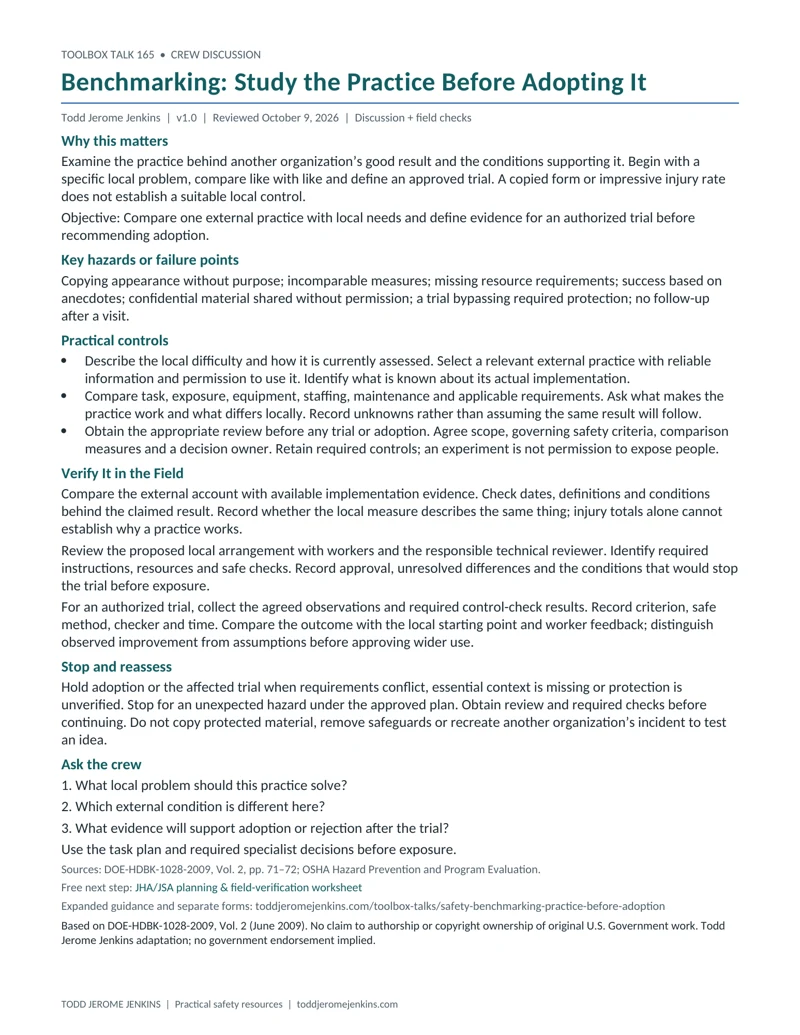
Toolbox Talk - Benchmarking a Safety Practice
Download toolbox talk - benchmarking a safety practice (PDF, 1 page)Editable toolbox talk - benchmarking a safety practice (Word)Preview the one-page toolbox talk
Supporting documents
Supervisor field checks and attendance records are included with a free account. No payment is required.
Supervisor Field Check - Benchmarking a Safety Practice
A separate check to verify conditions and controls before work. Includes a one-page PDF and editable Word file.
Attendance Sheet - Benchmarking a Safety Practice
A separate sign-in sheet to record the toolbox talk. Includes a one-page PDF and editable Word file.
Need the crew records? Create a free account to use these supporting documents and Jenkins Academy of Applied Technology. No payment is required. Email updates are optional.
Create Free AccountAlready have an account? Sign in
HOP skills practice • Batch 6, topic 42 of 52. A 5–10 minute toolbox talk plus time for actual field verification. One-page PDF and editable Word talk; separate supervisor and attendance forms.
What is this skill?
Benchmarking studies a practice used elsewhere and examines whether its conditions and evidence fit a local problem.
Why use it?
Examine the practice behind another organization’s good result and the conditions supporting it. Begin with a specific local problem, compare like with like and define an approved trial. A copied form or impressive injury rate does not establish a suitable local control.
When should we use it?
When considering an external idea, after a site visit or before adopting another team’s method.
Where does it apply?
Across organizations or departments through authorized exchanges and approved trials.
Learning objective
Compare one external practice with local needs and define evidence for an authorized trial before recommending adoption.
Key hazards or failure points
Copying appearance without purpose; incomparable measures; missing resource requirements; success based on anecdotes; confidential material shared without permission; a trial bypassing required protection; no follow-up after a visit.
How to use it — practical controls
- Define the local problem and current evidence. Obtain permission for any external material you use.
- Compare work, resources, exposures and requirements. Identify what makes the external practice possible and what differs here.
- Get required approval for a bounded trial, with protection, observations and stop conditions agreed beforehand.
Verify It in the Field
- Compare two fictional teams using the same form but different review support. Identify why copying the form may not reproduce the result.
- Confirm actual local resources and task requirements. Have responsible specialists resolve technical suitability before use.
- Study agreed trial observations and required control-check results. Record what improved, what did not and the decision on further use.
For real work, record the control, governing source and criterion, safe method, authorized checker, actual result and time. Mark VERIFIED, HOLD/NOT VERIFIED, or N/A with a reason. A practiced skill or matching label does not demonstrate that a physical safeguard functions. Do not create exposure to complete a check.
Stop and reassess
Hold adoption or the affected trial when requirements conflict, essential context is missing or protection is unverified. Stop for an unexpected hazard under the approved plan. Obtain review and required checks before continuing. Do not copy protected material, remove safeguards or recreate another organization’s incident to test an idea.
Toolbox talk questions
- What local problem should this practice solve?
- Which external condition is different here?
- What evidence will support adoption or rejection after the trial?
Examples across different work settings
These are original teaching examples, not operating instructions. Use paper, photographs or inert training items for practice. Change the setting to fit your team while retaining the skill steps and the applicable task requirements.
Retail
One store’s stock-movement method relies on a dedicated receiving area. Another store studies its own space and traffic arrangements before copying the method.
Public works
A neighboring team shares an approved planning aid. The receiving team checks whether local roles, equipment and required approvals match.
Design office
A useful peer-review practice includes protected reviewer time. Adopting its checklist alone would miss the support that made review possible.
Practice and discuss
Give each group a paper description of the same checklist: Team A has a designated reviewer; Team B has no confirmed reviewer availability. Ask which part is transferable and what must be arranged before a trial. External success is evidence to investigate, not proof of local effectiveness. Avoid unsupported “best in class” claims.
Leader follow-through — improve the conditions
Document what the team learned, including a justified decision not to adopt an idea. Preserve permission and attribution for external materials. A useful comparison studies the work and support behind the result, not only the published totals.
Short supervisor field check
- Specific local problem and starting evidence are defined.
- External practice and supporting information are credible and authorized.
- Important differences and comparable measures are documented.
- Trial has approval, required protection and stop criteria.
- Results and worker feedback support a recorded adoption decision.
Use the separate supervisor sheet to retain evidence, open items, correction owner, recheck result and required restart authority. Keep task-specific permits, inspections and technical decisions in their established process.
Attendance and follow-through
Use the separate attendance sheet for participants, roles, questions, actions and rebriefs. Attendance does not establish competence, verify a control or authorize work. Keep completed records private under employer procedures.
Source acknowledgment
Based on DOE-HDBK-1028-2009, Vol. 2 (June 2009). No claim to authorship or copyright ownership of original U.S. Government work. Todd Jerome Jenkins adaptation; no government endorsement implied. Explanations, examples, practice exercises and layouts are original adaptations. Third-party material credited in the handbook retains its original attribution; this notice does not claim rights in that material.
Source file inspected: Volume 2/VOLUME 2 BENCHMARKING.pdf; printed pages 71–72. Archived wording and unsupported best-in-class labels are excluded. No third-party forms or confidential benchmarking data reproduced.
Technical scope and references
References reviewed October 13, 2026. DOE human-performance tools and OSHA recommended practices support preparation and discussion; they do not establish universal technical acceptance criteria. Apply the current task procedure, manufacturer instructions, permit and required competent or qualified decisions. A successful exercise does not replace required training, technical verification or work authorization.
- DOE-HDBK-1028-2009, Volume 2 — Benchmarking — June 2009 guidance, printed pages 71–72: define a local problem, study comparable processes, use authorized exchange and account for differences before implementation. Original trial/evidence exercise; no unsupported best-in-class designation.
- OSHA — Hazard Prevention and Control — Recommended practices, action items 1, 2 and 6: evaluate controls used elsewhere, assess local suitability and verify effectiveness.
- OSHA — Program Evaluation and Improvement — Recommended practices: define useful indicators, compare information appropriately and involve workers in evaluating improvements.
The DOE handbook is June 2009 illustrative guidance, not a current requirements document. Availability of the official edition and the linked supporting guidance was checked October 13, 2026. Apply current task-specific requirements, manufacturer instructions, permits and required competent or qualified decisions; this talk supplies no universal technical acceptance criteria.
Connect this discussion to your JHA/JSA
Use the JHA/JSA planning and field-verification worksheet to record the actual task steps, hazards, responsible roles and controls. Return to What Changed Today? when the plan or conditions change.
Related Todd Jerome Jenkins articles: How to Conduct a Job Safety Analysis and What Is Human and Organizational Performance?.
Related toolbox talks
- Operating Experience: Does the Lesson Fit This Job?
- Problem Solving: Test the Explanation Before the Fix
Practice another HOP skill
- Toolbox Talk - Independent Oversight
- Toolbox Talk - Managing Change Safely
- Toolbox Talk - Designing Work to Tolerate Mistakes
- Toolbox Talk - Routine Work and Critical Steps
One next step
Use the free JHA/JSA planning and field-verification worksheet linked above to apply this skill to one actual task step. Record what must be checked before exposure and who will check it.