Download the talk and separate crew records
Free to download without an account. Each PDF is one page. Use the Word version to adapt the record to your task and approved procedures.
Supervisor field check
Download supervisor field check (PDF, 1 page)Editable supervisor field check (Word)Preview the one-page crew talk
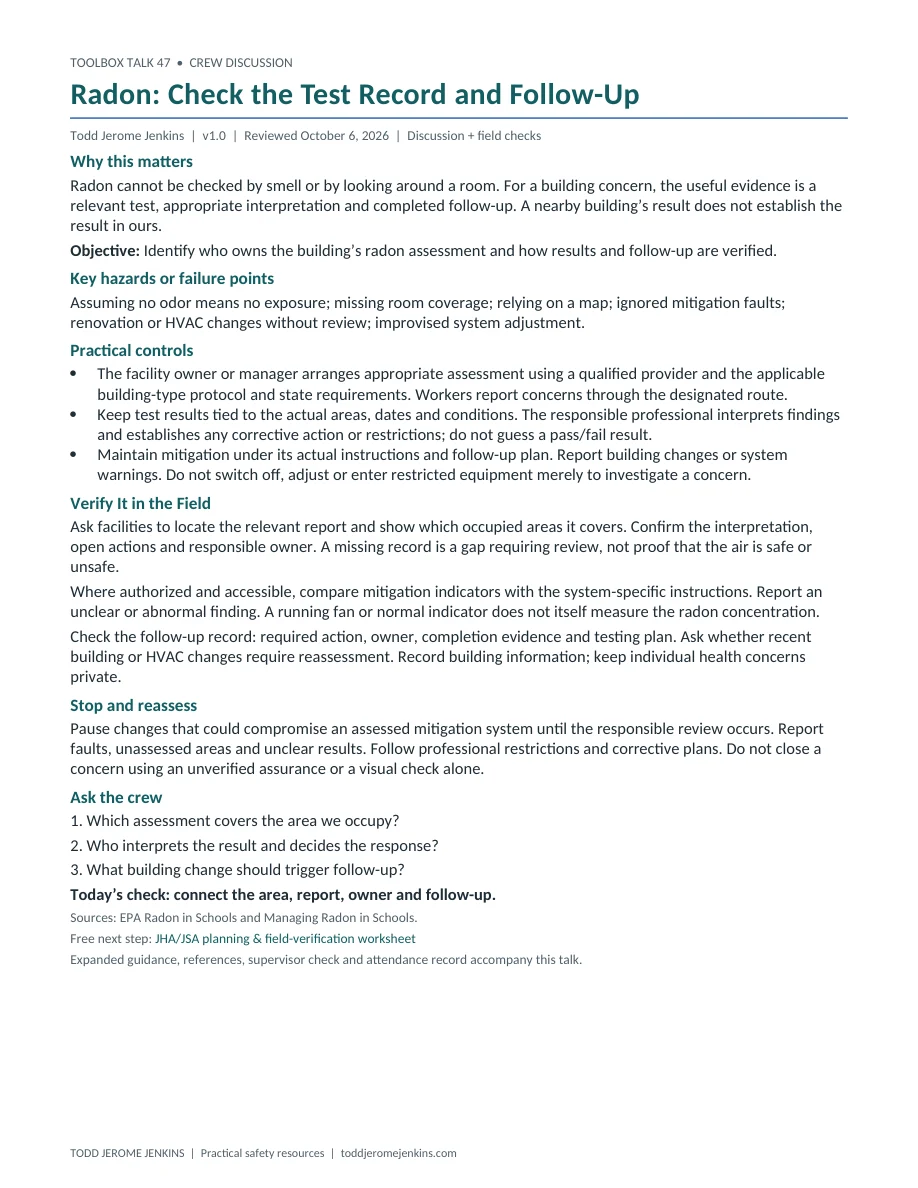
A 5–10 minute crew discussion, plus the time needed for field verification. All six downloads are free without a required signup.
Why this matters
Radon cannot be checked by smell or by looking around a room. For a building concern, the useful evidence is a relevant test, appropriate interpretation and completed follow-up. A nearby building’s result does not establish the result in ours.
Learning objective: Identify who owns the building’s radon assessment and how results and follow-up are verified.
Key hazards or failure points
Assuming no odor means no exposure; missing room coverage; relying on a map; ignored mitigation faults; renovation or HVAC changes without review; improvised system adjustment.
Practical controls
- The facility owner or manager arranges appropriate assessment using a qualified provider and the applicable building-type protocol and state requirements. Workers report concerns through the designated route.
- Keep test results tied to the actual areas, dates and conditions. The responsible professional interprets findings and establishes any corrective action or restrictions; do not guess a pass/fail result.
- Maintain mitigation under its actual instructions and follow-up plan. Report building changes or system warnings. Do not switch off, adjust or enter restricted equipment merely to investigate a concern.
Verify It in the Field
Ask facilities to locate the relevant report and show which occupied areas it covers. Confirm the interpretation, open actions and responsible owner. A missing record is a gap requiring review, not proof that the air is safe or unsafe.
Where authorized and accessible, compare mitigation indicators with the system-specific instructions. Report an unclear or abnormal finding. A running fan or normal indicator does not itself measure the radon concentration.
Check the follow-up record: required action, owner, completion evidence and testing plan. Ask whether recent building or HVAC changes require reassessment. Record building information; keep individual health concerns private.
Use the separate field check to record the source and criterion, safe method, checker, actual result and time. Mark VERIFIED, HOLD/NOT VERIFIED, or N/A with a reason. Check every required control; the examples below do not clear the whole task.
| Control | Safe verification | Evidence to record |
|---|---|---|
| Relevant assessment | Match room/use and test coverage with facilities. | Report, covered areas and unresolved coverage. |
| System status | Authorized person follows actual indicator/maintenance instructions. | Source, observed indication and escalation. |
| Completed follow-up | Check professional action and retesting plan. | Owner, due point and actual follow-up evidence. |
Stop and reassess
Pause changes that could compromise an assessed mitigation system until the responsible review occurs. Report faults, unassessed areas and unclear results. Follow professional restrictions and corrective plans. Do not close a concern using an unverified assurance or a visual check alone.
Crew discussion questions
- Which assessment covers the area we occupy?
- Who interprets the result and decides the response?
- What building change should trigger follow-up?
Today’s check: connect the area, report, owner and follow-up.
A situation to discuss
Illustrative situation: an occupied room changes use after a renovation. The old test record does not clearly cover its present use and conditions. Facilities asks the qualified provider what assessment is needed and tracks the response rather than treating the building’s previous report as automatic clearance.
Leader preparation and practical detail
Use measurement for the exposure question
EPA explains that radon cannot be detected by the senses and must be assessed through testing. Its school guidance links protocols for schools, commercial and other shared buildings. The protocol, locations, conditions and interpretation need to match the actual building. This talk does not prescribe a do-it-yourself measurement plan. [1]
Distinguish guidance from an occupational limit
An EPA residential or school action level must not be presented as a universal OSHA workplace exposure limit. The facility’s qualified adviser should identify the requirements and appropriate criteria for the building and activity. No numeric acceptance threshold is supplied here because the crew briefing cannot make that determination. [1], [2]
Follow changes and corrective actions
A mitigation system needs maintenance and follow-up under its design and instructions. EPA’s school-management guidance addresses qualified help, records and reassessment after relevant changes. Keep the action open until the required follow-up evidence exists; do not use fan noise or a gauge alone as proof that the exposure objective has been achieved. [2]
Short supervisor field check
- Relevant building/room report found or assessment owner assigned.
- Applicable professional protocol identified.
- Mitigation status checked only within authorization.
- Changes and faults escalated.
- Follow-up evidence and communication tracked.
Use the separate form to document evidence, restrictions, corrective-action owner, recheck and required restart approval. An unresolved required control means hold the affected work. Missing evidence is not a pass. Complete all task-specific inspections and permits.
Attendance and follow-through
The separate attendance sheet records participants, language support, questions, actions and late-arrival rebriefs. Attendance does not establish competence or prove controls function. Keep completed records private under the employer’s procedures.
Technical scope and references
This is building-awareness and follow-up guidance, not radiation-compliance assessment or a radon testing/mitigation specification. The cited EPA management material is school-focused; apply appropriate professional protocols and jurisdictional requirements to other buildings. [1], [2]
References checked October 6, 2026. Apply the jurisdiction, task, employer program and equipment instructions that govern the work. No site-specific manual, permit, engineering determination or product SDS has been approved by this general resource.
- EPA — Radon in Schools — EPA school guidance with commercial-building standard links. No claim that a residential action level is an OSHA workplace exposure limit. Do not invent testing duration or HVAC configuration.
- EPA — Managing Radon in Schools — School facility-management guidance; apply building-specific professional plan in other workplaces.
Connect this discussion to your JHA/JSA
Use How to Conduct a Job Safety Analysis to connect today’s work steps, hazards and controls. Revisit Pre-Job JHA/JSA: What Changed Today? whenever conditions change.
Related Todd Jerome Jenkins article: Hierarchy of Controls.
Related Todd Jerome Jenkins video: What Is the Hierarchy of Controls? | Workplace Safety Explained.
Related published crew resources: Respiratory Hazards: Know What You’re Breathing.
Put one check into practice
Download the free JHA/JSA planning and field-verification worksheet. For today’s task, record an important control, its source and the evidence needed before exposure. Complete the remaining required checks through your task plan.