Download the free crew talk
The one-page talk, editable Word version, and guidance below are open to everyone. No account required.
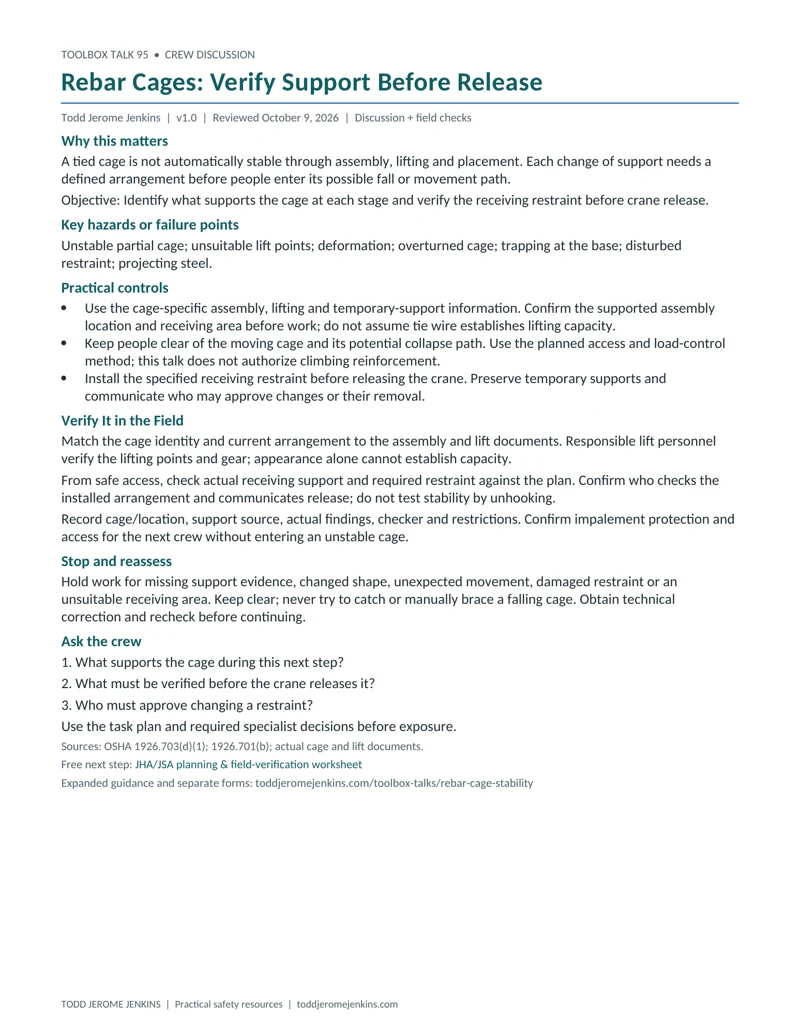
Preview the one-page crew talk
Supporting documents
Included with free Safety & Systems membership.
Supervisor field check
A separate check to verify conditions and controls before work. Includes a one-page PDF and editable Word file.
Attendance sheet
A separate sign-in sheet to record the crew discussion. Includes a one-page PDF and editable Word file.
Need the crew records? Join free to use these supporting documents and the Safety & Systems Academy. No payment details. Email updates are optional.
Get supporting documents — free membershipAlready a member? Use the same link to sign in.
A 5–10 minute crew discussion, plus time to verify the actual controls. The crew talk and Word version are public. Separate supervisor and attendance records are included with free Safety & Systems membership.
Why this matters
A tied cage is not automatically stable through assembly, lifting and placement. Each change of support needs a defined arrangement before people enter its possible fall or movement path.
Learning objective
Identify what supports the cage at each stage and verify the receiving restraint before crane release.
Key hazards or failure points
Unstable partial cage; unsuitable lift points; deformation; overturned cage; trapping at the base; disturbed restraint; projecting steel.
Practical controls
- Use the cage-specific assembly, lifting and temporary-support information. Confirm the supported assembly location and receiving area before work; do not assume tie wire establishes lifting capacity.
- Keep people clear of the moving cage and its potential collapse path. Use the planned access and load-control method; this talk does not authorize climbing reinforcement.
- Install the specified receiving restraint before releasing the crane. Preserve temporary supports and communicate who may approve changes or their removal.
Verify It in the Field
- Match the cage identity and current arrangement to the assembly and lift documents. Responsible lift personnel verify the lifting points and gear; appearance alone cannot establish capacity.
- From safe access, check actual receiving support and required restraint against the plan. Confirm who checks the installed arrangement and communicates release; do not test stability by unhooking.
- Record cage/location, support source, actual findings, checker and restrictions. Confirm impalement protection and access for the next crew without entering an unstable cage.
Stop and reassess
Hold work for missing support evidence, changed shape, unexpected movement, damaged restraint or an unsuitable receiving area. Keep clear; never try to catch or manually brace a falling cage. Obtain technical correction and recheck before continuing.
Crew discussion questions
- What supports the cage during this next step?
- What must be verified before the crane releases it?
- Who must approve changing a restraint?
For each required control, record its acceptance source and criterion, safe verification method, responsible checker, actual result and time. Use VERIFIED, HOLD/NOT VERIFIED, or N/A with a reason. A tick alone is not evidence. Complete all applicable task inspections; do not enter danger or improvise a test to fill out a form.
Leader preparation and practical detail
Follow the changing support
The related JHA covers a freestanding column cage assembled on a supported ground-level jig, lifted by its specified arrangement and secured in a released foundation location. It excludes climbing reinforcement, unprotected excavation work and slab mats. This briefing focuses on support changes; use the full JHA for the task sequence.
Apply the support duty without inventing a design
OSHA 1926.703(d)(1) requires adequate support against overturning and collapse for reinforcing steel in walls, piers, columns and similar vertical structures. It does not give a universal brace count, cage height, tie spacing or wind limit. The actual design and responsible technical decisions must establish the arrangement and release conditions.
A rigging release is a verified handoff
Illustrative situation: the cage is landed, but the planned receiving restraint does not fit. Keep the operation in its safe controlled state under the lift procedure and resolve the mismatch. Do not detach rigging to see whether the cage stays upright. The crew record should identify the unresolved restraint and person responsible for its disposition.
Keep impalement and stability checks distinct
A cage may have guarded projections and still collapse. TBT88 covers exposure to protruding reinforcing steel under 1926.701(b); protection against that hazard does not establish structural stability. Keep required protection and support effective as the next trade arrives; do not remove either merely because the crane has departed.
Short supervisor field check
- Cage and current support plan matched.
- Assembly and receiving areas released.
- Lift arrangement verified by responsible personnel.
- Required restraint checked before release.
- Access and ongoing support handed over.
Confirm the relevant trained/authorized people, unresolved items, interim protection, correction owner and recheck. Record required release authority and rebrief anyone affected. The separate sheet supports these records; it does not replace a specialist inspection, permit or engineering determination.
Attendance and follow-through
Use the separate attendance sheet for participants, roles, discussion concerns, actions and late-arrival rebriefs. Attendance is not proof of competence, functioning controls or authorization to work. Keep completed records private under employer procedures.
Technical scope and references
Reviewed October 9, 2026 for construction crew preparation. Apply the actual task, jurisdiction and relevant standard provisions. Manufacturer sources below are reference examples, not approval of your equipment. No site-specific design, permit, exposure assessment, product SDS or current model manual was supplied; obtain the applicable documents before work. This discussion does not replace required training.
- OSHA 1926.703(d)(1) — Support vertical reinforcing steel against overturning and collapse.
- OSHA 1926.701(b) — Guard reinforcing steel where workers could fall onto or into it.
Connect this discussion to your JHA/JSA
Use the related worked JHA/JSA/AHA example to prepare task steps, hazards and controls. Return to What Changed Today? when the plan or conditions change.
Related Todd Jerome Jenkins article: How to Conduct a Job Safety Analysis.
Related crew discussions
Put one check into practice
Use the free JHA/JSA planning and field-verification worksheet to record today’s change, the required protection and the evidence needed before exposure.