Download the free crew talk
The one-page talk, editable Word version, and guidance below are open to everyone. No account required.
Preview the one-page crew talk
Supporting documents
Included with free Safety & Systems membership.
Supervisor field check
A separate check to verify conditions and controls before work. Includes a one-page PDF and editable Word file.
Attendance sheet
A separate sign-in sheet to record the crew discussion. Includes a one-page PDF and editable Word file.
Need the crew records? Join free to use these supporting documents and the Safety & Systems Academy. No payment details. Email updates are optional.
Get supporting documents — free membershipAlready a member? Use the same link to sign in.
A 5–10 minute crew discussion, plus time to verify the actual controls. The crew talk and Word version are public. Separate supervisor and attendance records are included with free Safety & Systems membership.
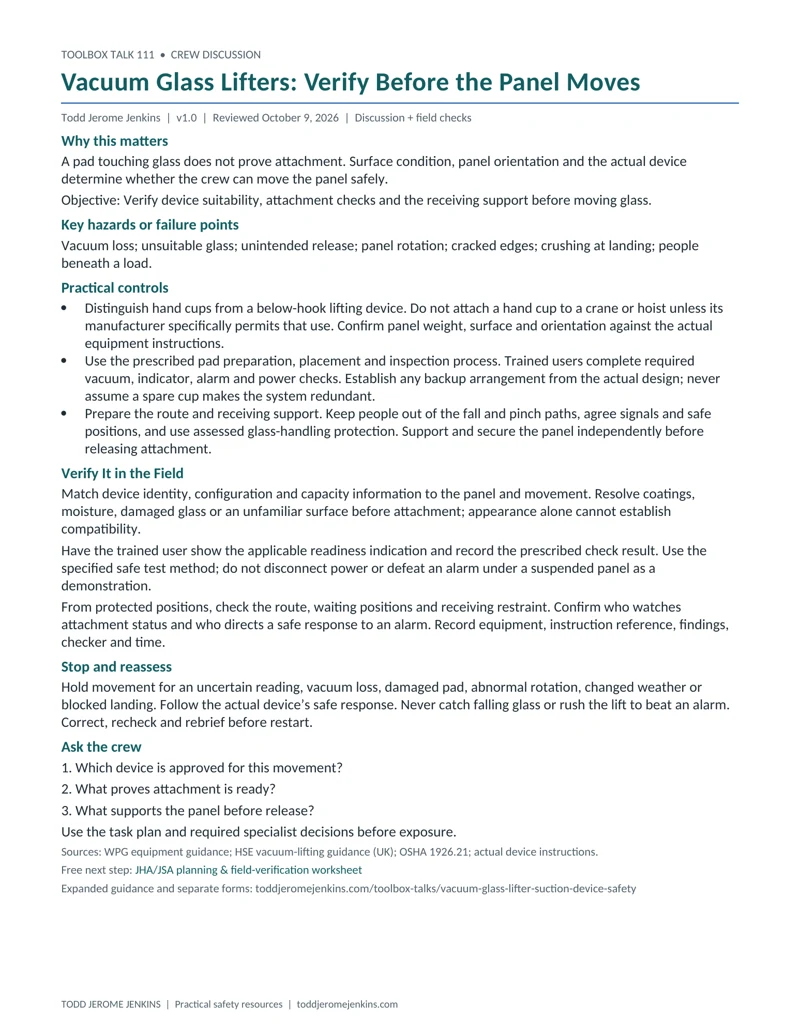
Why this matters
A pad touching glass does not prove attachment. Surface condition, panel orientation and the actual device determine whether the crew can move the panel safely.
Learning objective
Verify device suitability, attachment checks and the receiving support before moving glass.
Key hazards or failure points
Vacuum loss; unsuitable glass; unintended release; panel rotation; cracked edges; crushing at landing; people beneath a load.
Practical controls
- Distinguish hand cups from a below-hook lifting device. Do not attach a hand cup to a crane or hoist unless its manufacturer specifically permits that use. Confirm panel weight, surface and orientation against the actual equipment instructions.
- Use the prescribed pad preparation, placement and inspection process. Trained users complete required vacuum, indicator, alarm and power checks. Establish any backup arrangement from the actual design; never assume a spare cup makes the system redundant.
- Prepare the route and receiving support. Keep people out of the fall and pinch paths, agree signals and safe positions, and use assessed glass-handling protection. Support and secure the panel independently before releasing attachment.
Verify It in the Field
- Match device identity, configuration and capacity information to the panel and movement. Resolve coatings, moisture, damaged glass or an unfamiliar surface before attachment; appearance alone cannot establish compatibility.
- Have the trained user show the applicable readiness indication and record the prescribed check result. Use the specified safe test method; do not disconnect power or defeat an alarm under a suspended panel as a demonstration.
- From protected positions, check the route, waiting positions and receiving restraint. Confirm who watches attachment status and who directs a safe response to an alarm. Record equipment, instruction reference, findings, checker and time.
Stop and reassess
Hold movement for an uncertain reading, vacuum loss, damaged pad, abnormal rotation, changed weather or blocked landing. Follow the actual device’s safe response. Never catch falling glass or rush the lift to beat an alarm. Correct, recheck and rebrief before restart.
Crew discussion questions
- Which device is approved for this movement?
- What proves attachment is ready?
- What supports the panel before release?
For each required control, record its acceptance source and criterion, safe verification method, responsible checker, actual result and time. Use VERIFIED, HOLD/NOT VERIFIED, or N/A with a reason. A tick alone is not evidence. Complete all applicable task inspections; do not enter danger or improvise a test to fill out a form.
Leader preparation and practical detail
Keep manual handling separate from hoisting
The linked JHA concerns a specified panel moved between ground-level supports with a suitable vacuum lifter and hoisting arrangement. Hand-held cups provide a handling grip; their appearance or nominal capacity does not establish approval for crane attachment. For manual handling, plan the carrying team, unobstructed route and supported pauses rather than improvising a hoisting connection.
No universal emergency holding time
WPG warns that immediate load loss remains possible after power failure where condition or surface is unsuitable. Do not convert a reservoir or battery label into a guaranteed rescue interval. The actual equipment instructions must resolve readiness indications, required tests, reserve arrangements and the response to vacuum loss.
Backup protection is an equipment decision
HSE discusses reserve capacity and secondary or redundant arrangements for particular applications. Its numerical recommendations and UK examination rules are not universal US acceptance criteria. Have the responsible equipment specialist establish the actual application’s requirements; adding an improvised strap or another cup is not a verified backup design.
Separate attachment readiness from a clear route
Ask the crew to identify what changes between pickup, rotation and landing. A functioning vacuum system does not prevent glass striking a worker, a rack overturning or fingers being trapped against the frame. Record the actual panel and equipment, safe positions, independent receiving support and release decision. No model manual or site lift plan was supplied for this general briefing.
Short supervisor field check
- Device and panel compatibility confirmed.
- Required inspection and function checks passed.
- Model-specific backup provisions resolved.
- Route, positions and receiving support ready.
- Alarm response and release authority understood.
Confirm the relevant trained/authorized people, unresolved items, interim protection, correction owner and recheck. Record required release authority and rebrief anyone affected. The separate sheet supports these records; it does not replace a specialist inspection, permit or engineering determination.
Attendance and follow-through
Use the separate attendance sheet for participants, roles, discussion concerns, actions and late-arrival rebriefs. Attendance is not proof of competence, functioning controls or authorization to work. Keep completed records private under employer procedures.
Technical scope and references
Reviewed October 9, 2026 for construction crew preparation. Apply the actual task, jurisdiction and relevant standard provisions. Manufacturer sources below are reference examples, not approval of your equipment. No site-specific design, permit, exposure assessment, product SDS or current model manual was supplied; obtain the applicable documents before work. This discussion does not replace required training.
- Wood’s Powr-Grip — equipment FAQ — Manufacturer guidance: hand cups, load surface, vacuum loss and actual instructions; not a model manual.
- Wood’s Powr-Grip — Vacuum cup and lifter safety — Manufacturer overview of cup and lifter handling; use the actual model instructions.
- HSE — Vacuum lifting equipment — UK technical guidance on attachment suitability and vacuum failure; not US law or universal backup criteria.
- OSHA 1926.21(b)(2) — Construction hazard-recognition instruction.
Connect this discussion to your JHA/JSA
Use the related worked JHA/JSA/AHA example to prepare task steps, hazards and controls. Return to What Changed Today? when the plan or conditions change.
Related Todd Jerome Jenkins article: How to Conduct a Job Safety Analysis.
Related crew discussions
Put one check into practice
Use the free JHA/JSA planning and field-verification worksheet to record today’s change, the required protection and the evidence needed before exposure.