

 Free toolbox talk · TBT-129
Download the free toolbox talk
The one-page talk, editable Word version, and guidance below are open to everyone. No account required.
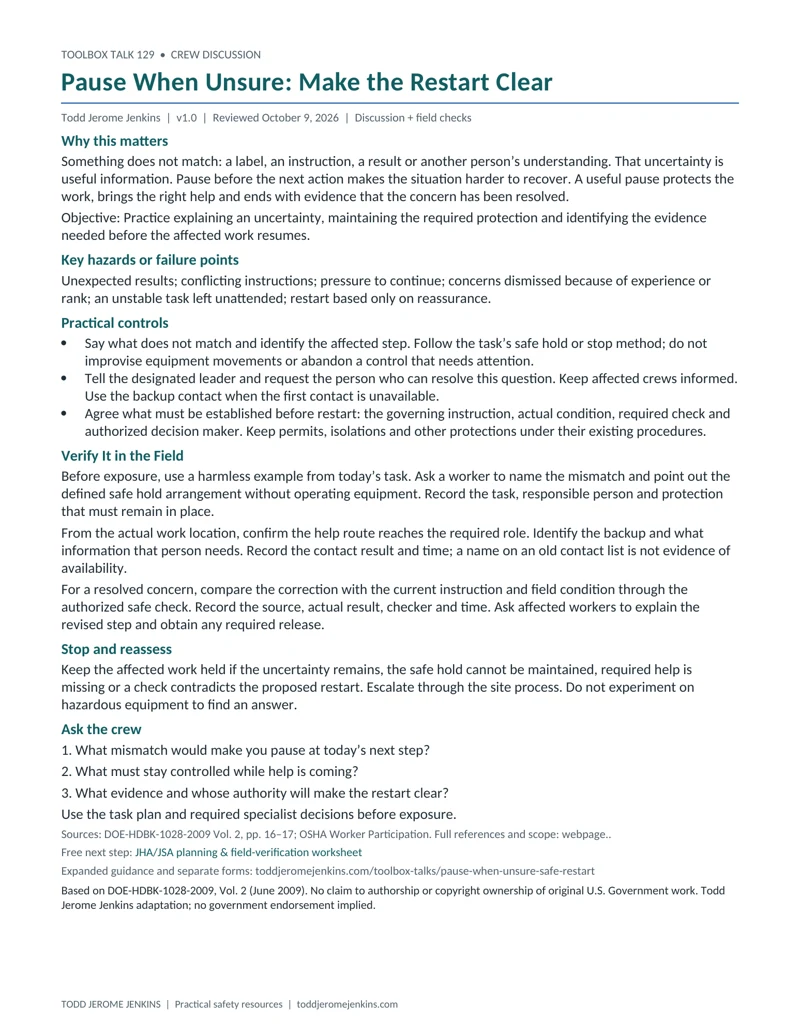
One-page toolbox talk
Download one-page toolbox talk (PDF, 1 page)Editable one-page toolbox talk (Word)Preview the one-page toolbox talk
Supporting documents
Supervisor field checks and attendance records are included with a free account. No payment is required.
Supervisor field check
A separate check to verify conditions and controls before work. Includes a one-page PDF and editable Word file.
Attendance sheet
A separate sign-in sheet to record the toolbox talk. Includes a one-page PDF and editable Word file.
Need the crew records? Create a free account to use these supporting documents and Jenkins Academy of Applied Technology. No payment is required. Email updates are optional.
Create Free AccountAlready have an account? Sign in
HOP skills practice • Batch 1, topic 4 of 5. A 5–10 minute toolbox talk plus time for actual field verification. One-page PDF and editable Word talk; separate supervisor and attendance forms.
What is this skill?
Pause when unsure means holding the affected action when the plan, conditions or result no longer makes sense. Maintain the required protection, explain the uncertainty and bring in the right help.
Why use it?
Continuing through uncertainty can make a problem harder to recover from. A useful pause gives people time and support to establish what is happening before the next action.
When should we use it?
Use it when instructions conflict, a result is unexpected, a needed condition is unverified or anyone raises a concern that remains unresolved.
Where does it apply?
Wherever the uncertainty is noticed: planning, an office, a service location or the work area. Use the task's safe hold or shutdown method; simply walking away may be unsafe.
Learning objective
Explain an uncertainty, identify the safe hold and name the evidence and authority needed for restart.
Key hazards or failure points
Pressure to continue; dismissed concerns; improvised shutdown; unavailable help; restart based only on reassurance.
How to use it — practical controls
- State the mismatch and hold the affected action using the task's safe method. Maintain protections and any needed monitoring.
- Notify the designated leader and obtain the required knowledgeable help. Use the backup contact if needed; tell affected people what remains held.
- Resolve the issue against the applicable instruction and actual conditions. Recheck protection and obtain required restart authorization; rebrief affected people.
Verify It in the Field
- Locate the actual safe hold arrangement, help route and restart requirements. Confirm the required contact is reachable; a name on a list is insufficient.
- Paper practice: one mock instruction says use Room A; another says Room B. State the conflict, keep the paper task held and identify who can resolve the instruction.
- Ask the facilitator for the corrected instruction and its approval basis. Explain what permits restart. Record the real correction, recheck result, checker and time separately.
For real work, record the control, governing source and criterion, safe method, authorized checker, actual result and time. Mark VERIFIED, HOLD/NOT VERIFIED, or N/A with a reason. A practiced skill or matching label does not demonstrate that a physical safeguard functions. Do not create exposure to complete a check.
Stop and reassess
Keep affected work held while the uncertainty or missing protection remains. Escalate if the safe hold cannot be maintained. Do not improvise equipment movements or bypass the task's emergency response.
Toolbox talk questions
- What would make us pause today?
- What must remain protected during the pause?
- Who resolves the concern and who authorizes restart?
Examples across different work settings
These are original teaching examples, not operating instructions. Use paper, photographs or inert training items for practice. Change the setting to fit your team while retaining the skill steps and the applicable task requirements.
Office planning
A booking and an approved work schedule name different rooms. Hold the affected assignment and ask the designated coordinator to resolve the conflict. Do not silently choose the more convenient record.
Field service
The item at the location does not match the work order. Maintain the task's required protection and contact the responsible planner or technical role. A familiar-looking substitute does not resolve the mismatch.
Production support
A documented check returns an unexpected indication. Follow the approved safe response and seek authorized help. Do not repeat the action merely to make the indication look normal.
Leader follow-through — improve the conditions
Respond to a pause by asking what information or support is missing. Address conflicting instructions, inaccessible help and schedule pressure. Track the correction and tell the person who raised the concern what changed.
Short supervisor field check
- Participant states the uncertainty without needing to prove a hazard first.
- Task-specific safe hold and protection responsibilities are identified.
- Required help and backup route are reachable.
- Correction and required safe recheck produce recorded evidence.
- Restart authority is confirmed and affected people are rebriefed.
Use the separate supervisor sheet to retain evidence, open items, correction owner, recheck result and required restart authority. Keep task-specific permits, inspections and technical decisions in their established process.
Attendance and follow-through
Use the separate attendance sheet for participants, roles, questions, actions and rebriefs. Attendance does not establish competence, verify a control or authorize work. Keep completed records private under employer procedures.
Source acknowledgment
Based on DOE-HDBK-1028-2009, Vol. 2 (June 2009). No claim to authorship or copyright ownership of original U.S. Government work. Todd Jerome Jenkins adaptation; no government endorsement implied. Explanations, examples, practice exercises and layouts are original adaptations. Third-party material credited in the handbook retains its original attribution; this notice does not claim rights in that material.
Source file inspected: Volume 2/VOLUME 2 PAUSE WHEN UNSURE.pdf; printed pages 16–17. Historical error-probability numbers are omitted. DOE-specific formal stop-work arrangements are not presented as a universal legal rule. No generic shutdown or restart method is supplied.
Technical scope and references
References reviewed October 13, 2026. DOE human-performance tools and OSHA recommended practices support preparation and discussion; they do not establish universal technical acceptance criteria. Apply the current task procedure, manufacturer instructions, permit and required competent or qualified decisions. A successful exercise does not replace required training, technical verification or work authorization.
- DOE-HDBK-1028-2009, Volume 2 — Pause When Unsure, printed pp. 16–17 — June 2009 illustrative guidance, not a current technical acceptance standard. Used for recognizing uncertainty and seeking help; old error-probability figures omitted.
- OSHA Recommended Practices — Worker Participation — Current program guidance on responding to concerns, temporary suspension requests and worker input; not a task-specific shutdown or restart procedure.
- HSE — Procedures — UK regulator guidance on usable procedures and the limitations of procedural controls; not a U.S. legal requirement.
The DOE handbook is June 2009 illustrative guidance, not a current requirements document. Availability of the official edition and the linked supporting guidance was checked October 13, 2026. Apply current task-specific requirements, manufacturer instructions, permits and required competent or qualified decisions; this talk supplies no universal technical acceptance criteria.
Connect this discussion to your JHA/JSA
Use the JHA/JSA planning and field-verification worksheet to record the actual task steps, hazards, responsible roles and controls. Return to What Changed Today? when the plan or conditions change.
Related Todd Jerome Jenkins articles: How to Conduct a Job Safety Analysis and What Is Human and Organizational Performance?.
Related toolbox talks
Practice another HOP skill
- STAR Self-Checking: Stop, Think, Act, Review
- Peer Checking: Agree Before the Action
- Three-Way Communication: Close the Loop
- Validate Assumptions: Find the Evidence
One next step
Use the free JHA/JSA planning and field-verification worksheet linked above to apply this skill to one actual task step. Record what must be checked before exposure and who will check it.