

 Free toolbox talk · TBT-125
Download the free toolbox talk
The one-page talk, editable Word version, and guidance below are open to everyone. No account required.
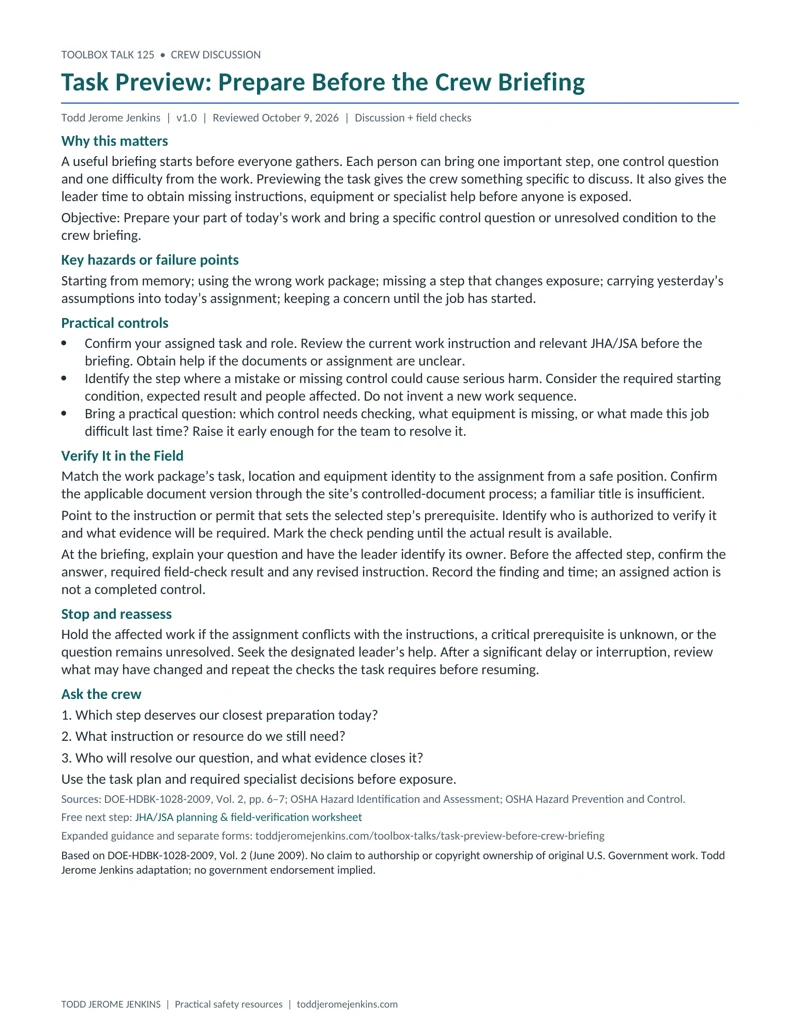
One-page toolbox talk
Download one-page toolbox talk (PDF, 1 page)Editable one-page toolbox talk (Word)Preview the one-page toolbox talk
Supporting documents
Supervisor field checks and attendance records are included with a free account. No payment is required.
Supervisor field check
A separate check to verify conditions and controls before work. Includes a one-page PDF and editable Word file.
Attendance sheet
A separate sign-in sheet to record the toolbox talk. Includes a one-page PDF and editable Word file.
Need the crew records? Create a free account to use these supporting documents and Jenkins Academy of Applied Technology. No payment is required. Email updates are optional.
Create Free AccountAlready have an account? Sign in
HOP skills practice • Batch 2, topic 6 of 52. A 5–10 minute toolbox talk plus time for actual field verification. One-page PDF and editable Word talk; separate supervisor and attendance forms.
What is this skill?
A task preview is your preparation before the team briefing or an important work step. Review your assignment, the current instructions, likely difficulties and the controls the work depends on.
Why use it?
People notice different problems. Preparing your part gives the team a useful question to resolve before work begins, rather than an assumption discovered after exposure.
When should we use it?
Before a briefing or job, before a consequential step, and after a delay or interruption that may change the task. Follow the task's required preparation process.
Where does it apply?
Where you can study the instructions and ask questions. Compare the work location safely when needed; a preview does not authorize entry into a restricted area.
Learning objective
Explain one important step, its required protection and one question that must be resolved before that step.
Key hazards or failure points
Wrong assignment; relying on memory; missing resources; unnoticed changes; assuming another person will resolve the concern.
How to use it — practical controls
- Confirm your role and current work package. Identify the important steps and where an error or missing protection could cause harm.
- Consider likely difficulties, consequences, required controls and the safe response to a mismatch. Review relevant experience without substituting it for instructions.
- Bring a specific question to the briefing. Assign an owner and a hold point; confirm the answer and required checks before relying on the result.
Verify It in the Field
- For the real task, locate the control's source, criterion and authorized checker. Obtain the actual safe-check result before exposure; a plan to check remains pending.
- Paper practice: a mock assignment lists Work Area C, while the attached instruction lists Work Area D. Explain your role, identify the mismatch and name the decision it blocks.
- Ask who owns the correction and what evidence closes it. Success means keeping the affected paper step held until the correct assignment and instruction agree.
For real work, record the control, governing source and criterion, safe method, authorized checker, actual result and time. Mark VERIFIED, HOLD/NOT VERIFIED, or N/A with a reason. A practiced skill or matching label does not demonstrate that a physical safeguard functions. Do not create exposure to complete a check.
Stop and reassess
Hold for conflicting scope, missing instructions, unavailable protection or an unresolved prerequisite. Ask the responsible leader for help and recheck changed conditions before restart.
Toolbox talk questions
- Which step needs our closest preparation?
- What made this task difficult last time?
- What evidence closes our open question?
Examples across different work settings
These are original teaching examples, not operating instructions. Use paper, photographs or inert training items for practice. Change the setting to fit your team while retaining the skill steps and the applicable task requirements.
Retail stockroom
Before a display change, a worker notices the plan depends on moving stock through an area scheduled for customer access. Raise the timing and separation question before the briefing. The responsible people must confirm the approved arrangement before movement begins.
Office records team
A person preparing an archive transfer finds two different destination lists. Previewing the task exposes the conflict before files are moved. Identify the controlled source and responsible owner; familiarity with last month's transfer does not settle today's destination.
Workshop or maintenance
The work package names a tool that is unavailable. Report the gap before arriving at the action point. A substitute requires the appropriate suitability review and instructions; the preview itself does not approve one.
Use SAFER as a preparation prompt
DOE uses SAFER for Task Preview. In this adaptation: Summarize the important steps; Anticipate where the work could go wrong; Foresee the consequences; Evaluate the controls and recovery arrangements; Review relevant experience. Use these prompts to prepare a useful contribution, not to create a second technical procedure or a universal risk score.
Leader follow-through — improve the conditions
Give people the assignment, instructions and preparation time early enough to contribute. Study repeated gaps in tools, information and coordination. Correct the planning process rather than treating predictable shortages as individual readiness failures.
Short supervisor field check
- Each person can identify the assignment, role and current instruction.
- Important step, possible consequence and required protection are understood.
- Relevant experience produces a specific question or preparation improvement.
- Open question has an owner, hold point and evidence of resolution.
- Actual control checks and required work authorization remain separate from preparation.
Use the separate supervisor sheet to retain evidence, open items, correction owner, recheck result and required restart authority. Keep task-specific permits, inspections and technical decisions in their established process.
Attendance and follow-through
Use the separate attendance sheet for participants, roles, questions, actions and rebriefs. Attendance does not establish competence, verify a control or authorize work. Keep completed records private under employer procedures.
Source acknowledgment
Based on DOE-HDBK-1028-2009, Vol. 2 (June 2009). No claim to authorship or copyright ownership of original U.S. Government work. Todd Jerome Jenkins adaptation; no government endorsement implied. Explanations, examples, practice exercises and layouts are original adaptations. Third-party material credited in the handbook retains its original attribution; this notice does not claim rights in that material.
Source file inspected: Volume 2/VOLUME 2 TASK PREVIEW.pdf; printed pages 6–7. No universal preview frequency, risk score or mandatory format is adopted. The exercise and examples are original; the source's SAFER concept is paraphrased.
Technical scope and references
References reviewed October 13, 2026. DOE human-performance tools and OSHA recommended practices support preparation and discussion; they do not establish universal technical acceptance criteria. Apply the current task procedure, manufacturer instructions, permit and required competent or qualified decisions. A successful exercise does not replace required training, technical verification or work authorization.
- DOE-HDBK-1028-2009, Volume 2 — Task Preview — June 2009 guidance, printed pages 6–7: individual preparation, important steps, controls, relevant experience and reconsideration after interruptions. No universal mandatory preview format or frequency is asserted.
- OSHA — Hazard Identification and Assessment — Recommended practices, action items 1 and 5: use relevant hazard information and anticipate nonroutine work.
- OSHA — Hazard Prevention and Control — Recommended practices, action items 3 and 6: assign control responsibility and evaluate implementation.
The DOE handbook is June 2009 illustrative guidance, not a current requirements document. Availability of the official edition and the linked supporting guidance was checked October 13, 2026. Apply current task-specific requirements, manufacturer instructions, permits and required competent or qualified decisions; this talk supplies no universal technical acceptance criteria.
Connect this discussion to your JHA/JSA
Use the JHA/JSA planning and field-verification worksheet to record the actual task steps, hazards, responsible roles and controls. Return to Pre-Job JHA/JSA: What Changed Today? when the plan or conditions change.
Related Todd Jerome Jenkins articles: How to Conduct a Job Safety Analysis and What Is Human and Organizational Performance?.
Related toolbox talks
Practice another HOP skill
- Work-Area Review: Does the Place Match the Plan?
- Pre-Job Briefing: Rehearse Roles and Controls
- Procedure Use: Confirm the Instructions Fit
- Place-Keeping: Know What Is Complete
Build on the first batch: STAR Self-Checking: Stop, Think, Act, Review; Pause When Unsure: Resolve Before Restart.
One next step
Use the free JHA/JSA planning and field-verification worksheet linked above to apply this skill to one actual task step. Record what must be checked before exposure and who will check it.