

 Free toolbox talk · TBT-153
Download the free toolbox talk
The one-page talk, editable Word version, and guidance below are open to everyone. No account required.
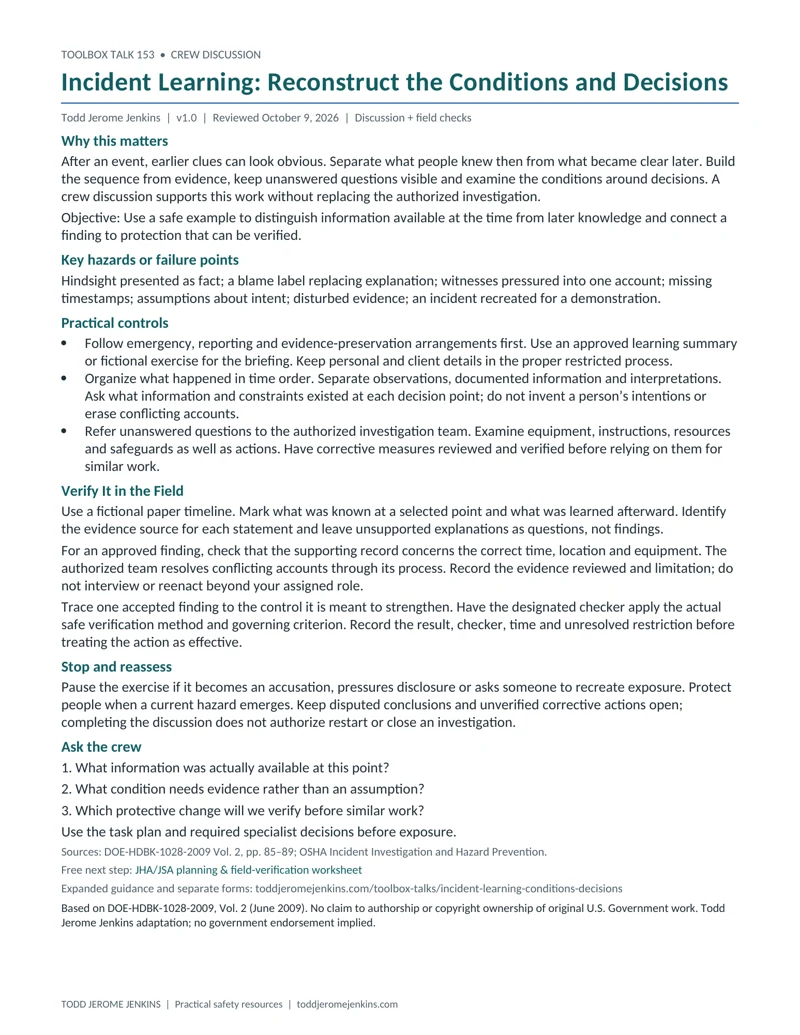
Toolbox Talk - Learning from Incident Context
Download toolbox talk - learning from incident context (PDF, 1 page)Editable toolbox talk - learning from incident context (Word)Preview the one-page toolbox talk
Supporting documents
Supervisor field checks and attendance records are included with a free account. No payment is required.
Supervisor Field Check - Learning from Incident Context
A separate check to verify conditions and controls before work. Includes a one-page PDF and editable Word file.
Attendance Sheet - Learning from Incident Context
A separate sign-in sheet to record the toolbox talk. Includes a one-page PDF and editable Word file.
Need the crew records? Create a free account to use these supporting documents and Jenkins Academy of Applied Technology. No payment is required. Email updates are optional.
Create Free AccountAlready have an account? Sign in
HOP skills practice • Batch 5, topic 29 of 52. A 5–10 minute toolbox talk plus time for actual field verification. One-page PDF and editable Word talk; separate supervisor and attendance forms.
What is this skill?
Incident learning reconstructs what people faced, what information they had and how protections performed.
Why use it?
Knowing the outcome can make earlier choices look simpler than they were.
When should we use it?
After immediate response and scene safety are addressed, through the authorized investigation process.
Where does it apply?
In a suitable private discussion and safe evidence review, not a public reenactment.
Learning objective
Separate known facts, recalled experience and open questions at one decision point.
Key hazards or failure points
Blame labels; hindsight; leading questions; altered evidence; treating one account as the whole event.
How to use it — practical controls
- Follow response and reporting arrangements. Preserve relevant evidence without delaying urgent care.
- Invite the person’s account and clarify the information available at the time. Keep uncertainty visible.
- Compare accounts and records. Study barriers and organizational conditions, then verify corrective actions.
Verify It in the Field
- For each proposed correction, identify its intended protective function and task-specific verification method.
- Paper practice: an instruction was revised after the event. Separate what was known then from what is known now.
- Write one neutral question and one evidence request. Do not fill a timeline gap with a guess.
For real work, record the control, governing source and criterion, safe method, authorized checker, actual result and time. Mark VERIFIED, HOLD/NOT VERIFIED, or N/A with a reason. A practiced skill or matching label does not demonstrate that a physical safeguard functions. Do not create exposure to complete a check.
Stop and reassess
Stop unsafe reconstruction or testing. Escalate remaining exposure and protect sensitive information through the investigation process.
Toolbox talk questions
- What was available to the person then?
- Which facts still need confirmation?
- How will we verify the correction?
Examples across different work settings
These are original teaching examples, not operating instructions. Use paper, photographs or inert training items for practice. Change the setting to fit your team while retaining the skill steps and the applicable task requirements.
Warehouse
A location label was replaced after a misrouting event. Investigators retain the earlier label record to understand what the worker actually saw.
Maintenance
A service instruction omitted a recent equipment change. The review examines document updates and handoffs alongside the actions taken.
Office operations
An outdated contact list delayed escalation. The team studies how updates reached users and tests the revised access process without staging a real emergency.
Practice the skill and understand its limits
Use a fictional timeline with three cards: before the event, information available at the time and information discovered later. Place each fact in the correct position. This is a learning exercise, not a complete investigation method or permission to alter a scene.
Leader follow-through — improve the conditions
Look beyond reminders and retraining. Improve instructions, equipment, coordination or resource decisions where the evidence supports change.
Short supervisor field check
- Immediate response and authorized process are respected.
- Evidence is preserved and privacy protected.
- Timeline distinguishes facts, accounts and unknowns.
- Controls and work conditions are examined.
- Corrective action has a safe effectiveness check.
Use the separate supervisor sheet to retain evidence, open items, correction owner, recheck result and required restart authority. Keep task-specific permits, inspections and technical decisions in their established process.
Attendance and follow-through
Use the separate attendance sheet for participants, roles, questions, actions and rebriefs. Attendance does not establish competence, verify a control or authorize work. Keep completed records private under employer procedures.
Source acknowledgment
Based on DOE-HDBK-1028-2009, Vol. 2 (June 2009). No claim to authorship or copyright ownership of original U.S. Government work. Todd Jerome Jenkins adaptation; no government endorsement implied. Explanations, examples, practice exercises and layouts are original adaptations. Third-party material credited in the handbook retains its original attribution; this notice does not claim rights in that material.
Source file inspected: Volume 2/VOLUME 2 INVESTIGATING EVENTS TRIGGERED BY HUMAN ERROR.pdf; printed pages 85–89. Source diagram, categorical causal claims and prescribed interview-before-evidence sequence are excluded; original neutral questions used.
Technical scope and references
References reviewed October 13, 2026. DOE human-performance tools and OSHA recommended practices support preparation and discussion; they do not establish universal technical acceptance criteria. Apply the current task procedure, manufacturer instructions, permit and required competent or qualified decisions. A successful exercise does not replace required training, technical verification or work authorization.
- DOE-HDBK-1028-2009, Volume 2 — Investigating Events Triggered by Human Error, printed pp. 85–89 — June 2009 historical context source. Original questions and scenarios; source diagram, categorical human-error claims and prescribed interview-before-evidence sequence not reproduced.
- OSHA — Incident Investigation — Current guidance on examining underlying conditions, worker/management perspectives and corrective action beyond fault labels.
- OSHA — Hazard Prevention and Control — Current recommended practices supporting approved corrective controls and verification of effectiveness.
The DOE handbook is June 2009 illustrative guidance, not a current requirements document. Availability of the official edition and the linked supporting guidance was checked October 13, 2026. Apply current task-specific requirements, manufacturer instructions, permits and required competent or qualified decisions; this talk supplies no universal technical acceptance criteria.
Connect this discussion to your JHA/JSA
Use the JHA/JSA planning and field-verification worksheet to record the actual task steps, hazards, responsible roles and controls. Return to What Changed Today? when the plan or conditions change.
Related Todd Jerome Jenkins articles: How to Conduct a Job Safety Analysis and What Is Human and Organizational Performance?.
Related toolbox talks
Practice another HOP skill
- Toolbox Talk - Self-Assessment of Real Work
- Toolbox Talk - Using Safety Indicators to Learn
- Toolbox Talk - Questioning the Work Plan
- Toolbox Talk - Briefing a Technical Task
One next step
Use the free JHA/JSA planning and field-verification worksheet linked above to apply this skill to one actual task step. Record what must be checked before exposure and who will check it.