

 Free toolbox talk · TBT-147
Download the free toolbox talk
The one-page talk, editable Word version, and guidance below are open to everyone. No account required.
Toolbox Talk - Making the Work Plan Achievable
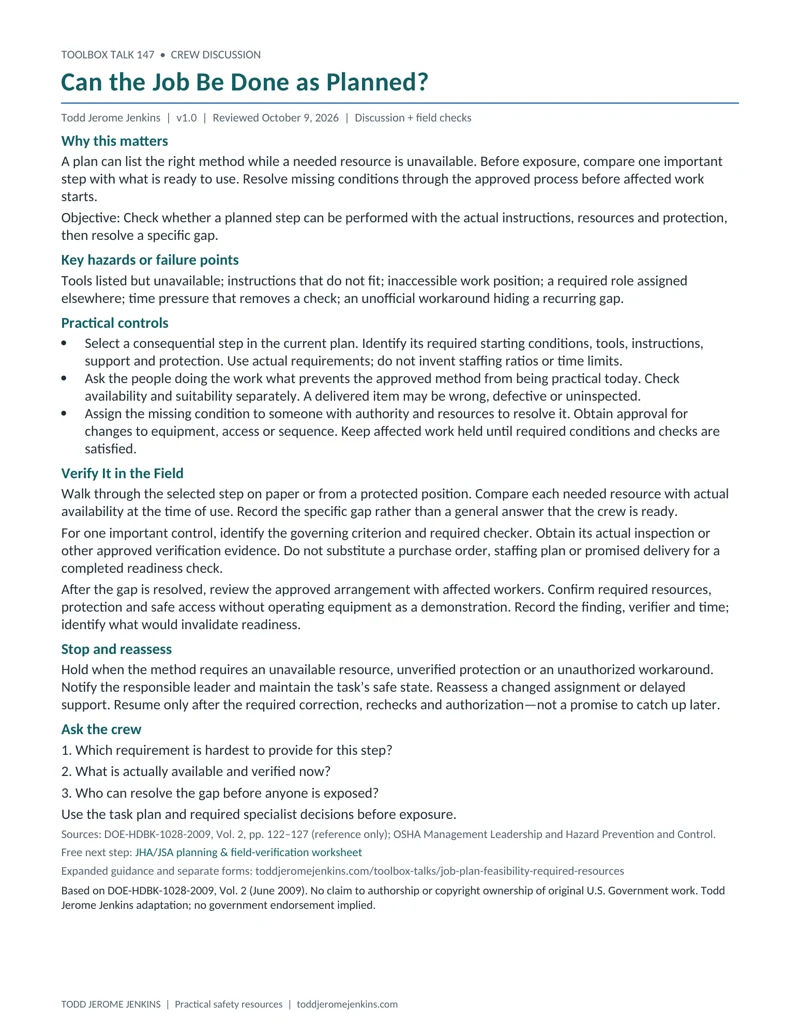
Download toolbox talk - making the work plan achievable (PDF, 1 page)Editable toolbox talk - making the work plan achievable (Word)Preview the one-page toolbox talk
Supporting documents
Supervisor field checks and attendance records are included with a free account. No payment is required.
Supervisor Field Check - Making the Work Plan Achievable
A separate check to verify conditions and controls before work. Includes a one-page PDF and editable Word file.
Attendance Sheet - Making the Work Plan Achievable
A separate sign-in sheet to record the toolbox talk. Includes a one-page PDF and editable Word file.
Need the crew records? Create a free account to use these supporting documents and Jenkins Academy of Applied Technology. No payment is required. Email updates are optional.
Create Free AccountAlready have an account? Sign in
HOP skills practice • Batch 5, topic 23 of 52. A 5–10 minute toolbox talk plus time for actual field verification. One-page PDF and editable Word talk; separate supervisor and attendance forms.
What is this skill?
Plan feasibility means confirming that the resources needed for the task are actually available.
Why use it?
A complete plan still leaves workers exposed when essential support exists only on paper.
When should we use it?
Before assigning work and whenever staffing, timing, equipment or access changes.
Where does it apply?
At the planning desk and the actual work location.
Learning objective
Match one task prerequisite to real evidence of availability and suitability.
Key hazards or failure points
Borrowed equipment assumed available; overlapping assignments; inaccessible instructions; missing expertise.
How to use it — practical controls
- Choose a task step. List the people, information, tools, access and protection it requires.
- Confirm each prerequisite at the time and location of use with its responsible owner.
- Resolve shortages through replanning. Rebrief the affected people before proceeding.
Verify It in the Field
- Check suitability using the task’s procedure, equipment instructions and required specialist decisions.
- Paper practice: two jobs reserve the same required specialist at the same time. Identify the conflict.
- Revise the paper schedule and name who must confirm availability. A booking alone is not field readiness.
For real work, record the control, governing source and criterion, safe method, authorized checker, actual result and time. Mark VERIFIED, HOLD/NOT VERIFIED, or N/A with a reason. A practiced skill or matching label does not demonstrate that a physical safeguard functions. Do not create exposure to complete a check.
Stop and reassess
Hold the affected task if required resources or protection cannot be verified. Do not silently replace a required control with extra effort.
Toolbox talk questions
- Which resource is shared with another job?
- What proves it will be ready here?
- Who can change the plan?
Examples across different work settings
These are original teaching examples, not operating instructions. Use paper, photographs or inert training items for practice. Change the setting to fit your team while retaining the skill steps and the applicable task requirements.
Community event
Two setup teams expect the same lifting aid. The coordinator changes the sequence and checks that each task can use the equipment when needed.
Home maintenance service
The assigned worker cannot access the current equipment instructions offline. The task is held until the correct instructions and required support are available.
Manufacturing
A planned changeover requires a specialist already assigned elsewhere. The manager adjusts the schedule rather than expecting the operator to improvise the specialist’s checks.
Practice the skill and understand its limits
Create a paper task with five prerequisite cards. Remove one card and ask the group to identify affected steps and the person who can resolve the gap. This is an original planning exercise, not a reproduction or validated version of the archived questionnaire.
Leader follow-through — improve the conditions
Track recurring shortages as planning problems. Include travel, preparation, verification and handoff time when allocating resources.
Short supervisor field check
- Task prerequisites are explicit.
- Resource owners confirm timing and availability.
- Suitability and control function have separate evidence.
- Conflicting assignments and shortages are resolved.
- Changed plan is authorized and rebriefed.
Use the separate supervisor sheet to retain evidence, open items, correction owner, recheck result and required restart authority. Keep task-specific permits, inspections and technical decisions in their established process.
Attendance and follow-through
Use the separate attendance sheet for participants, roles, questions, actions and rebriefs. Attendance does not establish competence, verify a control or authorize work. Keep completed records private under employer procedures.
Source acknowledgment
Based on DOE-HDBK-1028-2009, Vol. 2 (June 2009). No claim to authorship or copyright ownership of original U.S. Government work. Todd Jerome Jenkins adaptation; no government endorsement implied. Explanations, examples, practice exercises and layouts are original adaptations. Third-party material credited in the handbook retains its original attribution; this notice does not claim rights in that material.
Source file inspected: Volume 2/VOLUME 2 EMPLOYEE SURVEYS Job-site conditions Self-Assessment Questionnaire.pdf; printed pages 122–127. Reference-only: the archive explicitly credits an INPO adaptation. Questionnaire wording, categories, personal judgments, scoring and claimed effectiveness are excluded. The prerequisite exercise is original.
Technical scope and references
References reviewed October 13, 2026. DOE human-performance tools and OSHA recommended practices support preparation and discussion; they do not establish universal technical acceptance criteria. Apply the current task procedure, manufacturer instructions, permit and required competent or qualified decisions. A successful exercise does not replace required training, technical verification or work authorization.
- DOE-HDBK-1028-2009, Volume 2 — Job-Site Conditions Self-Assessment Questionnaire — June 2009, printed pages 122–127, inspected as reference-only topic context. The source expressly credits an INPO adaptation. No questionnaire items, categories, scoring, personal judgments or effectiveness claims are reproduced; the prerequisite-to-resource exercise is original.
- OSHA — Management Leadership — Recommended practices, action item 3: allocate time, tools, information and other resources to operate the safety program.
- OSHA — Hazard Prevention and Control — Recommended practices, action items 3 and 6: responsibility and checking actual implementation. No technical resource limits are invented.
The DOE handbook is June 2009 illustrative guidance, not a current requirements document. Availability of the official edition and the linked supporting guidance was checked October 13, 2026. Apply current task-specific requirements, manufacturer instructions, permits and required competent or qualified decisions; this talk supplies no universal technical acceptance criteria.
Connect this discussion to your JHA/JSA
Use the JHA/JSA planning and field-verification worksheet to record the actual task steps, hazards, responsible roles and controls. Return to What Changed Today? when the plan or conditions change.
Related Todd Jerome Jenkins articles: How to Conduct a Job Safety Analysis and What Is Human and Organizational Performance?.
Related toolbox talks
Practice another HOP skill
- Toolbox Talk - Evidence Before Sign-Off
- Toolbox Talk - Observing Work to Learn
- Toolbox Talk - Safety Climate in Everyday Decisions
- Toolbox Talk - Employee Feedback and Follow-Through
One next step
Use the free JHA/JSA planning and field-verification worksheet linked above to apply this skill to one actual task step. Record what must be checked before exposure and who will check it.