

 Free toolbox talk · TBT-126
Download the free toolbox talk
The one-page talk, editable Word version, and guidance below are open to everyone. No account required.
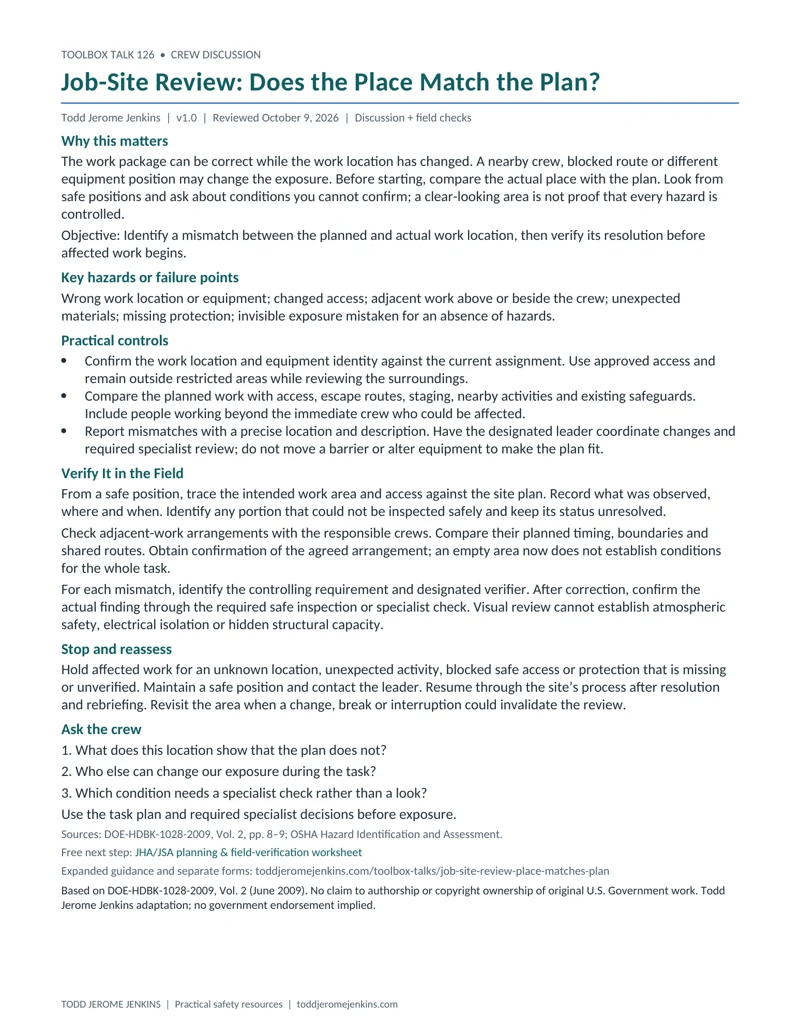
One-page toolbox talk
Download one-page toolbox talk (PDF, 1 page)Editable one-page toolbox talk (Word)Preview the one-page toolbox talk
Supporting documents
Supervisor field checks and attendance records are included with a free account. No payment is required.
Supervisor field check
A separate check to verify conditions and controls before work. Includes a one-page PDF and editable Word file.
Attendance sheet
A separate sign-in sheet to record the toolbox talk. Includes a one-page PDF and editable Word file.
Need the crew records? Create a free account to use these supporting documents and Jenkins Academy of Applied Technology. No payment is required. Email updates are optional.
Create Free AccountAlready have an account? Sign in
HOP skills practice • Batch 2, topic 7 of 52. A 5–10 minute toolbox talk plus time for actual field verification. One-page PDF and editable Word talk; separate supervisor and attendance forms.
What is this skill?
A work-area review compares the actual location, surroundings and nearby activities with the plan. It is the DOE Job-Site Review skill applied to any work setting.
Why use it?
A correct plan can meet a changed workplace. Reviewing the area helps expose a mismatch before people depend on an access route, boundary or safeguard that is no longer suitable.
When should we use it?
On arrival, before the affected work step, and after a break or change that could invalidate the earlier review. Revisit conditions as the task requires.
Where does it apply?
At the actual work location and its interfaces, viewed from approved safe positions. Include people, routes and activities beyond the immediate team.
Learning objective
Identify one difference between a plan and the work area and explain how its correction will be verified.
Key hazards or failure points
Wrong location; blocked routes; adjacent work; moved boundaries; unseen hazards; assuming a quiet area will stay quiet.
How to use it — practical controls
- Match the assignment to the location and item. Compare access, work boundaries, staging and nearby activity with the current plan.
- Ask affected teams what will change during the work. Report mismatches precisely; do not move a barrier or change equipment to make the plan fit.
- Arrange authorized corrections and required specialist assessments. Agree which changes require another review and how affected people will be informed.
Verify It in the Field
- Observe safely and record location, condition and time. Identify anything you cannot confirm. Looking alone cannot establish isolation, air quality or hidden structural capacity.
- Paper practice: draw a work area with a planned access route. Add a card showing stored material across that route. Name the mismatch and who must resolve it.
- Revise the drawing only after the facilitator supplies the agreed correction. For real work, obtain and record the authorized inspection or test result before exposure.
For real work, record the control, governing source and criterion, safe method, authorized checker, actual result and time. Mark VERIFIED, HOLD/NOT VERIFIED, or N/A with a reason. A practiced skill or matching label does not demonstrate that a physical safeguard functions. Do not create exposure to complete a check.
Stop and reassess
Hold affected work for uncertain location, unsafe access, uncoordinated activity or missing protection. Stay safe, notify the leader and obtain required correction, recheck and release.
Toolbox talk questions
- What changed since the plan was made?
- Who else can change our working conditions?
- Which condition needs more than a visual review?
Examples across different work settings
These are original teaching examples, not operating instructions. Use paper, photographs or inert training items for practice. Change the setting to fit your team while retaining the skill steps and the applicable task requirements.
School or community facility
A planned maintenance route now crosses an area being used for an event. Coordinate access and separation with the responsible people before work. A timetable alone does not establish the actual condition of the route.
Warehouse
The expected staging space is occupied, and another team plans a delivery through it. Compare the timing and boundaries with both teams. A space that is empty at briefing time may not remain available during the task.
Field service
The work order describes one access point, but the actual approach is obstructed. Report the exact location and obtain an approved arrangement. Do not explore a restricted or uncontrolled route to complete the review.
Record the limits of what was observed
A useful review states what was seen, where and when, and what still requires confirmation. A barrier's presence does not establish its suitability, and a closed cover does not establish the condition behind it. Identify the task-specific criterion and required inspection or test. Keep unverified required conditions on hold instead of treating an incomplete walk-through as an all-clear.
Leader follow-through — improve the conditions
Use repeated mismatches to improve scheduling, storage arrangements and information shared between teams. Give workers a clear route for obtaining help. A review is a snapshot; the organization must support coordination as conditions change.
Short supervisor field check
- Actual location and item match the assignment.
- Access, boundaries and nearby activities were reviewed from safe positions.
- Unknown or invisible conditions have the required further assessment.
- Correction has a responsible owner and actual verification evidence.
- Changes that invalidate the review and the required rebrief are understood.
Use the separate supervisor sheet to retain evidence, open items, correction owner, recheck result and required restart authority. Keep task-specific permits, inspections and technical decisions in their established process.
Attendance and follow-through
Use the separate attendance sheet for participants, roles, questions, actions and rebriefs. Attendance does not establish competence, verify a control or authorize work. Keep completed records private under employer procedures.
Source acknowledgment
Based on DOE-HDBK-1028-2009, Vol. 2 (June 2009). No claim to authorship or copyright ownership of original U.S. Government work. Todd Jerome Jenkins adaptation; no government endorsement implied. Explanations, examples, practice exercises and layouts are original adaptations. Third-party material credited in the handbook retains its original attribution; this notice does not claim rights in that material.
Source file inspected: Volume 2/VOLUME 2 JOB-SITE REVIEW.pdf; printed pages 8–9. The source's general walk-around advice is limited here to approved safe access. No universal inspection duration or visual proof of hidden hazards is asserted.
Technical scope and references
References reviewed October 13, 2026. DOE human-performance tools and OSHA recommended practices support preparation and discussion; they do not establish universal technical acceptance criteria. Apply the current task procedure, manufacturer instructions, permit and required competent or qualified decisions. A successful exercise does not replace required training, technical verification or work authorization.
- DOE-HDBK-1028-2009, Volume 2 — Job-Site Review — June 2009 guidance, printed pages 8–9: compare actual work conditions, identity, surroundings and hazards with the plan; resolve unexpected conditions. Original safe-observation exercise replaces any implication of unrestricted walk-around access.
- OSHA — Hazard Identification and Assessment — Recommended practices, action items 2 and 3: workplace inspections, worker input, changes and specialized assessment of health hazards.
The DOE handbook is June 2009 illustrative guidance, not a current requirements document. Availability of the official edition and the linked supporting guidance was checked October 13, 2026. Apply current task-specific requirements, manufacturer instructions, permits and required competent or qualified decisions; this talk supplies no universal technical acceptance criteria.
Connect this discussion to your JHA/JSA
Use the JHA/JSA planning and field-verification worksheet to record the actual task steps, hazards, responsible roles and controls. Return to Pre-Job JHA/JSA: What Changed Today? when the plan or conditions change.
Related Todd Jerome Jenkins articles: How to Conduct a Job Safety Analysis and What Is Human and Organizational Performance?.
Related toolbox talks
Practice another HOP skill
- Task Preview: Prepare Your Part Before the Briefing
- Pre-Job Briefing: Rehearse Roles and Controls
- Procedure Use: Confirm the Instructions Fit
- Place-Keeping: Know What Is Complete
Build on the first batch: STAR Self-Checking: Stop, Think, Act, Review; Pause When Unsure: Resolve Before Restart.
One next step
Use the free JHA/JSA planning and field-verification worksheet linked above to apply this skill to one actual task step. Record what must be checked before exposure and who will check it.