

 Free toolbox talk · TBT-143
Download the free toolbox talk
The one-page talk, editable Word version, and guidance below are open to everyone. No account required.
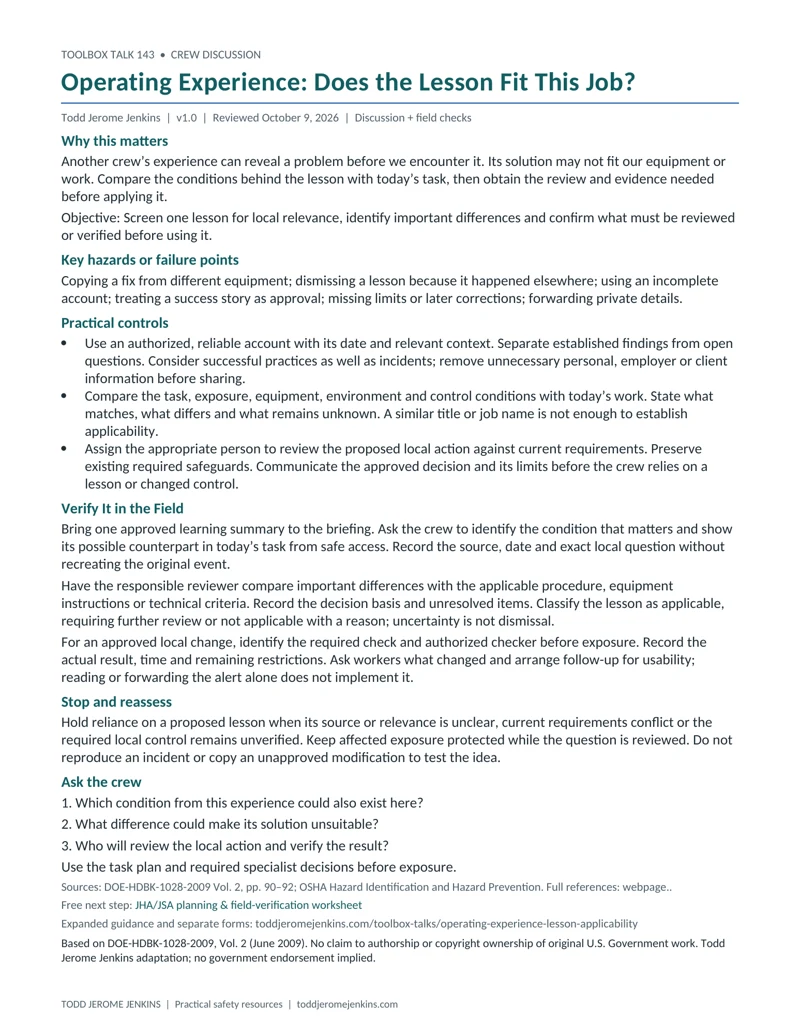
Toolbox Talk - Learning from Operating Experience
Download toolbox talk - learning from operating experience (PDF, 1 page)Editable toolbox talk - learning from operating experience (Word)Preview the one-page toolbox talk
Supporting documents
Supervisor field checks and attendance records are included with a free account. No payment is required.
Supervisor Field Check - Learning from Operating Experience
A separate check to verify conditions and controls before work. Includes a one-page PDF and editable Word file.
Attendance Sheet - Learning from Operating Experience
A separate sign-in sheet to record the toolbox talk. Includes a one-page PDF and editable Word file.
Need the crew records? Create a free account to use these supporting documents and Jenkins Academy of Applied Technology. No payment is required. Email updates are optional.
Create Free AccountAlready have an account? Sign in
HOP skills practice • Batch 4, topic 19 of 52. A 5–10 minute toolbox talk plus time for actual field verification. One-page PDF and editable Word talk; separate supervisor and attendance forms.
What is this skill?
Operating experience uses information from actual work, including helpful practices, difficult conditions and events, to ask what applies to today's task.
Why use it?
A lesson can reveal a local weakness, but its original solution may not fit our equipment or conditions. Check relevance before adopting it.
When should we use it?
During planning, before similar work and when new information could affect current controls or assumptions.
Where does it apply?
Across industries and work groups. A coordination lesson may transfer even when the original equipment solution does not.
Learning objective
Identify one relevant condition, one important difference and the review needed before using a lesson locally.
Key hazards or failure points
Copying a fix; dismissing another industry; incomplete accounts; outdated advice; sharing private details.
How to use it — practical controls
- Use an authorized, reliable account with its date and context. Distinguish established findings from open questions and protect private information.
- Compare tasks, hazards, equipment and control conditions. Record similarities, differences and unknowns; a matching job title is not enough.
- Obtain the required local review before a change. Preserve required safeguards, verify approved controls and communicate the decision and limits.
Verify It in the Field
- Use a fictional paper lesson about a missed shift restriction. Ask which part could apply locally and what evidence would answer that question.
- Add a different equipment model to the example. Success means seeking technical review before copying its solution.
- For a real lesson, record the applicability decision and basis. Verify any approved control using its governing criterion, safe method and authorized checker.
For real work, record the control, governing source and criterion, safe method, authorized checker, actual result and time. Mark VERIFIED, HOLD/NOT VERIFIED, or N/A with a reason. A practiced skill or matching label does not demonstrate that a physical safeguard functions. Do not create exposure to complete a check.
Stop and reassess
Hold reliance on unreviewed changes, uncertain sources or unverified controls. Keep affected exposure protected while questions are resolved; never recreate an event to test the lesson.
Toolbox talk questions
- Which condition could also exist here?
- What difference could make the original solution unsuitable?
- What evidence will show the local action works?
Examples across different work settings
These are original teaching examples, not operating instructions. Use paper, photographs or inert training items for practice. Change the setting to fit your team while retaining the skill steps and the applicable task requirements.
Manufacturing
A published lesson describes a guard change on a different machine model. The team recognizes a comparable exposure but routes the solution for the necessary technical review. The alert itself does not authorize modifying the local machine.
Hospitality operations
A lesson from logistics describes a restriction lost during shift change. A hotel maintenance team studies its own open-work handoff for the same communication gap. It transfers the question about responsibility, not the logistics equipment procedure.
Laboratory planning
Another laboratory reports that earlier preparation reduced rushed work. The local team studies whether its staffing, materials and task sequence support that approach. Any resulting change still follows local technical and safety requirements.
Use three clear applicability decisions
Record applicable, further review needed, or not applicable with a reason. Further review is an honest result when relevant facts are missing; it is not permission to continue an affected exposure. A not-applicable decision should identify the meaningful difference, not simply say that the event happened elsewhere. Include successful arrangements in learning, while checking what resources made them work. Forwarding an alert shows distribution. Implementation requires an approved action, field evidence where relevant and feedback from those using it.
Leader follow-through — improve the conditions
Make relevant experience available when the task is planned, not only in a general bulletin. Monitor whether lessons change instructions, resources or controls and whether those changes remain useful. Remove unnecessary personal and client details from shared summaries.
Short supervisor field check
- Source, date, context and permission to share are established.
- Similarities, differences and unknowns are explicit.
- Applicability decision has an owner and documented basis.
- Local changes receive the required technical and work-process review.
- Required control results and later usability feedback are recorded.
Use the separate supervisor sheet to retain evidence, open items, correction owner, recheck result and required restart authority. Keep task-specific permits, inspections and technical decisions in their established process.
Attendance and follow-through
Use the separate attendance sheet for participants, roles, questions, actions and rebriefs. Attendance does not establish competence, verify a control or authorize work. Keep completed records private under employer procedures.
Source acknowledgment
Based on DOE-HDBK-1028-2009, Vol. 2 (June 2009). No claim to authorship or copyright ownership of original U.S. Government work. Todd Jerome Jenkins adaptation; no government endorsement implied. Explanations, examples, practice exercises and layouts are original adaptations. Third-party material credited in the handbook retains its original attribution; this notice does not claim rights in that material.
Source file inspected: Volume 2/VOLUME 2 OPERATING EXPERIENCE.pdf; printed pages 90–92. Broad precursor-event assertions, numerical prediction and historical DOE program-order requirements are excluded. External technical fixes are not presented as approved local changes.
Technical scope and references
References reviewed October 13, 2026. DOE human-performance tools and OSHA recommended practices support preparation and discussion; they do not establish universal technical acceptance criteria. Apply the current task procedure, manufacturer instructions, permit and required competent or qualified decisions. A successful exercise does not replace required training, technical verification or work authorization.
- DOE-HDBK-1028-2009, Volume 2 — Operating Experience, printed pp. 90–92 — June 2009 illustrative concept source. Broad precursor-event claims and historical DOE program-order requirements are not carried into this general toolbox talk.
- OSHA Recommended Practices — Hazard Identification and Assessment — Current guidance on internal/external information, worker input and relevant hazard review.
- OSHA Recommended Practices — Hazard Prevention and Control — Current guidance on evaluating controls used elsewhere, selecting suitable local measures and checking effectiveness.
The DOE handbook is June 2009 illustrative guidance, not a current requirements document. Availability of the official edition and the linked supporting guidance was checked October 13, 2026. Apply current task-specific requirements, manufacturer instructions, permits and required competent or qualified decisions; this talk supplies no universal technical acceptance criteria.
Connect this discussion to your JHA/JSA
Use the JHA/JSA planning and field-verification worksheet to record the actual task steps, hazards, responsible roles and controls. Return to What Changed Today? when the plan or conditions change.
Related Todd Jerome Jenkins articles: How to Conduct a Job Safety Analysis and What Is Human and Organizational Performance?.
Related toolbox talks
Practice another HOP skill
- Toolbox Talk - Questioning Attitude
- Toolbox Talk - Work Turnover and Shift Handoff
- Toolbox Talk - Post-Job Review
- Toolbox Talk - Responding to Safety Concerns
One next step
Use the free JHA/JSA planning and field-verification worksheet linked above to apply this skill to one actual task step. Record what must be checked before exposure and who will check it.