

 Free toolbox talk · TBT-130
Download the free toolbox talk
The one-page talk, editable Word version, and guidance below are open to everyone. No account required.
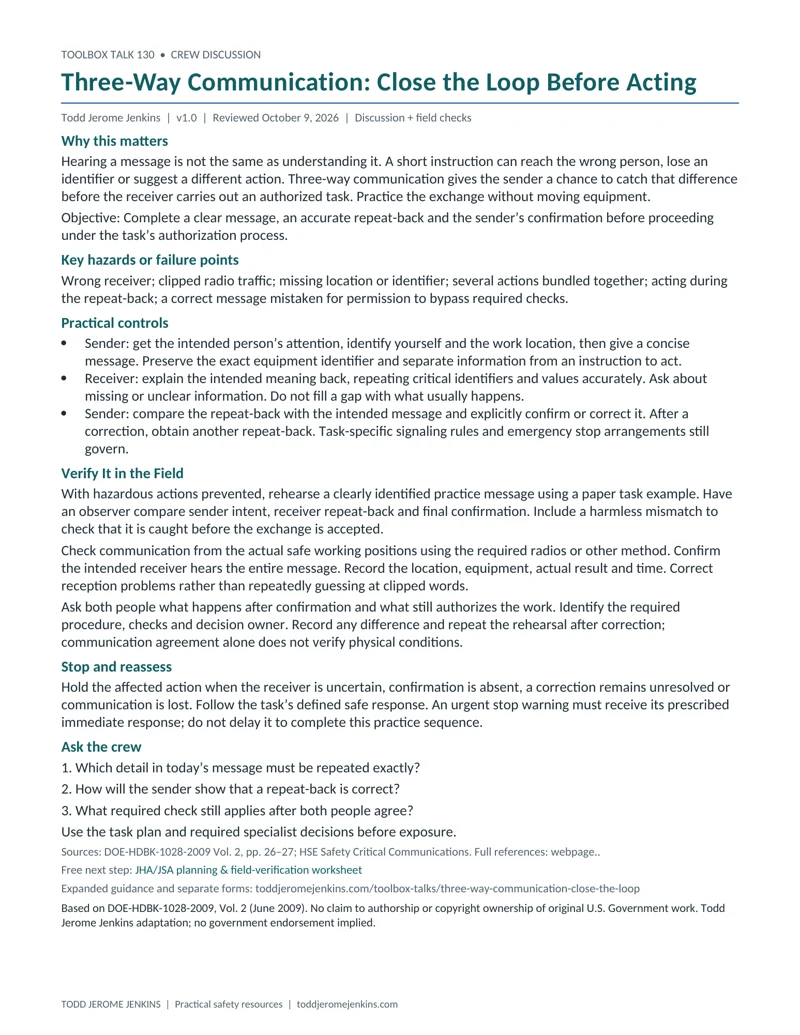
One-page toolbox talk
Download one-page toolbox talk (PDF, 1 page)Editable one-page toolbox talk (Word)Preview the one-page toolbox talk
Supporting documents
Supervisor field checks and attendance records are included with a free account. No payment is required.
Supervisor field check
A separate check to verify conditions and controls before work. Includes a one-page PDF and editable Word file.
Attendance sheet
A separate sign-in sheet to record the toolbox talk. Includes a one-page PDF and editable Word file.
Need the crew records? Create a free account to use these supporting documents and Jenkins Academy of Applied Technology. No payment is required. Email updates are optional.
Create Free AccountAlready have an account? Sign in
HOP skills practice • Batch 1, topic 3 of 5. A 5–10 minute toolbox talk plus time for actual field verification. One-page PDF and editable Word talk; separate supervisor and attendance forms.
What is this skill?
Three-way communication is a message, a repeat-back and the sender's confirmation or correction. It makes differences in understanding visible before an action depends on the message.
Why use it?
A message can sound clear while its identifier, location or intended action is misunderstood. Closing the loop gives both people a chance to resolve that difference.
When should we use it?
Use it for important verbal instructions or status information where misunderstanding could affect safety or the work. Follow any task-specific communication or signaling rules.
Where does it apply?
Face to face, by telephone or by radio, wherever the approved method provides reliable communication. Check it from the real safe working positions.
Learning objective
Complete the message, repeat-back and confirmation, including correction of an incorrect identifier.
Key hazards or failure points
Wrong receiver; clipped words; similar identifiers; several actions bundled together; acting before confirmation.
How to use it — practical controls
- SENDER: get the intended receiver's attention. State who, where and the concise message. Distinguish a status report from an instruction.
- RECEIVER: repeat the meaning back, preserving exact critical identifiers and values. Ask about unclear information instead of guessing.
- SENDER: confirm accuracy or correct the message and obtain another repeat-back. Agreement does not replace work authorization.
Verify It in the Field
- From safe working positions, check the actual communication method under expected conditions. Record whether the complete message was understood, by whom and when.
- Paper practice: tell a partner, 'Training only. Mark Room 12 unavailable.' Partner repeats Room 21. Correct it, hear Room 12 repeated and confirm before marking the paper.
- Ask what still authorizes the real work. A correct exchange does not prove that a physical control is present or functioning.
For real work, record the control, governing source and criterion, safe method, authorized checker, actual result and time. Mark VERIFIED, HOLD/NOT VERIFIED, or N/A with a reason. A practiced skill or matching label does not demonstrate that a physical safeguard functions. Do not create exposure to complete a check.
Stop and reassess
Hold the affected action for uncertainty, missing confirmation or lost communication. Follow prescribed emergency responses immediately; do not delay an urgent stop to finish a repeat-back exercise.
Toolbox talk questions
- Which identifier must be repeated exactly?
- How will we respond to a clipped message?
- What check is still required after confirmation?
Examples across different work settings
These are original teaching examples, not operating instructions. Use paper, photographs or inert training items for practice. Change the setting to fit your team while retaining the skill steps and the applicable task requirements.
Facilities coordination
A coordinator reports that Room 12 remains unavailable. The receiver repeats Room 21. Correcting and confirming the identifier prevents the wrong room being shown as available; it does not release either room for use.
Warehouse planning
A dispatcher requests a status report for Door 4. The receiver repeats the request as an instruction to open it. The sender corrects the intended meaning before anyone acts. An equipment instruction would require its own authorization and checks.
Office or technical support
A colleague requests revision 6 of a work package. The receiver repeats revision 9. The sender corrects the number and confirms the new repeat-back before the document is selected. Current-document control still applies.
Leader follow-through — improve the conditions
Investigate repeated communication gaps: noise, poor reception, language, workload and confusing names. Provide an approved method people can use reliably. Do not treat repeated requests for clarification as a worker problem.
Short supervisor field check
- Sender, receiver and intended location are clear.
- Meaning, critical identifiers and values are repeated accurately.
- Sender confirms or corrects and hears a new repeat-back after correction.
- Communication works from the actual safe positions and expected conditions.
- People distinguish understanding, work authorization and emergency response.
Use the separate supervisor sheet to retain evidence, open items, correction owner, recheck result and required restart authority. Keep task-specific permits, inspections and technical decisions in their established process.
Attendance and follow-through
Use the separate attendance sheet for participants, roles, questions, actions and rebriefs. Attendance does not establish competence, verify a control or authorize work. Keep completed records private under employer procedures.
Source acknowledgment
Based on DOE-HDBK-1028-2009, Vol. 2 (June 2009). No claim to authorship or copyright ownership of original U.S. Government work. Todd Jerome Jenkins adaptation; no government endorsement implied. Explanations, examples, practice exercises and layouts are original adaptations. Third-party material credited in the handbook retains its original attribution; this notice does not claim rights in that material.
Source file inspected: Volume 2/VOLUME 2 EFFECTIVE COMMUNICATION Three-Way Communication.pdf; printed pages 26–27. No generic signaling standard or emergency-response delay is created. Examples are original and do not prescribe equipment operation.
Technical scope and references
References reviewed October 13, 2026. DOE human-performance tools and OSHA recommended practices support preparation and discussion; they do not establish universal technical acceptance criteria. Apply the current task procedure, manufacturer instructions, permit and required competent or qualified decisions. A successful exercise does not replace required training, technical verification or work authorization.
- DOE-HDBK-1028-2009, Volume 2 — Three-Way Communication, printed pp. 26–27 — June 2009 illustrative communication guidance; original practice examples added, with no permission to operate equipment.
- HSE — Safety Critical Communications — Current UK regulator guidance on audience, method, timing and safety-critical information; not a U.S. signaling standard.
The DOE handbook is June 2009 illustrative guidance, not a current requirements document. Availability of the official edition and the linked supporting guidance was checked October 13, 2026. Apply current task-specific requirements, manufacturer instructions, permits and required competent or qualified decisions; this talk supplies no universal technical acceptance criteria.
Connect this discussion to your JHA/JSA
Use the JHA/JSA planning and field-verification worksheet to record the actual task steps, hazards, responsible roles and controls. Return to What Changed Today? when the plan or conditions change.
Related Todd Jerome Jenkins articles: How to Conduct a Job Safety Analysis and What Is Human and Organizational Performance?.
Related toolbox talks
Practice another HOP skill
- STAR Self-Checking: Stop, Think, Act, Review
- Peer Checking: Agree Before the Action
- Pause When Unsure: Resolve Before Restart
- Validate Assumptions: Find the Evidence
One next step
Use the free JHA/JSA planning and field-verification worksheet linked above to apply this skill to one actual task step. Record what must be checked before exposure and who will check it.