

 Free toolbox talk · TBT-132
Download the free toolbox talk
The one-page talk, editable Word version, and guidance below are open to everyone. No account required.
Toolbox Talk - Protecting Critical Steps from Interruptions
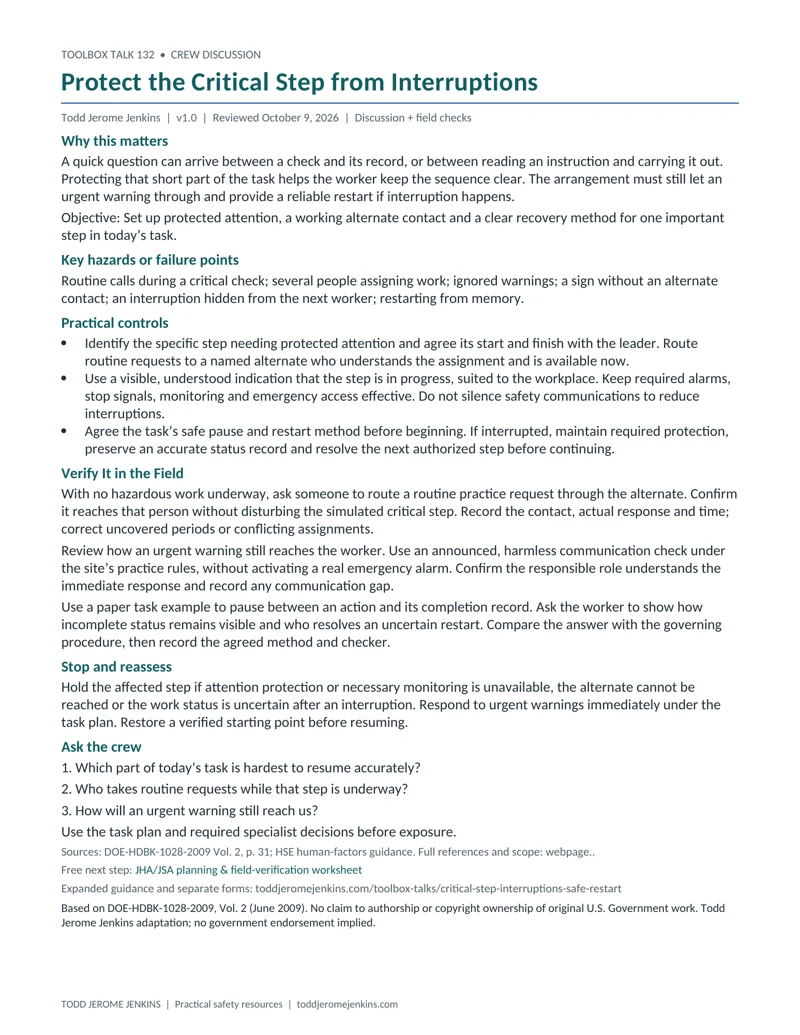
Download toolbox talk - protecting critical steps from interruptions (PDF, 1 page)Editable toolbox talk - protecting critical steps from interruptions (Word)Preview the one-page toolbox talk
Supporting documents
Supervisor field checks and attendance records are included with a free account. No payment is required.
Supervisor Field Check - Protecting Critical Steps from Interruptions
A separate check to verify conditions and controls before work. Includes a one-page PDF and editable Word file.
Attendance Sheet - Protecting Critical Steps from Interruptions
A separate sign-in sheet to record the toolbox talk. Includes a one-page PDF and editable Word file.
Need the crew records? Create a free account to use these supporting documents and Jenkins Academy of Applied Technology. No payment is required. Email updates are optional.
Create Free AccountAlready have an account? Sign in
HOP skills practice • Batch 3, topic 12 of 52. A 5–10 minute toolbox talk plus time for actual field verification. One-page PDF and editable Word talk; separate supervisor and attendance forms.
What is this skill?
Protecting a critical step means arranging time, coverage and communication so a person can complete an important action or review without routine interruptions.
Why use it?
An interruption can leave the action and its record out of step. A sign helps only when people know what to do instead.
When should we use it?
Before a task segment where losing place could cause a consequential mistake or an unreliable check.
Where does it apply?
At a desk, service counter, laboratory bench, workshop or field station, while keeping required monitoring effective.
Learning objective
Demonstrate a routine-request route, an urgent-warning route and an accurate restart after an interruption.
Key hazards or failure points
Unavailable alternate; ignored sign; blocked warnings; conflicting assignments; restart from memory.
How to use it — practical controls
- Agree the protected step's start and finish. Name an available alternate for routine requests and tell affected people how to reach them.
- Use an understood in-progress signal. Keep alarms, stop messages, required monitoring and emergency access effective.
- Agree the procedure's safe pause and restart method. After interruption, establish actual task status before continuing or repeating an action.
Verify It in the Field
- With no operational task underway, route a harmless routine request. Confirm the named alternate receives it; record any coverage gap.
- Discuss and rehearse an announced urgent-message route without activating real alarms. Confirm the worker can receive the warning.
- Interrupt a paper task between completion and recording. Ask the participant to preserve uncertainty and find the restart rule, not guess.
For real work, record the control, governing source and criterion, safe method, authorized checker, actual result and time. Mark VERIFIED, HOLD/NOT VERIFIED, or N/A with a reason. A practiced skill or matching label does not demonstrate that a physical safeguard functions. Do not create exposure to complete a check.
Stop and reassess
Hold the affected step for unavailable coverage, failed warning communication or uncertain task status. Follow the approved safe response and resolve restart before proceeding.
Toolbox talk questions
- Which step needs protected attention today?
- Who receives routine requests during it?
- How will we recover if completion is uncertain?
Examples across different work settings
These are original teaching examples, not operating instructions. Use paper, photographs or inert training items for practice. Change the setting to fit your team while retaining the skill steps and the applicable task requirements.
Engineering office
A reviewer checks a calculation package while a colleague covers routine questions. The in-progress notice names that colleague. Urgent changes affecting the review still reach the reviewer immediately through the agreed route.
Retail service
An employee reconciles a controlled inventory record. Another employee handles ordinary customer requests during the agreed interval. A safety concern still interrupts the task; the employee records the last confirmed point before resuming under the process.
Vehicle workshop
A technician is interrupted between a specified check and its record. The technician establishes status through the work instruction and supervisor rather than assuming the check was completed or automatically repeating a potentially consequential action.
A sign is only one part of the arrangement
Before using an in-progress signal, check that the alternate actually has capacity and knows which requests may wait. Define how someone with an urgent concern reaches the worker directly. Never use headphones, muted radios or inaccessible barriers to create focus where they defeat required warnings or monitoring. In the paper rehearsal, let an interruption expose incomplete status. The learning outcome is a reliable recovery path, not a demonstration of perfect memory.
Leader follow-through — improve the conditions
Review recurring interruptions with the people doing the work. Change assignment timing, staffing, request routing or workspace design when those conditions make protected attention impractical. A worker should not carry the entire burden of defending concentration.
Short supervisor field check
- Protected step and start/finish boundaries are explicit.
- Named alternate is available and receives a practice request.
- Urgent warnings, alarms and required monitoring remain effective.
- Paper interruption is resolved using the restart process.
- Coverage gaps and conflicting assignments have an owner and resolution.
Use the separate supervisor sheet to retain evidence, open items, correction owner, recheck result and required restart authority. Keep task-specific permits, inspections and technical decisions in their established process.
Attendance and follow-through
Use the separate attendance sheet for participants, roles, questions, actions and rebriefs. Attendance does not establish competence, verify a control or authorize work. Keep completed records private under employer procedures.
Source acknowledgment
Based on DOE-HDBK-1028-2009, Vol. 2 (June 2009). No claim to authorship or copyright ownership of original U.S. Government work. Todd Jerome Jenkins adaptation; no government endorsement implied. Explanations, examples, practice exercises and layouts are original adaptations. Third-party material credited in the handbook retains its original attribution; this notice does not claim rights in that material.
Source file inspected: Volume 2/VOLUME 2 Do Not Disturb Sign.pdf; printed pages 31. Source concerns technical preparation and review. Broader workplace examples and urgent-warning and restart exercises are original adaptations, not equipment instructions.
Technical scope and references
References reviewed October 13, 2026. DOE human-performance tools and OSHA recommended practices support preparation and discussion; they do not establish universal technical acceptance criteria. Apply the current task procedure, manufacturer instructions, permit and required competent or qualified decisions. A successful exercise does not replace required training, technical verification or work authorization.
- DOE-HDBK-1028-2009, Volume 2 — Do Not Disturb Sign, printed p. 31 — June 2009 guidance originally focused on technical preparation/review; crew interruption scenario is an original application, not an equipment instruction.
- HSE — Managing Human Failures — Current UK regulator guidance on task design, distraction, workload and error-tolerant systems; not a U.S. legal standard.
- HSE — Safety Critical Communications — Guidance supporting communication arrangements beyond a sign alone; urgent warnings remain effective.
The DOE handbook is June 2009 illustrative guidance, not a current requirements document. Availability of the official edition and the linked supporting guidance was checked October 13, 2026. Apply current task-specific requirements, manufacturer instructions, permits and required competent or qualified decisions; this talk supplies no universal technical acceptance criteria.
Connect this discussion to your JHA/JSA
Use the JHA/JSA planning and field-verification worksheet to record the actual task steps, hazards, responsible roles and controls. Return to What Changed Today? when the plan or conditions change.
Related Todd Jerome Jenkins articles: How to Conduct a Job Safety Analysis and What Is Human and Organizational Performance?.
Related toolbox talks
Practice another HOP skill
- Toolbox Talk - Phonetic Communication
- Toolbox Talk - Component Flagging
- Toolbox Talk - Concurrent Verification
- Toolbox Talk - Independent Verification
One next step
Use the free JHA/JSA planning and field-verification worksheet linked above to apply this skill to one actual task step. Record what must be checked before exposure and who will check it.