Download the talk and separate crew records
Free to download without an account. Each PDF is one page. Use the Word version to adapt the record to your task and approved procedures.
Supervisor field check
Download supervisor field check (PDF, 1 page)Editable supervisor field check (Word)Preview the one-page crew talk
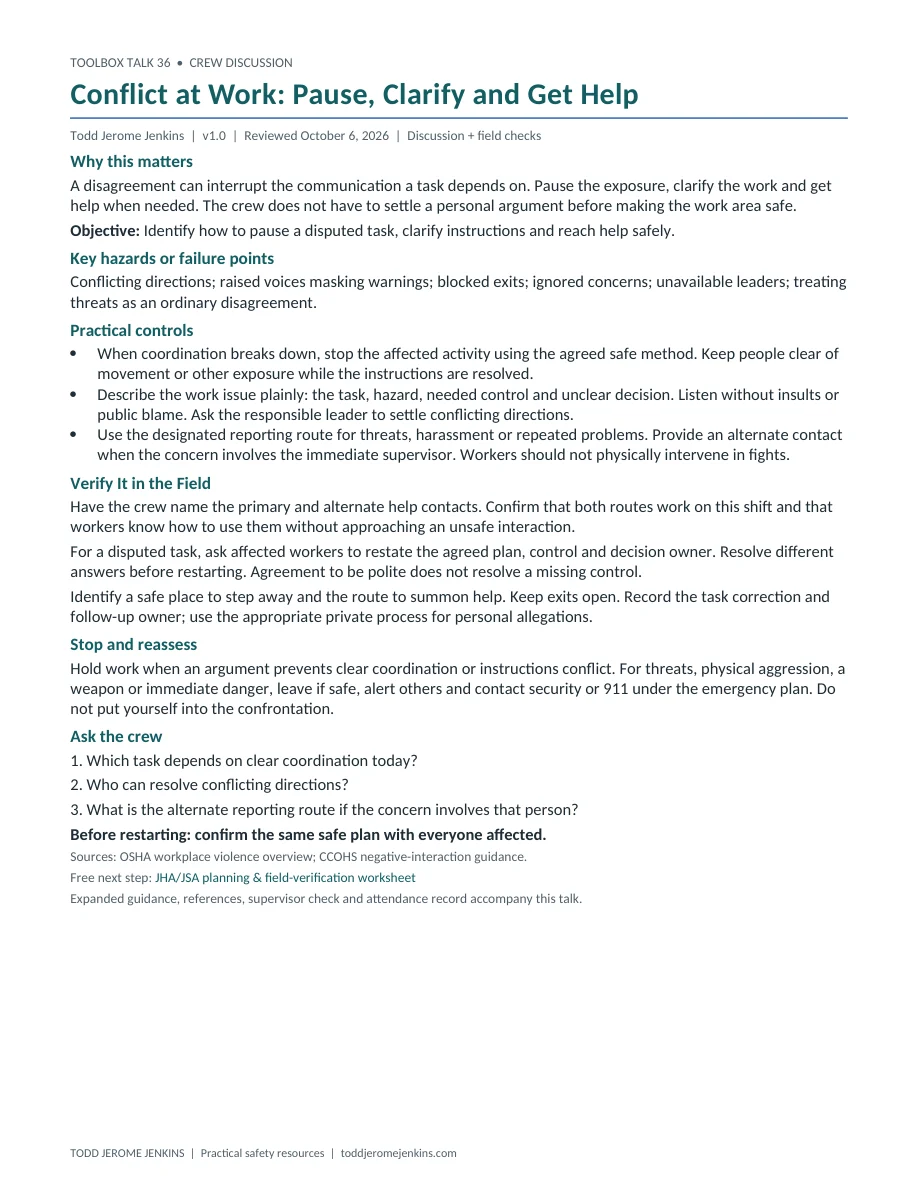
A 5–10 minute crew discussion, plus the time needed for field verification. All six downloads are free without a required signup.
Why this matters
A disagreement can interrupt the communication a task depends on. Pause the exposure, clarify the work and get help when needed. The crew does not have to settle a personal argument before making the work area safe.
Learning objective: Identify how to pause a disputed task, clarify instructions and reach help safely.
Key hazards or failure points
Conflicting directions; raised voices masking warnings; blocked exits; ignored concerns; unavailable leaders; treating threats as an ordinary disagreement.
Practical controls
- When coordination breaks down, stop the affected activity using the agreed safe method. Keep people clear of movement or other exposure while the instructions are resolved.
- Describe the work issue plainly: the task, hazard, needed control and unclear decision. Listen without insults or public blame. Ask the responsible leader to settle conflicting directions.
- Use the designated reporting route for threats, harassment or repeated problems. Provide an alternate contact when the concern involves the immediate supervisor. Workers should not physically intervene in fights.
Verify It in the Field
Have the crew name the primary and alternate help contacts. Confirm that both routes work on this shift and that workers know how to use them without approaching an unsafe interaction.
For a disputed task, ask affected workers to restate the agreed plan, control and decision owner. Resolve different answers before restarting. Agreement to be polite does not resolve a missing control.
Identify a safe place to step away and the route to summon help. Keep exits open. Record the task correction and follow-up owner; use the appropriate private process for personal allegations.
Use the separate field check to record the source and criterion, safe method, checker, actual result and time. Mark VERIFIED, HOLD/NOT VERIFIED, or N/A with a reason. Check every required control; the examples below do not clear the whole task.
| Control | Safe verification | Evidence to record |
|---|---|---|
| Clear directions | Ask each affected person to restate the revised task and role. | Resolved instruction, decision owner and restart limits. |
| Usable help route | Confirm primary and alternate contacts are reachable. | Contact method and coverage. |
| Safe withdrawal | Identify an unobstructed route away from the interaction. | Route and method for summoning help. |
Stop and reassess
Hold work when an argument prevents clear coordination or instructions conflict. For threats, physical aggression, a weapon or immediate danger, leave if safe, alert others and contact security or 911 under the emergency plan. Do not put yourself into the confrontation.
Crew discussion questions
- Which task depends on clear coordination today?
- Who can resolve conflicting directions?
- What is the alternate reporting route if the concern involves that person?
Before restarting: confirm the same safe plan with everyone affected.
A situation to discuss
Illustrative situation: two people give an operator different movement instructions. The agreed stop signal brings the movement to a safe stop. The leader assigns one clear signaling arrangement and rebriefs everyone before resuming. The argument is addressed separately through the appropriate channel.
Leader preparation and practical detail
Separate the task problem from the conduct problem
First remove the immediate exposure using the approved safe method. Then identify which direction, role or control needs a decision. A leader can correct the work plan while still following up on disrespectful conduct. Do not tell someone to accept an unsafe instruction merely to avoid disagreement.
Make reporting lead to action
Give workers a primary and alternate route and explain who receives each type of concern. Record what will happen next and when the reporter can expect a follow-up, without promising a particular outcome or absolute confidentiality. The supervisor should not diagnose anger or assume a mental-health condition explains an interaction. [1], [3]
Recognize when to leave
Canadian CCOHS guidance supports respectful communication, ending unsafe interactions and getting help. It is practical guidance rather than a US legal rule. Threats or physical danger require the site’s protective response; a crew briefing is not training to restrain someone, break up a fight or manage an armed threat. [2]
Short supervisor field check
- Affected exposure safely paused when needed.
- Instructions and decision owner clarified.
- Primary and alternate reporting routes usable.
- Safe withdrawal and emergency help route identified.
- Task correction and private follow-up assigned.
Use the separate form to document evidence, restrictions, corrective-action owner, recheck and required restart approval. An unresolved required control means hold the affected work. Missing evidence is not a pass. Complete all task-specific inspections and permits.
Attendance and follow-through
The separate attendance sheet records participants, language support, questions, actions and late-arrival rebriefs. Attendance does not establish competence or prove controls function. Keep completed records private under the employer’s procedures.
Technical scope and references
This resource addresses task coordination and respectful reporting. It does not provide counseling, a violence-risk diagnosis or physical-intervention training. Use the employer’s prevention, reporting and emergency arrangements and applicable requirements. [1], [2]
References checked October 6, 2026. Apply the jurisdiction, task, employer program and equipment instructions that govern the work. No site-specific manual, permit, engineering determination or product SDS has been approved by this general resource.
- Workplace Violence — Overview — Workplace risk assessment plus implemented prevention program, engineering/administrative controls and training. No inference that anger or a mental-health diagnosis predicts violence.
- Violence and Harassment in the Workplace — Dealing with Negative Interactions — Canadian agency practical guidance, not US legal standard. Calm simple respectful communication; clarify concerns; end unsafe interaction; get help; do not physically intervene beyond training/safety. Do not reproduce fixed personal-space distance as safety guarantee.
- Supporting Mental Health in the Workplace: Checklist for Supervisors — Relieve job stressors through realistic workload/time/resources, support channels and private check-ins. Do not force disclosure. Supervisor supports/refers; does not diagnose. Do not promise absolute confidentiality or guarantee employment outcomes.
Connect this discussion to your JHA/JSA
Use How to Conduct a Job Safety Analysis to connect today’s work steps, hazards and controls. Revisit Pre-Job JHA/JSA: What Changed Today? whenever conditions change.
Related published crew resources: New to the Job: Show the Work Before You Start; Human Performance: Make the Next Step Clearer; Learning Teams: Ask What Makes Work Difficult.
Put one check into practice
Download the free JHA/JSA planning and field-verification worksheet. For today’s task, record an important control, its source and the evidence needed before exposure. Complete the remaining required checks through your task plan.