Download the talk and separate crew records
Free to download without an account. Each PDF is one page. Use the Word version to adapt the record to your task and approved procedures.
Supervisor field check
Download supervisor field check (PDF, 1 page)Editable supervisor field check (Word)Preview the one-page crew talk
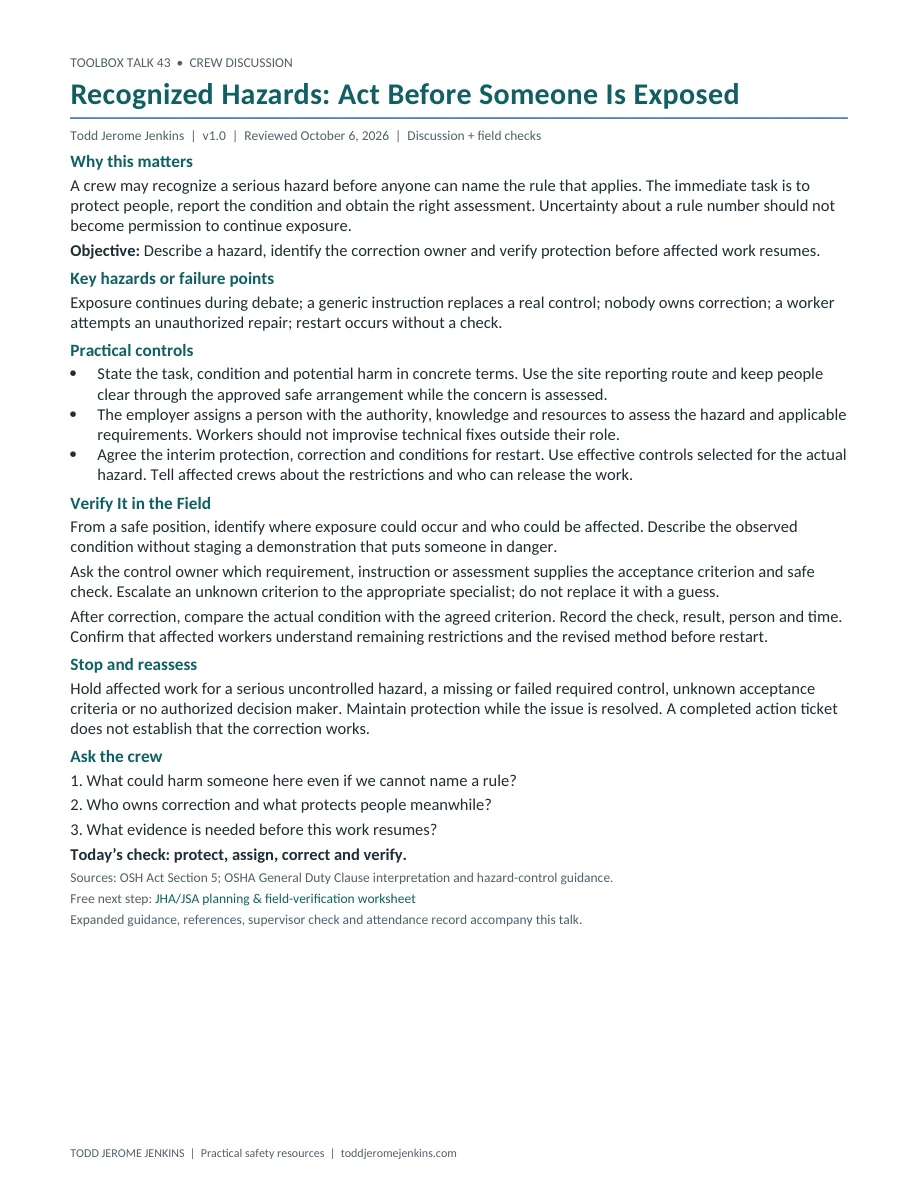
A 5–10 minute crew discussion, plus the time needed for field verification. All six downloads are free without a required signup.
Why this matters
A crew may recognize a serious hazard before anyone can name the rule that applies. The immediate task is to protect people, report the condition and obtain the right assessment. Uncertainty about a rule number should not become permission to continue exposure.
Learning objective: Describe a hazard, identify the correction owner and verify protection before affected work resumes.
Key hazards or failure points
Exposure continues during debate; a generic instruction replaces a real control; nobody owns correction; a worker attempts an unauthorized repair; restart occurs without a check.
Practical controls
- State the task, condition and potential harm in concrete terms. Use the site reporting route and keep people clear through the approved safe arrangement while the concern is assessed.
- The employer assigns a person with the authority, knowledge and resources to assess the hazard and applicable requirements. Workers should not improvise technical fixes outside their role.
- Agree the interim protection, correction and conditions for restart. Use effective controls selected for the actual hazard. Tell affected crews about the restrictions and who can release the work.
Verify It in the Field
From a safe position, identify where exposure could occur and who could be affected. Describe the observed condition without staging a demonstration that puts someone in danger.
Ask the control owner which requirement, instruction or assessment supplies the acceptance criterion and safe check. Escalate an unknown criterion to the appropriate specialist; do not replace it with a guess.
After correction, compare the actual condition with the agreed criterion. Record the check, result, person and time. Confirm that affected workers understand remaining restrictions and the revised method before restart.
Use the separate field check to record the source and criterion, safe method, checker, actual result and time. Mark VERIFIED, HOLD/NOT VERIFIED, or N/A with a reason. Check every required control; the examples below do not clear the whole task.
| Control | Safe verification | Evidence to record |
|---|---|---|
| Interim protection | Observe the affected area from a protected position. | Restriction and people/approaches covered. |
| Defined acceptance | Control owner identifies the governing source and safe check. | Criterion, method and responsible reviewer. |
| Verified correction | Compare actual result with the criterion before release. | Result, time, checker and remaining restriction. |
Stop and reassess
Hold affected work for a serious uncontrolled hazard, a missing or failed required control, unknown acceptance criteria or no authorized decision maker. Maintain protection while the issue is resolved. A completed action ticket does not establish that the correction works.
Crew discussion questions
- What could harm someone here even if we cannot name a rule?
- Who owns correction and what protects people meanwhile?
- What evidence is needed before this work resumes?
Today’s check: protect, assign, correct and verify.
A situation to discuss
Illustrative situation: a damaged access arrangement is discovered before a delivery. The crew prevents use and reports the exact location. The employer obtains the appropriate assessment and provides a verified alternative instead of leaving the route open while the rule is discussed.
Leader preparation and practical detail
Understand the legal scope
Section 5 of the OSH Act establishes employer duties concerning recognized hazards likely to cause death or serious physical harm and compliance with OSHA standards. OSHA explains that General Duty Clause enforcement has specific elements and applies where no specific standard addresses the particular hazard. This page does not decide whether a workplace condition is a violation. [1], [2]
Keep responsibility attached to authority
Workers contribute observations and use the reporting arrangements. That participation does not transfer the employer’s control obligations to them. Assign someone able to obtain technical advice, resources and correction. If a worker can only report a defect, do not make that person responsible for engineering or approving its repair. [1], [3]
Close the exposure gap
A practical action record names interim protection as well as the permanent correction. Verify both. If a repair is complete but the work method or nearby exposure has changed, reassess before release. OSHA’s recommended practices support assigning control owners and checking effectiveness; the actual technical criteria come from the governing source. [3]
Short supervisor field check
- Hazard and exposure described specifically.
- Interim protection in place.
- Correction owner has authority and resources.
- Source criterion and safe check identified.
- Actual correction verified and restart communicated.
Use the separate form to document evidence, restrictions, corrective-action owner, recheck and required restart approval. An unresolved required control means hold the affected work. Missing evidence is not a pass. Complete all task-specific inspections and permits.
Attendance and follow-through
The separate attendance sheet records participants, language support, questions, actions and late-arrival rebriefs. Attendance does not establish competence or prove controls function. Keep completed records private under the employer’s procedures.
Technical scope and references
This is practical hazard response with a brief federal legal context. It is not legal advice about a particular violation or an unlimited statement of statutory work-refusal rights. Applicable standards, employer procedures and jurisdictional requirements govern the task. [1], [2], [3]
References checked October 6, 2026. Apply the jurisdiction, task, employer program and equipment instructions that govern the work. No site-specific manual, permit, engineering determination or product SDS has been approved by this general resource.
- OSH Act Section 5 — Duties — Statutory federal duties; do not transfer employer control obligations to workers.
- OSHA interpretation — Elements necessary for a General Duty Clause violation — Interpretation letter dated 2003; inspected current OSHA-hosted text. Not new law or a definitive legal determination for a specific workplace.
- OSHA Recommended Practices — Hazard Prevention and Control — Recommended practices, not a standalone technical acceptance standard. Site-specific criteria must come from applicable authoritative sources.
Connect this discussion to your JHA/JSA
Use How to Conduct a Job Safety Analysis to connect today’s work steps, hazards and controls. Revisit Pre-Job JHA/JSA: What Changed Today? whenever conditions change.
Related Todd Jerome Jenkins article: How to Read OSHA Standards.
Related Todd Jerome Jenkins video: How to Read an OSHA Standard.
Related published crew resources: Competent Person: Know Who Can Correct the Hazard; Hierarchy of Controls: Verify the Protection.
Put one check into practice
Download the free JHA/JSA planning and field-verification worksheet. For today’s task, record an important control, its source and the evidence needed before exposure. Complete the remaining required checks through your task plan.