

 Free toolbox talk · TBT-88
Download the free toolbox talk
The one-page talk, editable Word version, and guidance below are open to everyone. No account required.
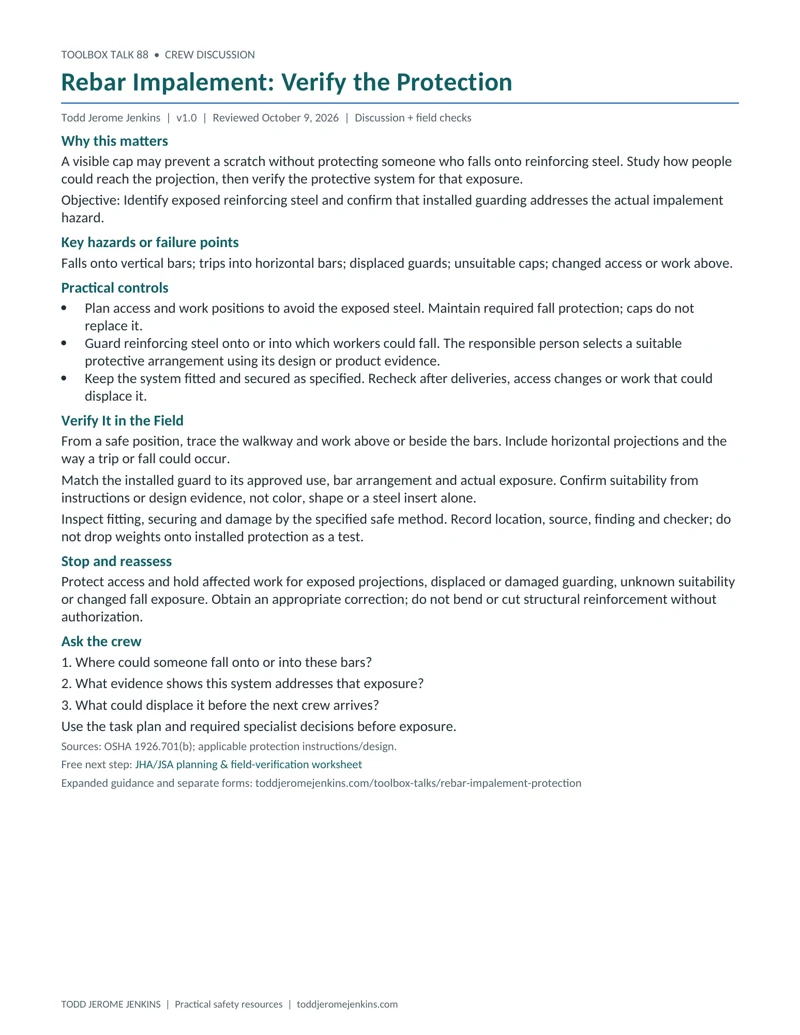
One-page toolbox talk
Download one-page toolbox talk (PDF, 1 page)Editable one-page toolbox talk (Word)Preview the one-page toolbox talk
Supporting documents
Supervisor field checks and attendance records are included with a free account. No payment is required.
Supervisor field check
A separate check to verify conditions and controls before work. Includes a one-page PDF and editable Word file.
Attendance sheet
A separate sign-in sheet to record the toolbox talk. Includes a one-page PDF and editable Word file.
Need the crew records? Create a free account to use these supporting documents and Jenkins Academy of Applied Technology. No payment is required. Email updates are optional.
Create Free AccountAlready have an account? Sign in
A 5–10 minute toolbox talk, plus time to verify the actual controls. The toolbox talk and Word version are public. Separate supervisor and attendance records are included with a free Safety account.
Why this matters
A visible cap may prevent a scratch without protecting someone who falls onto reinforcing steel. Study how people could reach the projection, then verify the protective system for that exposure.
Learning objective
Identify exposed reinforcing steel and confirm that installed guarding addresses the actual impalement hazard.
Key hazards or failure points
Falls onto vertical bars; trips into horizontal bars; displaced guards; unsuitable caps; changed access or work above.
Practical controls
- Plan access and work positions to avoid the exposed steel. Maintain required fall protection; caps do not replace it.
- Guard reinforcing steel onto or into which workers could fall. The responsible person selects a suitable protective arrangement using its design or product evidence.
- Keep the system fitted and secured as specified. Recheck after deliveries, access changes or work that could displace it.
Verify It in the Field
- From a safe position, trace the walkway and work above or beside the bars. Include horizontal projections and the way a trip or fall could occur.
- Match the installed guard to its approved use, bar arrangement and actual exposure. Confirm suitability from instructions or design evidence, not color, shape or a steel insert alone.
- Inspect fitting, securing and damage by the specified safe method. Record location, source, finding and checker; do not drop weights onto installed protection as a test.
Stop and reassess
Protect access and hold affected work for exposed projections, displaced or damaged guarding, unknown suitability or changed fall exposure. Obtain an appropriate correction; do not bend or cut structural reinforcement without authorization.
toolbox talk questions
- Where could someone fall onto or into these bars?
- What evidence shows this system addresses that exposure?
- What could displace it before the next crew arrives?
For each required control, record its acceptance source and criterion, safe verification method, responsible checker, actual result and time. Use VERIFIED, HOLD/NOT VERIFIED, or N/A with a reason. A tick alone is not evidence. Complete all applicable task inspections; do not enter danger or improvise a test to fill out a form.
Leader preparation and practical detail
Look beyond cap presence
Illustrative situation: a bundle is moved and uncovers horizontal bars beside a route. The crew protects access and reviews the new exposure instead of assuming that only upward-pointing reinforcement matters.
Distinguish scratch and impalement protection
OSHA's interpretations explain why ordinary mushroom-style scratch caps do not establish impalement protection. This does not mean every mushroom cap is prohibited for every intended purpose. Select the protection for the actual fall exposure, then verify its installation.
Use evidence without inventing a field test
The federal rule is performance-based. OSHA's 2014 interpretation discusses protective performance but does not prescribe a universal field drop test. This talk does not approve a product or adopt a numerical test. State-plan requirements and actual system instructions may add criteria.
Include the handoff
Record the guarded location and who maintains it as access and tasks change. A photograph may support the record, but it does not replace the suitability evidence or ongoing observation. Keep completed records under employer procedures.
Apply this briefing to steel and framing work
Panel and column landings: keep dowel protection in the sequence
Starter bars and projecting reinforcement can become exposed when a panel, column, bundle or temporary access arrangement changes position. Include the receiving crew’s approach, connection position and retreat route in the impalement review. A guard that worked for yesterday’s walkway may not address today’s work above or beside the same bars.
Before a task requires moving protection, the erection lead and responsible safety reviewer establish how exposure will remain controlled throughout that step. From safe access, match the proposed arrangement to its product instructions or design evidence and the actual fall exposure. Do not remove protection first and decide what replaces it afterward.
Record the affected projections, sequence, alternative protection, checker and time. Keep other crews out of the affected area until the specified protection is restored or the exposure is otherwise eliminated. Hold the step for missing guarding, uncertain suitability or a changed access route. Do not alter structural reinforcement to solve an access problem without authorization.
Sources checked October 9, 2026: OSHA 1926.701(b).
Record the acceptance source, safe check method, assigned verifier, actual result and time. Hold affected work for an unresolved required control; correct, recheck and rebrief before authorized restart.
Apply this briefing to framing and masonry work
Masonry reinforcement: check above the unfinished wall
Vertical reinforcement can extend above an unfinished block wall or through open cells. The exposure changes when workers raise their platform, lean over the wall or lower units around the bars. Before that stage, the masonry foreman should identify the positions from which someone could fall onto or into reinforcement, including nearby access and material-handling positions.
1926.701(b) requires guarding that eliminates the impalement hazard. Have the person responsible for the guarding arrangement compare the actual bar layout and exposure with the applicable product instructions or engineered detail. Where placing units requires a guard to be removed, agree on protection throughout that operation and verify its restoration before releasing the next work position. Do not use a person, dropped weight or improvised impact test to prove the arrangement.
Record: wall/grid and construction stage, guarding reference, responsible verifier, observed condition and time. Hold the affected position if protrusions become exposed, the planned guard conflicts with placement or its suitability remains uncertain.
Record the acceptance source, safe check method, assigned verifier, actual result and time. Hold affected work for an unresolved required control; correct, recheck and rebrief before authorized restart.
Short supervisor field check
- From a safe position, trace the walkway and work above or beside the bars. Include horizontal projections and the way a trip or fall could occur.
- Match the installed guard to its approved use, bar arrangement and actual exposure. Confirm suitability from instructions or design evidence, not color, shape or a steel insert alone.
- Inspect fitting, securing and damage by the specified safe method. Record location, source, finding and checker; do not drop weights onto installed protection as a test.
Confirm the relevant trained/authorized people, unresolved items, interim protection, correction owner and recheck. Record required release authority and rebrief anyone affected. The separate sheet supports these records; it does not replace a specialist inspection, permit or engineering determination.
Attendance and follow-through
Use the separate attendance sheet for participants, roles, discussion concerns, actions and late-arrival rebriefs. Attendance is not proof of competence, functioning controls or authorization to work. Keep completed records private under employer procedures.
Technical scope and references
Reviewed October 9, 2026 for construction crew preparation. Apply the actual task, jurisdiction and relevant standard provisions. Manufacturer sources below are reference examples, not approval of your equipment. No site-specific design, permit, exposure assessment, product SDS or current model manual was supplied; obtain the applicable documents before work. This discussion does not replace required training.
- OSHA 1926.701(b) — Guarding reinforcing steel against impalement.
- OSHA rebar-cap clarification, May 29, 1997 — Historical interpretation distinguishing scratch protection.
- OSHA rebar-guarding interpretation, August 26, 2014 — Performance standard and state-plan distinction.
- OSHA horizontal-rebar interpretation — Exposure-dependent guarding; do not turn examples into universal safe heights.
Connect this discussion to your JHA/JSA
Use the related worked JHA/JSA/AHA example to prepare task steps, hazards and controls. Return to What Changed Today? when the plan or conditions change.
Related Todd Jerome Jenkins article: How to Conduct a Job Safety Analysis.
Related toolbox talks
Put one check into practice
Use the free JHA/JSA planning and field-verification worksheet to record today’s change, the required protection and the evidence needed before exposure.