Download the talk and separate crew records
Free to download without an account. Each PDF is one page. Use the Word version to adapt the record to your task and approved procedures.
Supervisor field check
Download supervisor field check (PDF, 1 page)Editable supervisor field check (Word)Preview the one-page crew talk
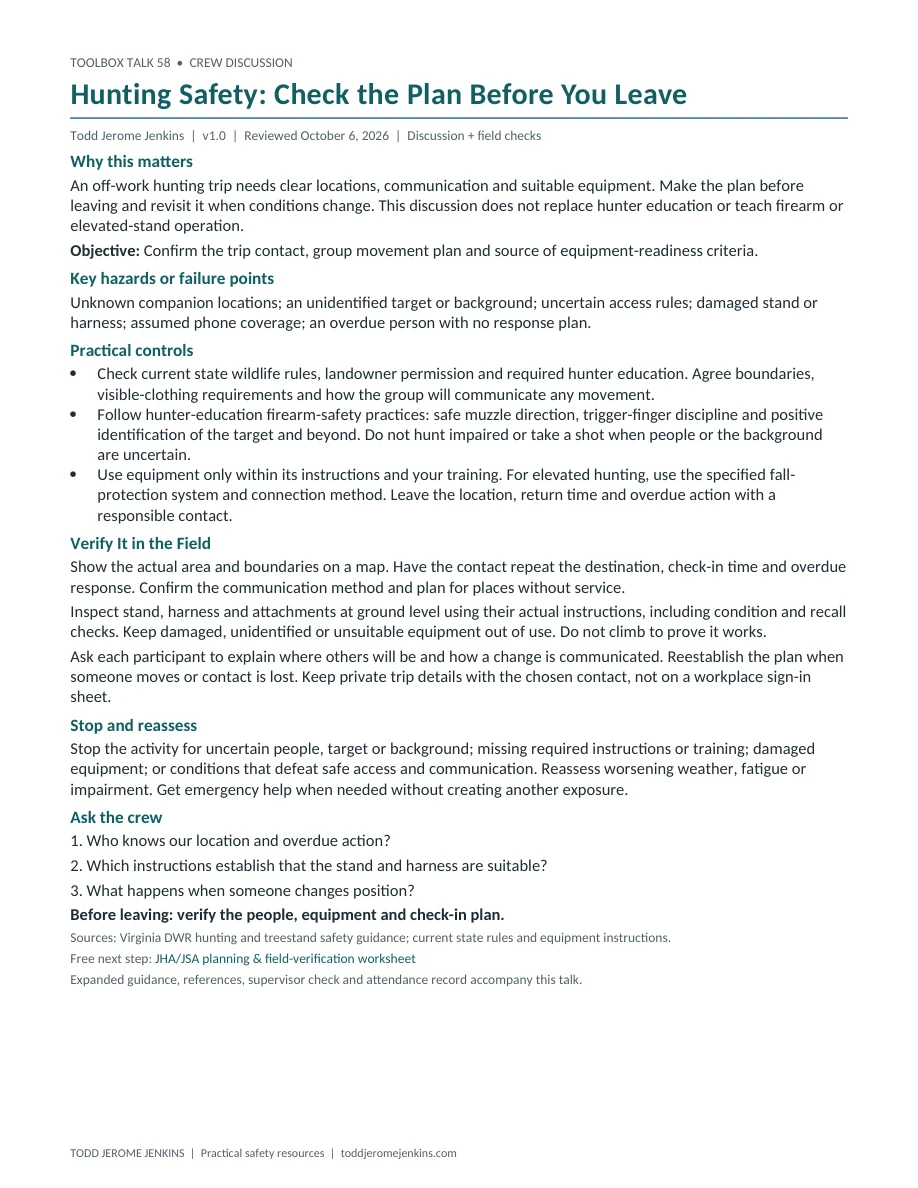
A 5–10 minute crew discussion, plus the time needed for field verification. All six downloads are free without a required signup.
Why this matters
An off-work hunting trip needs clear locations, communication and suitable equipment. Make the plan before leaving and revisit it when conditions change. This discussion does not replace hunter education or teach firearm or elevated-stand operation.
Learning objective: Confirm the trip contact, group movement plan and source of equipment-readiness criteria.
Key hazards or failure points
Unknown companion locations; an unidentified target or background; uncertain access rules; damaged stand or harness; assumed phone coverage; an overdue person with no response plan.
Practical controls
- Check current state wildlife rules, landowner permission and required hunter education. Agree boundaries, visible-clothing requirements and how the group will communicate any movement.
- Follow hunter-education firearm-safety practices: safe muzzle direction, trigger-finger discipline and positive identification of the target and beyond. Do not hunt impaired or take a shot when people or the background are uncertain.
- Use equipment only within its instructions and your training. For elevated hunting, use the specified fall-protection system and connection method. Leave the location, return time and overdue action with a responsible contact.
Verify It in the Field
Show the actual area and boundaries on a map. Have the contact repeat the destination, check-in time and overdue response. Confirm the communication method and plan for places without service.
Inspect stand, harness and attachments at ground level using their actual instructions, including condition and recall checks. Keep damaged, unidentified or unsuitable equipment out of use. Do not climb to prove it works.
Ask each participant to explain where others will be and how a change is communicated. Reestablish the plan when someone moves or contact is lost. Keep private trip details with the chosen contact, not on a workplace sign-in sheet.
Use the separate field check to record the source and criterion, safe method, checker, actual result and time. Mark VERIFIED, HOLD/NOT VERIFIED, or N/A with a reason. Check every required control; the examples below do not clear the whole task.
| Control | Safe verification | Evidence to record |
|---|---|---|
| Known location | Contact repeats mapped area, return time and overdue action. | Private trip plan and confirmed contact. |
| Suitable equipment | Ground-level checks against actual instructions and recall information. | Condition, source and hold for uncertainty. |
| Shared movement plan | Participants explain positions and change communication. | Agreed method; activity stops when locations are unclear. |
Stop and reassess
Stop the activity for uncertain people, target or background; missing required instructions or training; damaged equipment; or conditions that defeat safe access and communication. Reassess worsening weather, fatigue or impairment. Get emergency help when needed without creating another exposure.
Crew discussion questions
- Who knows our location and overdue action?
- Which instructions establish that the stand and harness are suitable?
- What happens when someone changes position?
Before leaving: verify the people, equipment and check-in plan.
A situation to discuss
Illustrative situation: a hunter finds an unreadable stand label and cannot establish the correct instructions. The equipment is not used. The group changes its plan within its training and permissions and updates the person holding the trip information.
Leader preparation and practical detail
Use the right authority for the trip
Wildlife seasons, access, education and visible-clothing requirements depend on the state and activity. Check current official rules for the actual location; a previous season’s handout is not enough. The Virginia DWR references support general safety preparation, not an assertion that Virginia rules apply everywhere. [1]
Keep equipment checks on safe ground
Read the actual stand and fall-protection instructions, inspect condition and check recall status before use. A general checklist cannot approve a tree, attachment method or rescue arrangement. Resolve uncertainty with the manufacturer and appropriate training. The resource does not authorize an improvised climb or suspension test. [2]
Make the contact plan useful
Give the chosen contact a usable location and explicit action if the group is overdue. Agree how changed positions and return times will be communicated. Treat lost communication or unknown companion locations as reasons to reassess the activity. This is a voluntary take-home discussion; the employer should not collect personal trip or health details.
Short supervisor field check
- Voluntary off-work scope explained.
- Current state wildlife authority identified.
- Equipment instructions and safe ground checks understood.
- Location/contact planning exercise completed.
- No weapon demonstration or private medical disclosure requested.
Use the separate form to document evidence, restrictions, corrective-action owner, recheck and required restart approval. An unresolved required control means hold the affected work. Missing evidence is not a pass. Complete all task-specific inspections and permits.
Attendance and follow-through
The separate attendance sheet records participants, language support, questions, actions and late-arrival rebriefs. Attendance does not establish competence or prove controls function. Keep completed records private under the employer’s procedures.
Technical scope and references
This is voluntary off-work readiness guidance, not firearm instruction, hunter certification, stand installation or rescue training. Current state wildlife rules, landowner permissions and actual equipment instructions govern. No weapon demonstration is part of this talk. [1], [2]
References checked October 6, 2026. Apply the jurisdiction, task, employer program and equipment instructions that govern the work. No site-specific manual, permit, engineering determination or product SDS has been approved by this general resource.
- Virginia DWR — Safety at the Top of the List During Holiday Hunting Season — December 3, 2025 primary agency release: hunter education, firearm handling basics, target/beyond, visible clothing, local rules checked each year, elevated-hunting harness/connection and ground-level practice. Safety principles only; no current season/date/legal-color extrapolation.
- Virginia DWR — Treestand Safety — Full page read: instructions, stand/attachment inspection, recall check, location/communication plan, full-body harness, unloaded equipment for ascent/descent and haul line. Do not reproduce its blanket medication exclusion; route functional medication questions to clinician/pharmacist and fitness-for-task policy. No dimensions or rigging instructions invented.
Connect this discussion to your JHA/JSA
Use How to Conduct a Job Safety Analysis to connect today’s work steps, hazards and controls. Revisit Pre-Job JHA/JSA: What Changed Today? whenever conditions change.
Related published crew resources: Working Alone: Check In and Get Help; Severe Weather: Know When and Where to Shelter; Cold Weather: Check Warmth, Traction and Recovery; Medication and Safe Work: Check Before the Task; Impaired Driving: Confirm the Sober Ride.
Put one check into practice
Download the free JHA/JSA planning and field-verification worksheet. For today’s task, record an important control, its source and the evidence needed before exposure. Complete the remaining required checks through your task plan.