Download the talk and separate crew records
Free to download without an account. Each PDF is one page. Use the Word version to adapt the record to your task and approved procedures.
Supervisor field check
Download supervisor field check (PDF, 1 page)Editable supervisor field check (Word)Preview the one-page crew talk
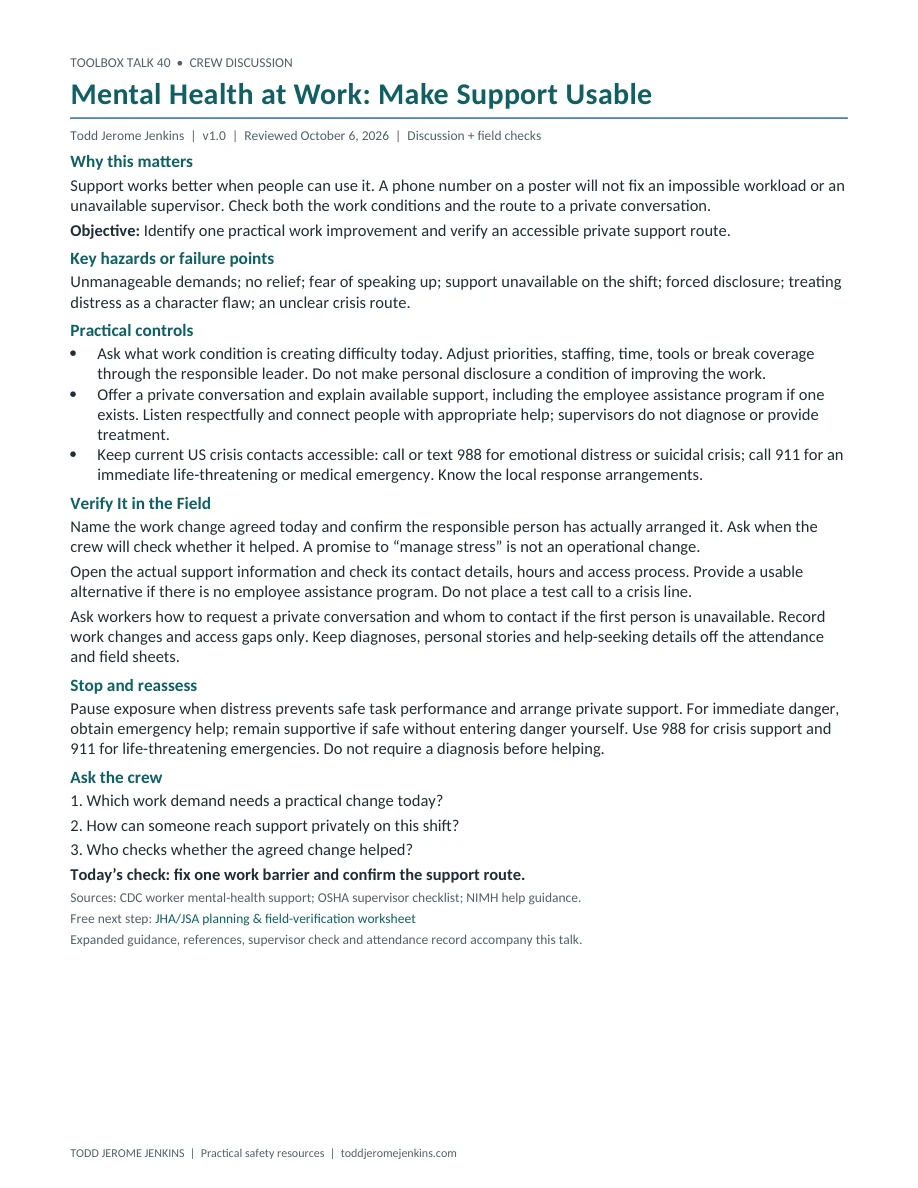
A 5–10 minute crew discussion, plus the time needed for field verification. All six downloads are free without a required signup.
Why this matters
Support works better when people can use it. A phone number on a poster will not fix an impossible workload or an unavailable supervisor. Check both the work conditions and the route to a private conversation.
Learning objective: Identify one practical work improvement and verify an accessible private support route.
Key hazards or failure points
Unmanageable demands; no relief; fear of speaking up; support unavailable on the shift; forced disclosure; treating distress as a character flaw; an unclear crisis route.
Practical controls
- Ask what work condition is creating difficulty today. Adjust priorities, staffing, time, tools or break coverage through the responsible leader. Do not make personal disclosure a condition of improving the work.
- Offer a private conversation and explain available support, including the employee assistance program if one exists. Listen respectfully and connect people with appropriate help; supervisors do not diagnose or provide treatment.
- Keep current US crisis contacts accessible: call or text 988 for emotional distress or suicidal crisis; call 911 for an immediate life-threatening or medical emergency. Know the local response arrangements.
Verify It in the Field
Name the work change agreed today and confirm the responsible person has actually arranged it. Ask when the crew will check whether it helped. A promise to “manage stress” is not an operational change.
Open the actual support information and check its contact details, hours and access process. Provide a usable alternative if there is no employee assistance program. Do not place a test call to a crisis line.
Ask workers how to request a private conversation and whom to contact if the first person is unavailable. Record work changes and access gaps only. Keep diagnoses, personal stories and help-seeking details off the attendance and field sheets.
Use the separate field check to record the source and criterion, safe method, checker, actual result and time. Mark VERIFIED, HOLD/NOT VERIFIED, or N/A with a reason. Check every required control; the examples below do not clear the whole task.
| Control | Safe verification | Evidence to record |
|---|---|---|
| Work improvement | Confirm a real staffing, priority, equipment or time change. | Change, owner and follow-up time. |
| Accessible support | Check actual service information and shift access. | Contact method, hours and unresolved access gap. |
| Private help route | Confirm a primary and alternate contact without requesting disclosures. | Route and backup; no health details. |
Stop and reassess
Pause exposure when distress prevents safe task performance and arrange private support. For immediate danger, obtain emergency help; remain supportive if safe without entering danger yourself. Use 988 for crisis support and 911 for life-threatening emergencies. Do not require a diagnosis before helping.
Crew discussion questions
- Which work demand needs a practical change today?
- How can someone reach support privately on this shift?
- Who checks whether the agreed change helped?
Today’s check: fix one work barrier and confirm the support route.
A situation to discuss
Illustrative situation: repeated late changes are leaving a crew without reliable relief. The supervisor changes task priorities and assigns coverage, then checks back with the crew. The support contact remains available privately; workers do not have to explain personal health circumstances to justify fixing the staffing gap.
Leader preparation and practical detail
Address the conditions of work
CDC and OSHA guidance includes organizational support and realistic resources, workload and time. Use the crew conversation to identify an operational problem the leader can act on. Name the change, owner and follow-up. Asking everyone to be more resilient is not evidence that the workload has become workable. [1], [2]
Make privacy practical
Explain where a private conversation can happen and how the worker can reach the appropriate support service. Check the service’s actual terms rather than promising absolute confidentiality or an employment outcome. Participation in this talk must not require personal disclosure. Keep attendance as an attendance record and route sensitive information through the appropriate private process. [2], [3]
Know which help to call
NIMH identifies 988 call, text or chat for emotional distress or suicidal crisis and 911 for life-threatening situations. Supportive listening and helping someone connect with care can matter; this briefing is not suicide-risk assessment or counseling training. If staying with someone is safe, help them reach support, and obtain emergency help when immediate danger is present. [3], [4]
Short supervisor field check
- One concrete work barrier and responsible owner identified.
- Agreed work change actually arranged.
- Support contact details, hours and access checked.
- Private route, backup and crisis contacts understood.
- Follow-up assigned; personal health details excluded from records.
Use the separate form to document evidence, restrictions, corrective-action owner, recheck and required restart approval. An unresolved required control means hold the affected work. Missing evidence is not a pass. Complete all task-specific inspections and permits.
Attendance and follow-through
The separate attendance sheet records participants, language support, questions, actions and late-arrival rebriefs. Attendance does not establish competence or prove controls function. Keep completed records private under the employer’s procedures.
Technical scope and references
This is supportive work planning and referral guidance. It does not diagnose a condition, assess fitness for duty or predict dangerousness. The contact numbers are for the United States; verify local services elsewhere. Apply the employer’s appropriate private support and emergency processes. [1], [2], [3], [4]
References checked October 6, 2026. Apply the jurisdiction, task, employer program and equipment instructions that govern the work. No site-specific manual, permit, engineering determination or product SDS has been approved by this general resource.
- Providing Support for Worker Mental Health — Organizational practices and workload/resource imbalance matter. Verify real work changes and access to support, not only a resilience slogan. 988 call/text/chat available for crisis support.
- Supporting Mental Health in the Workplace: Checklist for Supervisors — Relieve job stressors through realistic workload/time/resources, support channels and private check-ins. Do not force disclosure. Supervisor supports/refers; does not diagnose. Do not promise absolute confidentiality or guarantee employment outcomes.
- Help for Mental Illnesses — Life-threatening situation:911. Emotional distress/suicidal crisis:call/text988 or online chat. Veterans:988 then1, text838255. Do not stop treatment without consulting provider. EAP existence/access must be verified locally.
- 5 Action Steps to Help Someone Having Thoughts of Suicide — Nonjudgmental presence, help connect to988/trusted support, follow-up. No copied graphics and no unsafe physical confrontation for means restriction.
Connect this discussion to your JHA/JSA
Use How to Conduct a Job Safety Analysis to connect today’s work steps, hazards and controls. Revisit Pre-Job JHA/JSA: What Changed Today? whenever conditions change.
Related Todd Jerome Jenkins article: Learning Teams in Workplace Safety.
Related published crew resources: Working Alone: Check In and Get Help; New to the Job: Show the Work Before You Start; Human Performance: Make the Next Step Clearer; Learning Teams: Ask What Makes Work Difficult.
Put one check into practice
Download the free JHA/JSA planning and field-verification worksheet. For today’s task, record an important control, its source and the evidence needed before exposure. Complete the remaining required checks through your task plan.