

 Free toolbox talk · TBT-67

Download the free toolbox talk
The one-page talk, editable Word version, and guidance below are open to everyone. No account required.
One-page toolbox talk
Download one-page toolbox talk (PDF, 1 page)Editable one-page toolbox talk (Word)Preview the one-page toolbox talk
Supporting documents
Supervisor field checks and attendance records are included with a free account. No payment is required.
Supervisor field check
A separate check to verify conditions and controls before work. Includes a one-page PDF and editable Word file.
Attendance sheet
A separate sign-in sheet to record the toolbox talk. Includes a one-page PDF and editable Word file.
Need the crew records? Create a free account to use these supporting documents and Jenkins Academy of Applied Technology. No payment is required. Email updates are optional.
Create Free AccountAlready have an account? Sign in
A 5–10 minute toolbox talk, plus the time needed for field verification. Toolbox talk downloads are public; supporting records are included with a free Safety account.
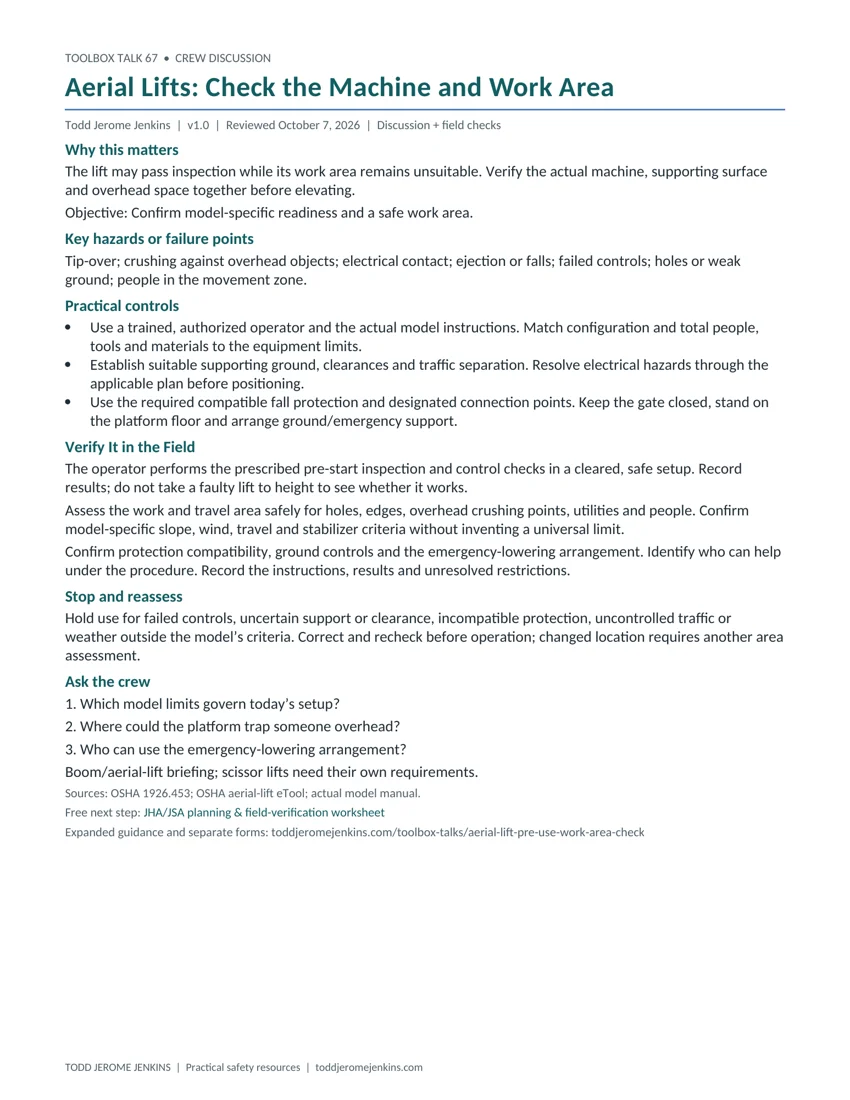
Why this matters
The lift may pass inspection while its work area remains unsuitable. Verify the actual machine, supporting surface and overhead space together before elevating.
Learning objective: Confirm model-specific readiness and a safe work area.
Key hazards or failure points
Tip-over; crushing against overhead objects; electrical contact; ejection or falls; failed controls; holes or weak ground; people in the movement zone.
Practical controls
- Use a trained, authorized operator and the actual model instructions. Match configuration and total people, tools and materials to the equipment limits.
- Establish suitable supporting ground, clearances and traffic separation. Resolve electrical hazards through the applicable plan before positioning.
- Use the required compatible fall protection and designated connection points. Keep the gate closed, stand on the platform floor and arrange ground/emergency support.
Verify It in the Field
The operator performs the prescribed pre-start inspection and control checks in a cleared, safe setup. Record results; do not take a faulty lift to height to see whether it works.
Assess the work and travel area safely for holes, edges, overhead crushing points, utilities and people. Confirm model-specific slope, wind, travel and stabilizer criteria without inventing a universal limit.
Confirm protection compatibility, ground controls and the emergency-lowering arrangement. Identify who can help under the procedure. Record the instructions, results and unresolved restrictions.
Use the separate field check to record the acceptance source and criterion, safe method, checker, actual result and time. Mark VERIFIED, HOLD/NOT VERIFIED, or N/A with a reason. A checkmark alone is not evidence that protection works. Complete all required task checks; do not enter danger or improvise a test.
| Control | Safe verification | Evidence |
|---|---|---|
| Machine readiness | Operator completes the model’s safe checks. | Model, method, actual result and defects. |
| Work-area suitability | Assess support and movement/overhead paths before operation. | Limits, hazards, restrictions and corrections. |
| Emergency arrangement | Confirm ground access, designated help and procedure. | People, communication and unresolved readiness gaps. |
Stop and reassess
Hold use for failed controls, uncertain support or clearance, incompatible protection, uncontrolled traffic or weather outside the model’s criteria. Correct and recheck before operation; changed location requires another area assessment.
toolbox talk questions
- Which model limits govern today’s setup?
- Where could the platform trap someone overhead?
- Who can use the emergency-lowering arrangement?
A situation to discuss
Illustrative situation: the lift passes its machine check, but a new overhead pipe crosses the planned platform path. The operator holds elevation and revises positioning and access before the task proceeds.
Leader preparation and practical detail
Use the correct equipment category
Boom-type aerial lifts and scissor lifts must not be treated as interchangeable. This resource addresses boom/aerial-lift preparation. The actual equipment category, instructions and applicable standard determine protection and operating requirements. [1, 2]
A function check needs a safe setup
The operator follows the model procedure for controls and safety devices, with the area clear and the machine in the specified condition. Daily control testing applies to extensible and articulating boom platforms under 1926.453. A defect requires correction, not an improvised bypass or trial at height. [1]
Plan assistance before elevation
Identify the ground controls and people authorized to use them under the equipment procedure. An emergency plan must work at the location, with access and communication available. This talk supplies no universal lowering sequence, anchorage capacity or electrical approach distance. Use the actual instructions and applicable technical determination. [2]
Apply this briefing to steel and framing work
Steel connections: keep the platform clear of moving members
Coordinate the aerial lift’s position with the arriving steel member before either moves. Identify where the platform, boom, worker and tools could be trapped between the member and erected steel. Check the final connection position as well as the approach; a route can be clear until the last part of the movement.
The authorized lift operator and erection lead compare the proposed position with the actual model instructions and lift sequence. Confirm clearance from a safe location, communication with the crane team and a planned response if the member does not fit. Do not use the platform to push or support steel unless that use is specifically permitted for the equipment and authorized setup.
Record the machine, connection location, positioning restrictions and communication result with checker/time. While working from the lift, do not attach fall protection to adjacent structural steel; use the required compatible system and designated machine connection point. Hold for unexpected contact, lost clearance or pressure to climb onto rails to reach the connection.
Sources checked October 9, 2026: OSHA 1926.453(b)(2).
Aerial lifts for framers: check the panel-handling envelope
Before lifting a worker and framing materials, the authorized operator should review the intended fastening position and the space needed to handle each piece. Include tools, occupants and any permitted material carrier in the configuration review. 1926.453(b)(2)(vi) requires compliance with the manufacturer’s boom and basket load limits; available weight capacity alone does not approve carrying large panels or adding an attachment.
At ground level, compare the proposed arrangement with the actual model instructions, including permitted accessories, material dimensions, wind limits and work-position restrictions. If the instructions do not establish suitability, hold that arrangement for the manufacturer’s direction or select another method. Plan movement so the platform and worker cannot be trapped against a header, truss or projecting member. Do not attach fall protection to adjacent framing while working from the lift.
Record: model, attachment/material configuration, instruction reference, operator, findings and time. Stop for changed panel size, restricted visibility, an unapproved carrier or inadequate working clearance.
Record the acceptance source, safe check method, assigned verifier, actual result and time. Hold affected work for an unresolved required control; correct, recheck and rebrief before authorized restart.
Apply this briefing to masonry and glazing work
Glazing from a boom lift: coordinate the two movements
When a boom lift positions installers beside separately hoisted glass, the platform and the panel need a coordinated approach. Before elevation, the authorized lift operator and glazing lead should identify who directs each movement, how either team calls a stop and where the platform can remain clear while glass enters the opening.
Compare the intended positions with the actual lift instructions and installation sequence. Keep the personnel lift’s load separate from the glass-hoisting arrangement; OSHA’s aerial-lift guidance says not to use the lift as a crane. Check that racks, glass or vehicles will not block ground controls or the planned emergency response. 1926.453(b)(2) addresses authorized operation, platform position and lower controls. Review emergency actions using the model procedure, without an exposed demonstration.
Record: lift/model, facade bay, movement and emergency references, operator/receiving roles, actual clearance and communication findings, and time. Hold movement for competing instructions, blocked assistance or a panel position that traps the platform.
Record the acceptance source, safe check method, assigned verifier, actual result and time. Hold affected work for an unresolved required control; correct, recheck and rebrief before authorized restart.
Apply this briefing to glazing and roofing work
Boom lifts at roof edges: check the eave and parapet position
Roof-edge work can trap a worker between the platform and an eave, gutter or parapet. Before elevation, the authorized operator and roofing lead review the full approach and working position, including projecting tools and materials.
Use the actual model instructions to verify reach, platform load and permitted material arrangement. Plan the task so the worker remains on the basket floor; do not add a ladder or climb the rails to reach coping or flashing. While working from the lift, use its required compatible protection and designated attachment point, not a roof anchorage. A basket reaching roof level does not itself establish an approved transfer method onto the roof.
Check clearances and ground assistance from safe positions before movement. Keep tear-off debris, deliveries and roofing materials away from the planned emergency access. Record the model, roof-edge location, instruction reference, operator, clearance findings and time. Hold for an unreachable fastening point, trapping risk, blocked assistance or an unreviewed material configuration; change the method before continuing.
Source checked October 9, 2026: OSHA 1926.453(b)(2). Scope: work from a boom-supported platform.
Record the acceptance source, safe check method, assigned verifier, actual result and time. Hold affected work for an unresolved required control; correct, recheck and rebrief before authorized restart.
Apply this briefing to roofing and siding work
Exterior siding from a boom lift: reassess before turning the corner
Moving to the next building face changes more than the view. The lift may move from pavement to backfill, pass a drain cover or approach a service cable hidden by the corner. Before repositioning, the authorized operator and siding lead review the new travel route, supporting surface and full boom/platform movement.
Verify the next setup: Use the actual model instructions and site ground information to resolve slopes, covers, voids, underground work and other support concerns. Inspect from safe access; do not drive onto an uncertain cover to test it. Check projections, eaves and electrical exposures throughout the approach, and establish the applicable electrical controls before movement. A safe distance from the previous wall does not establish clearance at the new face.
Confirm that the selected material arrangement remains permitted and that the worker can fasten siding while standing on the basket floor. Long pieces must not obscure controls or force an unapproved reach. Keep the machine's designated protection connection and the planned ground assistance available. Do not use the platform to pull a partly fastened panel into alignment.
Record: model, new elevation/location, ground and operating references, operator, observed support/clearance findings, emergency-access check and time. Hold travel or elevation for uncertain ground, an obstructed view, unreviewed material handling or changed wind conditions. Resolve the setup or use another suitable method before resuming.
Sources checked October 9, 2026: OSHA 1926.453(b)(2) and OSHA aerial-lift eTool. Scope: boom-supported platform work.
Record the acceptance source, safe check method, assigned verifier, actual result and time. Hold affected work for an unresolved required control; correct, recheck and rebrief before authorized restart.
Short supervisor field check
- Operator and model-specific instructions confirmed.
- Inspection and control checks acceptable.
- Ground, utilities and clearances assessed.
- Capacity and compatible fall protection verified.
- Ground support and emergency lowering ready.
Record unresolved items, restrictions, correction owner, recheck result and required restart authorization. Reference permits and specialist inspections rather than treating this form as a replacement. Rebrief workers affected by a change.
Attendance and follow-through
Use the separate attendance sheet for participants, discussion concerns, actions and late-arrival rebriefs. Attendance does not establish competence, verify controls or authorize work. Keep completed records private under the employer’s recordkeeping procedures.
Technical scope and references
Construction boom/aerial-lift preparation. Scissor lifts require a separate applicability review. No equipment model was supplied; all model-specific criteria and emergency operations must come from the actual instructions and required trained personnel. [1, 2]
References reviewed October 7, 2026. Apply the industry, activity and jurisdiction that govern the work. No actual site permit, equipment manual, exposure assessment or engineering determination was supplied for this general discussion.
- OSHA 1926.453 — Aerial lifts — Construction aerial-lift requirements, controls and operation.
- OSHA eTool — Aerial lifts — Guidance on training, inspection, work areas and operating hazards.
Connect this discussion to your JHA/JSA
Use How to Conduct a Job Safety Analysis to connect task steps, hazards and controls. Revisit Pre-Job JHA/JSA: What Changed Today? when conditions change.
Work through the related Aerial Lift JHA, then adapt its assumptions to the actual work.
Related toolbox talks
- Fall Prevention: Verify the Controls
- Mobile Equipment: Separate People from Movement
- Competent Person: Know Who Can Correct the Hazard
- Electrical & Extension-Cord Checks
Put one check into practice
Use the free JHA/JSA planning and field-verification worksheet to record today’s changes, important controls and the evidence needed before exposure.
Apply this to a specific situation
Scissor Lifts: Overhead Crushing Hazards adds a focused toolbox exercise and field-verification guidance.