

 Free toolbox talk · TBT-144
Download the free toolbox talk
The one-page talk, editable Word version, and guidance below are open to everyone. No account required.
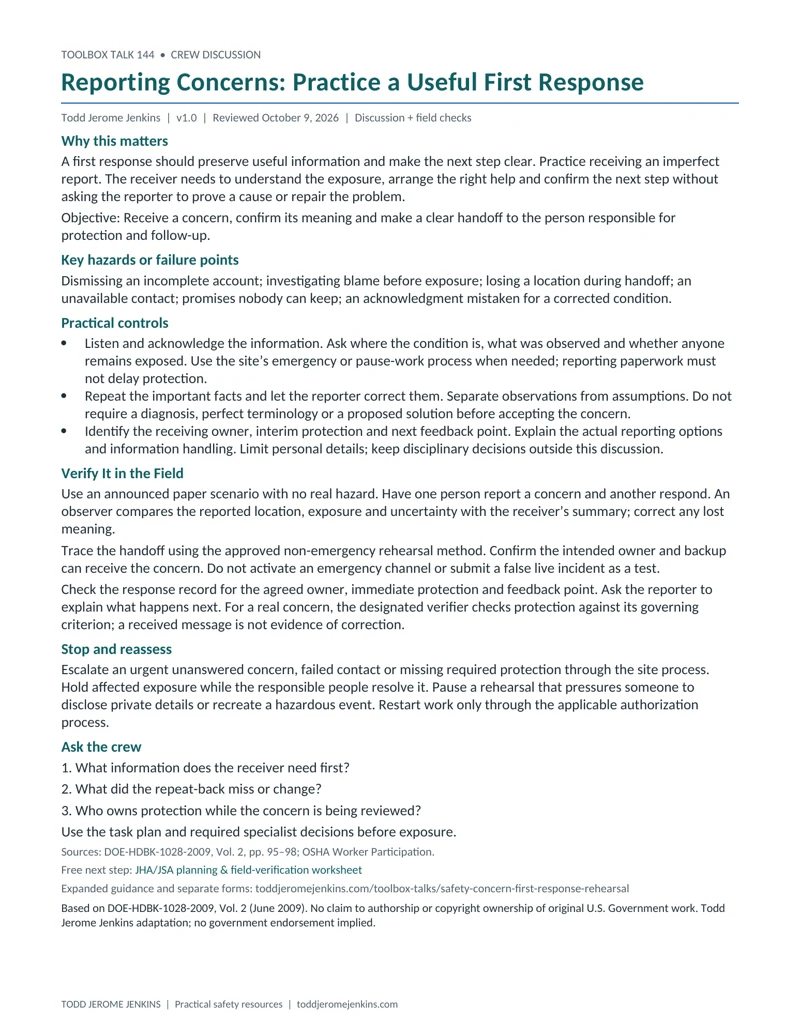
Toolbox Talk - Responding to Safety Concerns
Download toolbox talk - responding to safety concerns (PDF, 1 page)Editable toolbox talk - responding to safety concerns (Word)Preview the one-page toolbox talk
Supporting documents
Supervisor field checks and attendance records are included with a free account. No payment is required.
Supervisor Field Check - Responding to Safety Concerns
A separate check to verify conditions and controls before work. Includes a one-page PDF and editable Word file.
Attendance Sheet - Responding to Safety Concerns
A separate sign-in sheet to record the toolbox talk. Includes a one-page PDF and editable Word file.
Need the crew records? Create a free account to use these supporting documents and Jenkins Academy of Applied Technology. No payment is required. Email updates are optional.
Create Free AccountAlready have an account? Sign in
HOP skills practice • Batch 4, topic 20 of 52. A 5–10 minute toolbox talk plus time for actual field verification. One-page PDF and editable Word talk; separate supervisor and attendance forms.
What is this skill?
Responding to a safety concern means receiving the information, understanding possible exposure and connecting the issue to protection and follow-up.
Why use it?
A useful concern may arrive with missing details. The first response can preserve that information or make people less willing to raise the next concern.
When should we use it?
Whenever someone reports a changed condition, error, near miss, work difficulty or uncertainty about protection.
Where does it apply?
In person, by phone or through the organization's approved reporting routes. Use the emergency process when the situation requires it.
Learning objective
Receive an incomplete concern, repeat its important facts and establish who owns protection and follow-up.
Key hazards or failure points
Demanding proof; assigning blame first; losing location; failed handoff; promises beyond authority; receipt mistaken for correction.
How to use it — practical controls
- Acknowledge the concern. Clarify location, observation and possible exposure. Use the required emergency or pause process without waiting for paperwork.
- Repeat important facts and uncertainty so the reporter can correct them. Do not demand a diagnosis or solution before receiving the concern.
- Confirm the responsible owner, interim protection, backup contact and feedback point. Explain actual information handling without making unsupported promises.
Verify It in the Field
- Use a fictional report: something changed near room B, source unknown. Ask a partner to respond without sending the reporter closer for proof.
- An observer checks that location, exposure and uncertainty survive the repeat-back. Confirm the owner and next update in the rehearsal.
- For a real concern, verify protection and correction through the designated safe method and criterion. A received report is not proof of a safe condition.
For real work, record the control, governing source and criterion, safe method, authorized checker, actual result and time. Mark VERIFIED, HOLD/NOT VERIFIED, or N/A with a reason. A practiced skill or matching label does not demonstrate that a physical safeguard functions. Do not create exposure to complete a check.
Stop and reassess
Escalate urgent unanswered concerns, failed contacts or missing required protection. Maintain the affected hold until the established restart process is complete. Never stage a false live emergency for practice.
Toolbox talk questions
- What does the receiver need to know first?
- What uncertainty must stay visible in the handoff?
- Who owns protection and the next update?
Examples across different work settings
These are original teaching examples, not operating instructions. Use paper, photographs or inert training items for practice. Change the setting to fit your team while retaining the skill steps and the applicable task requirements.
Building services
A cleaner notices a new odor but cannot identify its source. The receiver establishes location and potential exposure, follows the appropriate site response and obtains qualified help. The cleaner is not asked to investigate closer to prove the report.
Distribution center
A worker reports a near miss but is uncertain about one part of the sequence. The leader preserves that uncertainty, addresses current exposure and routes the report for review. The first conversation does not decide blame or require a complete causal account.
Remote project support
A coordinator receives a message that two work instructions conflict. The coordinator confirms which revisions are involved, who may rely on them and who will resolve the conflict. A named person owns the hold and update rather than leaving the message in a general inbox.
Practice the receiver's response
Give the reporter a fictional card with one detail deliberately unknown. The receiver should preserve that gap while clarifying what is needed for protection and handoff. Do not use surprise tests, activate emergency channels or submit a false incident report. For actual reports, use accessible routes and communicate the real limits of confidentiality. Do not promise anonymity, immunity or immediate repair that the organization cannot deliver. This conversation supports learning and response; it is not a disciplinary hearing or a substitute for required reporting.
Leader follow-through — improve the conditions
Study whether people can reach a responsible receiver and get useful feedback. Address inaccessible forms, language barriers, unclear ownership and responses that discourage reporting. Keep participants informed when resolution is delayed and confirm that necessary interim protection remains effective.
Short supervisor field check
- Receiver acknowledges an incomplete report without demanding a diagnosis.
- Location, possible exposure and uncertainty are confirmed.
- Urgent protection and emergency routes are understood.
- Owner, backup, handoff receipt and feedback point are established.
- Verified correction and authorized release remain separate from reporting.
Use the separate supervisor sheet to retain evidence, open items, correction owner, recheck result and required restart authority. Keep task-specific permits, inspections and technical decisions in their established process.
Attendance and follow-through
Use the separate attendance sheet for participants, roles, questions, actions and rebriefs. Attendance does not establish competence, verify a control or authorize work. Keep completed records private under employer procedures.
Source acknowledgment
Based on DOE-HDBK-1028-2009, Vol. 2 (June 2009). No claim to authorship or copyright ownership of original U.S. Government work. Todd Jerome Jenkins adaptation; no government endorsement implied. Explanations, examples, practice exercises and layouts are original adaptations. Third-party material credited in the handbook retains its original attribution; this notice does not claim rights in that material.
Source file inspected: Volume 2/VOLUME 2 REPORTING ERRORS AND NEAR MISSES.pdf; printed pages 95–98. Culpability tests, disciplinary prescriptions and the embedded page 99 decision tree were inspected but are excluded. No promise of anonymity, immunity or a universal response deadline is made.
Technical scope and references
References reviewed October 13, 2026. DOE human-performance tools and OSHA recommended practices support preparation and discussion; they do not establish universal technical acceptance criteria. Apply the current task procedure, manufacturer instructions, permit and required competent or qualified decisions. A successful exercise does not replace required training, technical verification or work authorization.
- DOE-HDBK-1028-2009, Volume 2 — Reporting Errors and Near Misses — June 2009 historical guidance, printed pages 95–98: usable feedback routes, reporting barriers, ownership and feedback. Culpability tests, disciplinary prescriptions and the printed page 99 diagram are excluded.
- OSHA — Worker Participation — Recommended practices, action items 2 and 5: accessible reporting, response, feedback and removing barriers. No universal response deadline, confidentiality guarantee or work-refusal rule is asserted.
The DOE handbook is June 2009 illustrative guidance, not a current requirements document. Availability of the official edition and the linked supporting guidance was checked October 13, 2026. Apply current task-specific requirements, manufacturer instructions, permits and required competent or qualified decisions; this talk supplies no universal technical acceptance criteria.
Connect this discussion to your JHA/JSA
Use the JHA/JSA planning and field-verification worksheet to record the actual task steps, hazards, responsible roles and controls. Return to What Changed Today? when the plan or conditions change.
Related Todd Jerome Jenkins articles: How to Conduct a Job Safety Analysis and What Is Human and Organizational Performance?.
Related toolbox talks
Practice another HOP skill
- Toolbox Talk - Questioning Attitude
- Toolbox Talk - Work Turnover and Shift Handoff
- Toolbox Talk - Post-Job Review
- Toolbox Talk - Learning from Operating Experience
One next step
Use the free JHA/JSA planning and field-verification worksheet linked above to apply this skill to one actual task step. Record what must be checked before exposure and who will check it.