

 Free toolbox talk · TBT-66

Download the free toolbox talk
The one-page talk, editable Word version, and guidance below are open to everyone. No account required.
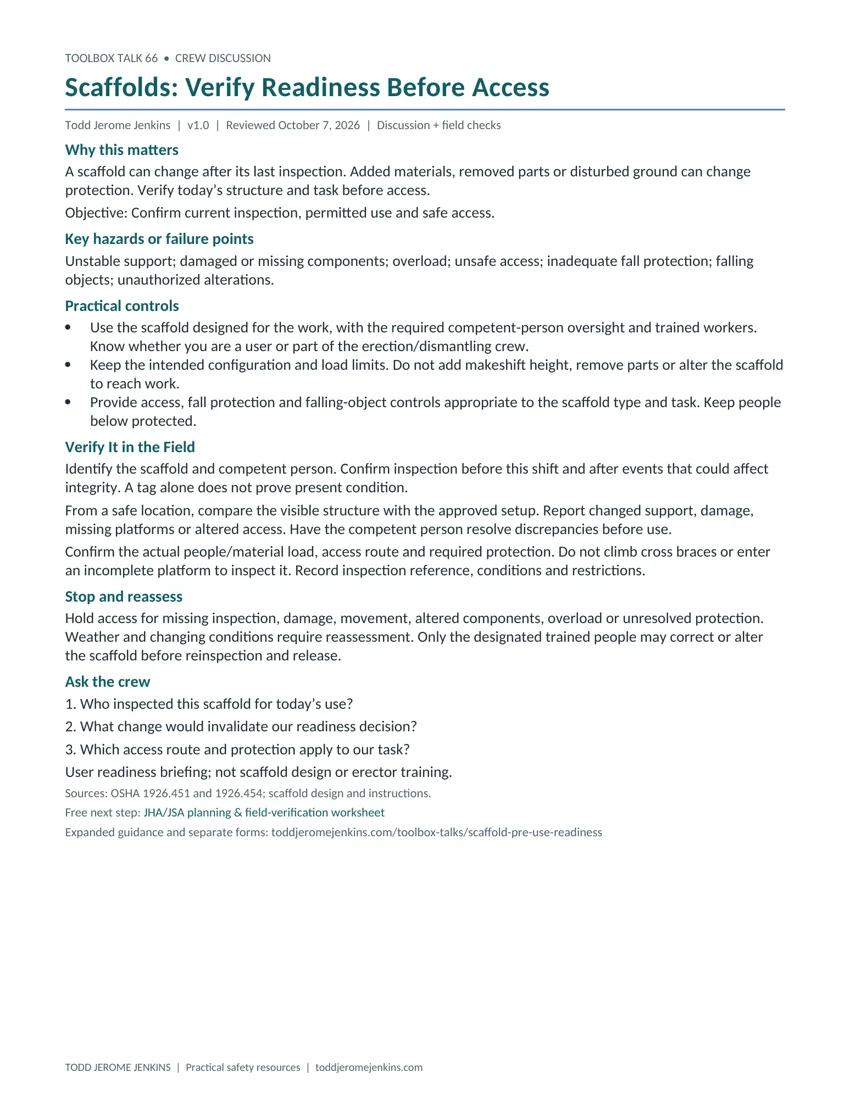
One-page toolbox talk
Download one-page toolbox talk (PDF, 1 page)Editable one-page toolbox talk (Word)Preview the one-page toolbox talk
Supporting documents
Supervisor field checks and attendance records are included with a free account. No payment is required.
Supervisor field check
A separate check to verify conditions and controls before work. Includes a one-page PDF and editable Word file.
Attendance sheet
A separate sign-in sheet to record the toolbox talk. Includes a one-page PDF and editable Word file.
Need the crew records? Create a free account to use these supporting documents and Jenkins Academy of Applied Technology. No payment is required. Email updates are optional.
Create Free AccountAlready have an account? Sign in
A 5–10 minute toolbox talk, plus the time needed for field verification. Toolbox talk downloads are public; supporting records are included with a free Safety account.
Why this matters
A scaffold can change after its last inspection. Added materials, removed parts or disturbed ground can change protection. Verify today’s structure and task before access.
Learning objective: Confirm current inspection, permitted use and safe access.
Key hazards or failure points
Unstable support; damaged or missing components; overload; unsafe access; inadequate fall protection; falling objects; unauthorized alterations.
Practical controls
- Use the scaffold designed for the work, with the required competent-person oversight and trained workers. Know whether you are a user or part of the erection/dismantling crew.
- Keep the intended configuration and load limits. Do not add makeshift height, remove parts or alter the scaffold to reach work.
- Provide access, fall protection and falling-object controls appropriate to the scaffold type and task. Keep people below protected.
Verify It in the Field
Identify the scaffold and competent person. Confirm inspection before this shift and after events that could affect integrity. A tag alone does not prove present condition.
From a safe location, compare the visible structure with the approved setup. Report changed support, damage, missing platforms or altered access. Have the competent person resolve discrepancies before use.
Confirm the actual people/material load, access route and required protection. Do not climb cross braces or enter an incomplete platform to inspect it. Record inspection reference, conditions and restrictions.
Use the separate field check to record the acceptance source and criterion, safe method, checker, actual result and time. Mark VERIFIED, HOLD/NOT VERIFIED, or N/A with a reason. A checkmark alone is not evidence that protection works. Complete all required task checks; do not enter danger or improvise a test.
| Control | Safe verification | Evidence |
|---|---|---|
| Current inspection | Match the competent-person inspection to the scaffold and shift. | Inspector, time, scope and restrictions. |
| Unchanged configuration | Observe safely and report discrepancies. | Changed component or support and disposition. |
| Permitted use | Compare load, access and protection with the approved arrangement. | Design/instruction reference and resolved task limits. |
Stop and reassess
Hold access for missing inspection, damage, movement, altered components, overload or unresolved protection. Weather and changing conditions require reassessment. Only the designated trained people may correct or alter the scaffold before reinspection and release.
toolbox talk questions
- Who inspected this scaffold for today’s use?
- What change would invalidate our readiness decision?
- Which access route and protection apply to our task?
A situation to discuss
Illustrative situation: a green tag remains in place, but material delivery has damaged an access component. The crew holds access and contacts the competent person. The tag is not accepted as evidence that the changed structure is ready.
Leader preparation and practical detail
Distinguish users from erectors
Scaffold use, erection, alteration and dismantling involve different tasks and training. The competent-person determination for supported-scaffold erector/dismantler fall protection is not a general exemption for users. Match the worker’s role and scaffold type to the applicable requirements. [1, 2]
Inspect the actual structure
OSHA requires competent-person inspection before each work shift and after occurrences that could affect structural integrity. A status tag can help communicate a decision, but it does not replace that inspection or resolve a subsequent change. Users should report discrepancies from a safe position. [1]
Control material changes
Ask where materials will be placed and how they affect the design and rated load. Delivery pressures must not turn a work platform into unplanned storage. The competent person and required design authority resolve configuration and load questions; the crew does not test capacity by adding weight. [1]
Apply this briefing to steel and framing work
Framing from scaffolds: review the next sheathing delivery
Before sheathing sheets or lumber are delivered to a scaffold, tell the competent person where the materials will land, how much will be present and how workers will handle them. A platform suitable for fastening may not match the proposed staging arrangement. Under 1926.451(a)(6) and (f)(1), construction and loading must follow the qualified-person design and the applicable load limits.
From a safe position, the competent person should compare the proposed delivery and work position with that design, access and protection. Refer unresolved load or configuration changes to the qualified designer. Include sheet handling near the open work face and the effect of wind; do not remove a rail, tie or platform component to make a panel fit. A contact from a delivery requires reassessment and any required inspection.
Record: scaffold/bay, planned material quantity and placement, design reference, verifier, findings and time. Hold delivery or access for an unresolved loading change, damaged component or unprotected handling position.
Record the acceptance source, safe check method, assigned verifier, actual result and time. Hold affected work for an unresolved required control; correct, recheck and rebrief before authorized restart.
Apply this briefing to framing and masonry work
Masonry scaffolds: reassess as the wall rises
As masonry rises, yesterday’s platform height can leave today’s worker reaching awkwardly or looking for something to stand on. Before the next lift of wall, the masonry foreman should tell the scaffold competent person the proposed working height, access route and position of mortar boards and units. Do not improvise extra height with stacked blocks or similar makeshift platforms.
Under 1926.451, alterations require the prescribed competent-person supervision and trained workers. Before use, the competent person should inspect the revised configuration against its design, platform arrangement, access, loading and fall-protection requirements. Check the actual work-face relationship from a protected position. The special provision for overhand bricklaying on a supported scaffold does not remove protection requirements at its other open sides and ends or authorize unrelated work without appropriate protection.
Record: scaffold/bay, working level and intended task, design reference, competent person, inspection findings and time. Hold access if height changes invite makeshift standing surfaces or the revised configuration has not been inspected.
Record the acceptance source, safe check method, assigned verifier, actual result and time. Hold affected work for an unresolved required control; correct, recheck and rebrief before authorized restart.
Apply this briefing to masonry and glazing work
Masonry scaffolds: follow the falling material to the level below
Look beyond the mortar board. Loose units, broken block, hand tools and mortar can leave a working platform through different paths. Before stocking the next bay, the masonry lead and scaffold competent person review what could fall and where people could be below.
From protected positions, compare the actual stock height, platform edges and containment openings with the selected falling-object controls. A toeboard hidden behind a taller pile does not establish adequate protection. Have the competent person resolve screening, containment or other required measures under the scaffold arrangement. A canopy or catch platform needs capacity appropriate to the potential impact; do not test it by dropping a block.
Record the bay, materials, protection method, access restriction and checker/time. Plan controlled debris removal before accumulation defeats protection. Hold stocking or work if loose material can bypass the chosen control, someone enters the restricted area below, or delivery changes the arrangement. A masonry wall's limited-access zone does not automatically protect every scaffold exposure.
Sources checked October 9, 2026: OSHA 1926.451(h) and 1926.706(a).
Glazing beside scaffolds: check the panel’s approach
A scaffold inspection does not clear the path of a glass panel being hoisted beside it. Before pickup, the glazing lead, lift team and scaffold competent person should compare the panel’s travel and rotation with the actual scaffold, ties, access and occupied platforms. Identify any point where glass or lifting equipment could contact the scaffold or trap a worker against it.
1926.451(f)(9) requires tag lines or equivalent load-control measures where swinging loads hoisted onto or near scaffolds might contact them. Select the arrangement through the lift plan; workers must not reach into the panel’s path to compensate for poor control. From safe positions, confirm the planned guide locations and communication before movement. Keep glass off guardrails and outside unapproved support arrangements; scaffold construction and loading must follow its qualified-person design.
Record: scaffold/bay, panel route and control method, design/lift references, responsible people, observed clearance and communication results, and time. Hold for unresolved contact risk, changed rotation or impact that requires competent-person reassessment.
Record the acceptance source, safe check method, assigned verifier, actual result and time. Hold affected work for an unresolved required control; correct, recheck and rebrief before authorized restart.
Apply this briefing to glazing and roofing work
Roofing scaffolds: verify the scaffold-to-roof transfer
A scaffold beside the eave does not automatically provide a safe roof access point. Before using it for transfer, the roofing lead and scaffold competent person identify the intended crossing, roof landing and protection on both sides.
From protected positions, compare the actual gap and level difference with the approved access arrangement and 1926.451(e). Direct access has specific horizontal and vertical limits; if the arrangement does not meet them, provide another compliant access method. Check that the transfer does not require climbing a guardrail or crossbrace. Any scaffold alteration needs the prescribed competent-person direction and trained workers, followed by the required inspection.
Review where roof rolls, tools and waste will pass. Confirm that they do not block access, exceed the scaffold's permitted loading or prompt removal of protection. Record the scaffold/bay, transfer arrangement, design reference, competent person, observed findings and time. Hold access when the roof level, platform configuration or material route changes until both sides of the transfer are verified again.
Sources checked October 9, 2026: OSHA 1926.451(e), (f) and 1926.501.
Record the acceptance source, safe check method, assigned verifier, actual result and time. Hold affected work for an unresolved required control; correct, recheck and rebrief before authorized restart.
Apply this briefing to roofing and siding work
Siding scaffolds: review the work-face gap and the tie sequence
New insulation, recessed openings and projecting trim change the relationship between the scaffold and the wall. A platform that suits one siding course may leave a different gap or awkward reach at the next bay. Before that change, the siding lead shows the scaffold competent person the actual material, installation sequence and required working positions.
Verify from protected access: Compare the platform-to-work-face relationship with the applicable 1926.451(b)(3) provision and the scaffold design. Do not transfer an exception for another activity to siding. Check that workers can handle the material without makeshift standing surfaces or removing required protection. Review the quantity and placement of stock against the permitted loading before delivery.
Identify scaffold ties or other components that conflict with the next panel. Resolve the installation sequence with the scaffold's responsible design and erection personnel before anyone removes, relocates or covers a necessary connection. Required alterations must be directed by the competent person and performed by the selected trained, experienced workers. The siding crew should not independently remove a tie to finish a panel.
Record: scaffold/bay, upcoming course, design and instruction references, gap/protection and tie findings, competent person and time. Hold the affected area for an unresolved conflict, changed support or an uninspected alteration. After correction, verify access, configuration, loading and protection before release. Adding sheeting or screens also requires review of the resulting scaffold arrangement and wind effects.
Source checked October 9, 2026: OSHA 1926.451(b)(3), (f)(1), (3), (7), (12).
Record the acceptance source, safe check method, assigned verifier, actual result and time. Hold affected work for an unresolved required control; correct, recheck and rebrief before authorized restart.
Short supervisor field check
- Actual scaffold and competent person identified.
- Required current inspection confirmed.
- Support and components match the intended setup.
- Load, access and required protections verified.
- Changes and alteration authority understood.
Record unresolved items, restrictions, correction owner, recheck result and required restart authorization. Reference permits and specialist inspections rather than treating this form as a replacement. Rebrief workers affected by a change.
Attendance and follow-through
Use the separate attendance sheet for participants, discussion concerns, actions and late-arrival rebriefs. Attendance does not establish competence, verify controls or authorize work. Keep completed records private under the employer’s recordkeeping procedures.
Technical scope and references
Construction scaffolds under Subpart L. Supported, suspended and other types have different requirements. This talk does not establish design capacity, qualify an erector or supply a universal fall-protection configuration. [1, 2]
References reviewed October 7, 2026. Apply the industry, activity and jurisdiction that govern the work. No actual site permit, equipment manual, exposure assessment or engineering determination was supplied for this general discussion.
- OSHA 1926.451 — Scaffolds — Design, capacity, access, use, inspection and fall protection.
- OSHA 1926.454 — Training requirements — Training by scaffold role and retraining requirements.
Connect this discussion to your JHA/JSA
Use How to Conduct a Job Safety Analysis to connect task steps, hazards and controls. Revisit Pre-Job JHA/JSA: What Changed Today? when conditions change.
Work through the related Scaffold Erection and Dismantling JHA, then adapt its assumptions to the actual work.
Related toolbox talks
- Fall Prevention: Verify the Controls
- Competent Person: Know Who Can Correct the Hazard
- Barricades: What Does This Boundary Keep Out?
- Pre-Job JHA/JSA: What Changed Today?
Put one check into practice
Use the free JHA/JSA planning and field-verification worksheet to record today’s changes, important controls and the evidence needed before exposure.
Related framing and masonry tasks
Related masonry and glazing tasks
Apply this to a specific situation
Scaffold Alterations: Before a Part Is Moved adds a focused toolbox exercise and field-verification guidance.
Apply this to a specific situation
Rolling Scaffolds: Move, Lock, Recheck adds a focused toolbox exercise and field-verification guidance.