Download the talk and separate crew records
Free to download without an account. Each PDF is one page. Use the Word version to adapt the record to your task and approved procedures.
Supervisor field check
Download supervisor field check (PDF, 1 page)Editable supervisor field check (Word)Preview the one-page crew talk
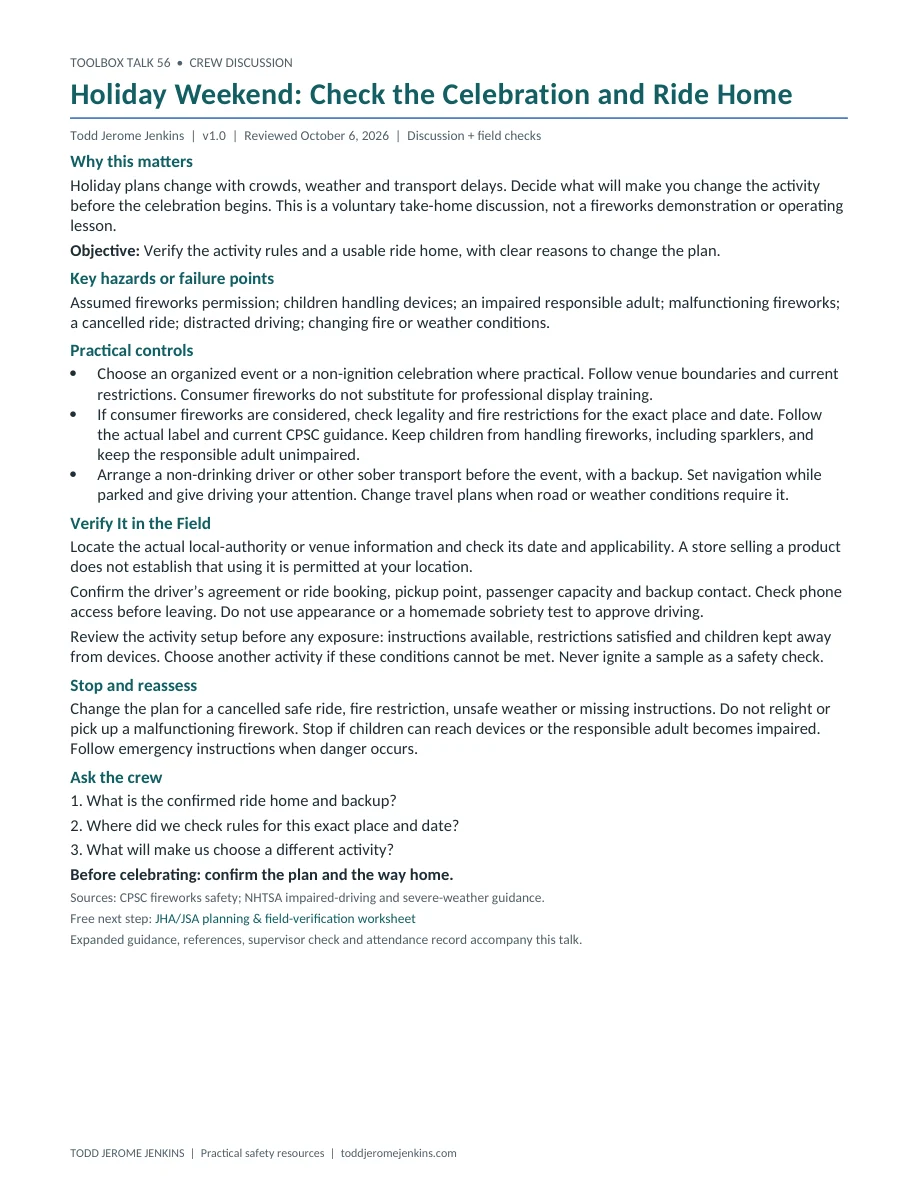
A 5–10 minute crew discussion, plus the time needed for field verification. All six downloads are free without a required signup.
Why this matters
Holiday plans change with crowds, weather and transport delays. Decide what will make you change the activity before the celebration begins. This is a voluntary take-home discussion, not a fireworks demonstration or operating lesson.
Learning objective: Verify the activity rules and a usable ride home, with clear reasons to change the plan.
Key hazards or failure points
Assumed fireworks permission; children handling devices; an impaired responsible adult; malfunctioning fireworks; a cancelled ride; distracted driving; changing fire or weather conditions.
Practical controls
- Choose an organized event or a non-ignition celebration where practical. Follow venue boundaries and current restrictions. Consumer fireworks do not substitute for professional display training.
- If consumer fireworks are considered, check legality and fire restrictions for the exact place and date. Follow the actual label and current CPSC guidance. Keep children from handling fireworks, including sparklers, and keep the responsible adult unimpaired.
- Arrange a non-drinking driver or other sober transport before the event, with a backup. Set navigation while parked and give driving your attention. Change travel plans when road or weather conditions require it.
Verify It in the Field
Locate the actual local-authority or venue information and check its date and applicability. A store selling a product does not establish that using it is permitted at your location.
Confirm the driver’s agreement or ride booking, pickup point, passenger capacity and backup contact. Check phone access before leaving. Do not use appearance or a homemade sobriety test to approve driving.
Review the activity setup before any exposure: instructions available, restrictions satisfied and children kept away from devices. Choose another activity if these conditions cannot be met. Never ignite a sample as a safety check.
Use the separate field check to record the source and criterion, safe method, checker, actual result and time. Mark VERIFIED, HOLD/NOT VERIFIED, or N/A with a reason. Check every required control; the examples below do not clear the whole task.
| Control | Safe verification | Evidence to record |
|---|---|---|
| Permitted activity | Check the actual local restrictions and venue rules. | Source, date and changed plan. |
| Confirmed ride | Verify driver/booking, pickup and available backup. | Arrangement and fallback contact. |
| Protected gathering | Responsible adult checks labels/restrictions and children’s access beforehand. | Unresolved condition means change activity; no test ignition. |
Stop and reassess
Change the plan for a cancelled safe ride, fire restriction, unsafe weather or missing instructions. Do not relight or pick up a malfunctioning firework. Stop if children can reach devices or the responsible adult becomes impaired. Follow emergency instructions when danger occurs.
Crew discussion questions
- What is the confirmed ride home and backup?
- Where did we check rules for this exact place and date?
- What will make us choose a different activity?
Before celebrating: confirm the plan and the way home.
A situation to discuss
Illustrative situation: a holiday gathering is planned where new fire restrictions prohibit the proposed activity. The organizer checks the current notice, changes to a non-ignition celebration and reconfirms the ride arrangements. Last year’s permission is not used as approval for this year.
Leader preparation and practical detail
Choose the activity before setting up
The simplest useful change may be choosing a non-ignition celebration or attending an organized event within its rules. If consumer fireworks are considered, current CPSC guidance addresses children, impairment, labels and malfunctioning devices. This resource is not a complete firing or disposal procedure and provides no invented launch distance or waiting time. [1]
Keep transport independent of optimism
Obtain an actual sober-driver agreement or ride booking and a backup that works at the expected finishing time. NHTSA advises planning sober transportation before drinking. A person saying they feel fine does not establish driving readiness. Use the separate sober-ride talk for the detailed transport check. [2]
Reassess weather and restrictions
Check official local instructions and road conditions when plans change. An organized event can also be postponed or cancelled. Follow boundaries and evacuation directions, and do not drive through flooded or closed roads to preserve a holiday schedule. [3]
Short supervisor field check
- Voluntary off-work scope and no demonstration explained.
- Current restriction source identified.
- Actual transport and backup prompted.
- Clear stop decision for misfire, impairment or children’s access.
- Current CPSC guidance available for further review.
Use the separate form to document evidence, restrictions, corrective-action owner, recheck and required restart approval. An unresolved required control means hold the affected work. Missing evidence is not a pass. Complete all task-specific inspections and permits.
Attendance and follow-through
The separate attendance sheet records participants, language support, questions, actions and late-arrival rebriefs. Attendance does not establish competence or prove controls function. Keep completed records private under the employer’s procedures.
Technical scope and references
This is an off-work seasonal planning reminder. It does not teach fireworks operation or professional display work. Applicable law, current fire restrictions, product labels and venue instructions govern. Keep personal travel details private. [1], [2], [3]
References checked October 6, 2026. Apply the jurisdiction, task, employer program and equipment instructions that govern the work. No site-specific manual, permit, engineering determination or product SDS has been approved by this general resource.
- CPSC — Fireworks Safety — Children, including sparklers; legality/consumer labeling; no impairment; water available; follow labels; never relight or pick up malfunctioning fireworks. Current page inspected; no invented dud wait time, launch distance or disposal procedure.
- Drunk Driving — Self-perceived sobriety and appearance do not establish safe driving. Plan non-drinking designated driver or sober transport before drinking. Use seat belts. Report impaired road users safely to law enforcement. No BAC, number-of-drinks, waiting-period or self-test clearance rule proposed.
- NHTSA — Driving in Severe Weather — Full page read: reduced speed/increased spacing, official road conditions, no flooded/closed roads, pedestrians, emergency communication. No safe water depth; do not use agency danger examples as thresholds.
Connect this discussion to your JHA/JSA
Use How to Conduct a Job Safety Analysis to connect today’s work steps, hazards and controls. Revisit Pre-Job JHA/JSA: What Changed Today? whenever conditions change.
Related published crew resources: Heat: Conditions Change, Controls Change; Severe Weather: Know When and Where to Shelter; Distracted Driving: Set Up Before Moving; Impaired Driving: Confirm the Sober Ride; Bad-Weather Driving: Decide Before You Go.
Put one check into practice
Download the free JHA/JSA planning and field-verification worksheet. For today’s task, record an important control, its source and the evidence needed before exposure. Complete the remaining required checks through your task plan.