Download the talk and separate crew records
Free to download without an account. Each PDF is one page. Use the Word version to adapt the record to your task and approved procedures.
Supervisor field check
Download supervisor field check (PDF, 1 page)Editable supervisor field check (Word)Preview the one-page crew talk
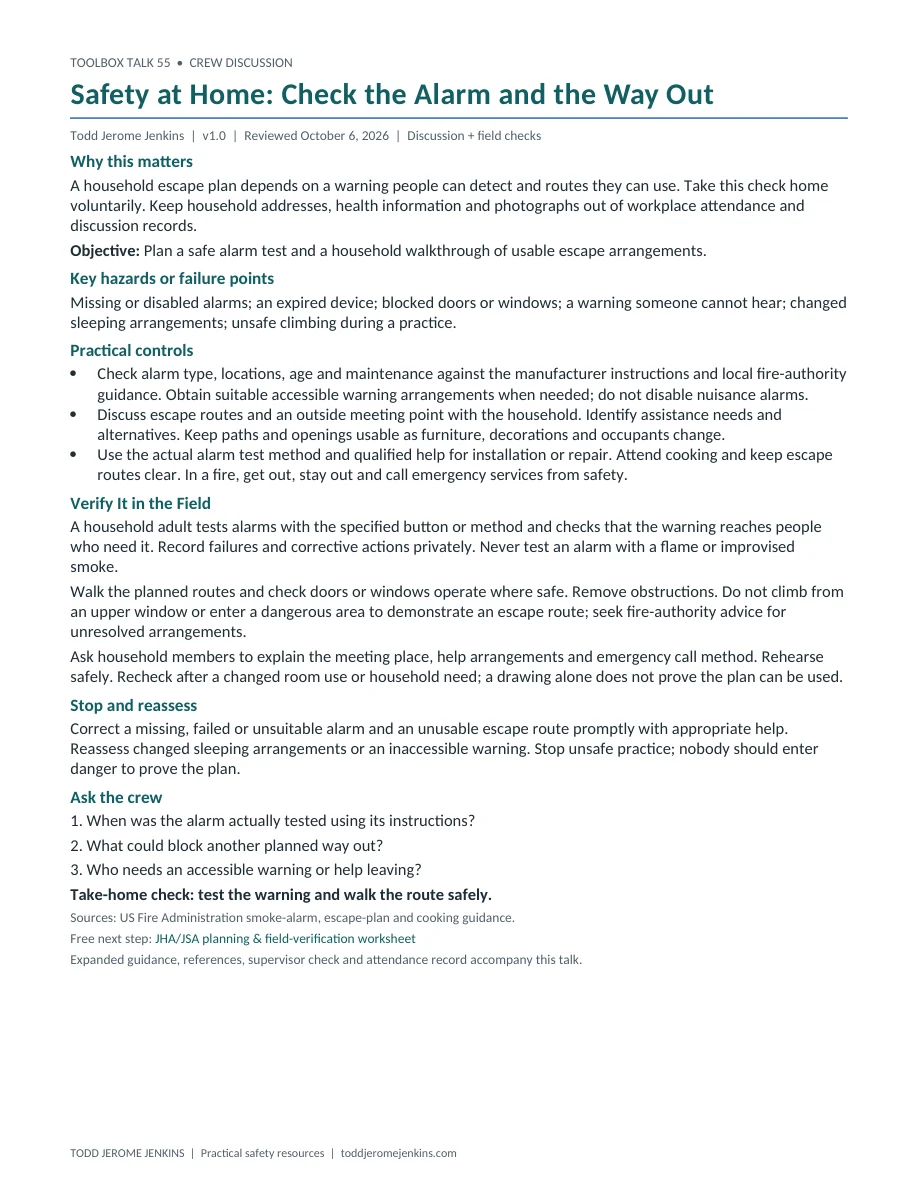
A 5–10 minute crew discussion, plus the time needed for field verification. All six downloads are free without a required signup.
Why this matters
A household escape plan depends on a warning people can detect and routes they can use. Take this check home voluntarily. Keep household addresses, health information and photographs out of workplace attendance and discussion records.
Learning objective: Plan a safe alarm test and a household walkthrough of usable escape arrangements.
Key hazards or failure points
Missing or disabled alarms; an expired device; blocked doors or windows; a warning someone cannot hear; changed sleeping arrangements; unsafe climbing during a practice.
Practical controls
- Check alarm type, locations, age and maintenance against the manufacturer instructions and local fire-authority guidance. Obtain suitable accessible warning arrangements when needed; do not disable nuisance alarms.
- Discuss escape routes and an outside meeting point with the household. Identify assistance needs and alternatives. Keep paths and openings usable as furniture, decorations and occupants change.
- Use the actual alarm test method and qualified help for installation or repair. Attend cooking and keep escape routes clear. In a fire, get out, stay out and call emergency services from safety.
Verify It in the Field
A household adult tests alarms with the specified button or method and checks that the warning reaches people who need it. Record failures and corrective actions privately. Never test an alarm with a flame or improvised smoke.
Walk the planned routes and check doors or windows operate where safe. Remove obstructions. Do not climb from an upper window or enter a dangerous area to demonstrate an escape route; seek fire-authority advice for unresolved arrangements.
Ask household members to explain the meeting place, help arrangements and emergency call method. Rehearse safely. Recheck after a changed room use or household need; a drawing alone does not prove the plan can be used.
Use the separate field check to record the source and criterion, safe method, checker, actual result and time. Mark VERIFIED, HOLD/NOT VERIFIED, or N/A with a reason. Check every required control; the examples below do not clear the whole task.
| Control | Safe verification | Evidence to record |
|---|---|---|
| Working warning | Household adult follows the actual alarm test instructions. | Private result, date and repair/replacement action. |
| Usable exit | Walk routes and check openings without unsafe climbing. | Obstruction corrected or appropriate advice requested. |
| Shared response | Household explains meeting point and help arrangements. | Privately confirmed plan and needed change. |
Stop and reassess
Correct a missing, failed or unsuitable alarm and an unusable escape route promptly with appropriate help. Reassess changed sleeping arrangements or an inaccessible warning. Stop unsafe practice; nobody should enter danger to prove the plan.
Crew discussion questions
- When was the alarm actually tested using its instructions?
- What could block another planned way out?
- Who needs an accessible warning or help leaving?
Take-home check: test the warning and walk the route safely.
A situation to discuss
Illustrative situation: a household rearranges a bedroom and blocks the window included in its escape plan. A safe walkthrough identifies the change. The household restores usable access and revisits the plan with appropriate advice rather than practicing a risky climb.
Leader preparation and practical detail
Use the correct alarm guidance
USFA recommends smoke alarms in bedrooms, outside sleeping areas and on every level, with testing at least monthly and maintenance following the actual instructions. Device and battery arrangements vary. Check local requirements and the manufacturer rather than applying a blanket battery-replacement rule to every model. [1]
Make the plan usable for the household
USFA encourages identifying ways out, keeping routes clear, choosing an outside meeting place and practicing. Adapt the plan to the building and people. A person may need an accessible alarm or assistance arrangement. Ask the local fire authority about unresolved needs and high-rise or other special conditions. [1], [2]
Keep the workplace discussion voluntary
The facilitator can explain the safe check and direct people to current fire-authority resources. Do not ask employees to submit home addresses, room photographs, family diagnoses or proof of a household drill. Use the attendance form only for the workplace discussion. The household keeps its personal plan privately.
Short supervisor field check
- Voluntary take-home scope explained.
- Manufacturer and local fire guidance identified.
- Safe test and walkthrough methods understood.
- Appropriate help route for failed alarms/access needs given.
- No private household information collected.
Use the separate form to document evidence, restrictions, corrective-action owner, recheck and required restart approval. An unresolved required control means hold the affected work. Missing evidence is not a pass. Complete all task-specific inspections and permits.
Attendance and follow-through
The separate attendance sheet records participants, language support, questions, actions and late-arrival rebriefs. Attendance does not establish competence or prove controls function. Keep completed records private under the employer’s procedures.
Technical scope and references
This is a voluntary household resource, not an employer inspection of employees’ homes. Local fire/building requirements and alarm instructions govern. Do not treat the separate leader form as household certification or collect private home information. [1], [2], [3]
References checked October 6, 2026. Apply the jurisdiction, task, employer program and equipment instructions that govern the work. No site-specific manual, permit, engineering determination or product SDS has been approved by this general resource.
- USFA — Smoke Alarms — Bedrooms, outside sleeping areas, every level; manufacturer instructions; monthly testing; battery/replacement approach varies by model; accessible alarms and local fire marshal requirements. Reviewed by agency September 28, 2026. Do not repeat archive universal every-room placement or annual battery replacement regardless of alarm type.
- USFA — Home Fire Escape Plans — Map doors/windows, identify two routes per room, clear openings, outside meeting place and practice with household; separate high-rise guidance. Do not have people climb out upper windows to verify.
- USFA — Cooking Fire Safety — Attend cooking; shut burner when leaving; keep combustibles away; pot handles back; lid nearby. Avoid turning a brief into hands-on firefighting training. Statistics excluded.
Connect this discussion to your JHA/JSA
Use How to Conduct a Job Safety Analysis to connect today’s work steps, hazards and controls. Revisit Pre-Job JHA/JSA: What Changed Today? whenever conditions change.
Related published crew resources: Housekeeping Is a Control; Emergency Evacuation: Know the Route and Count the Crew; Fire Extinguishers: Know When to Evacuate; Chemical Exposure: Verify the Help Before Use.
Put one check into practice
Download the free JHA/JSA planning and field-verification worksheet. For today’s task, record an important control, its source and the evidence needed before exposure. Complete the remaining required checks through your task plan.