Download the talk and separate crew records
Free to download without an account. Each PDF is one page. Use the Word version to adapt the record to your task and approved procedures.
Supervisor field check
Download supervisor field check (PDF, 1 page)Editable supervisor field check (Word)Preview the one-page crew talk
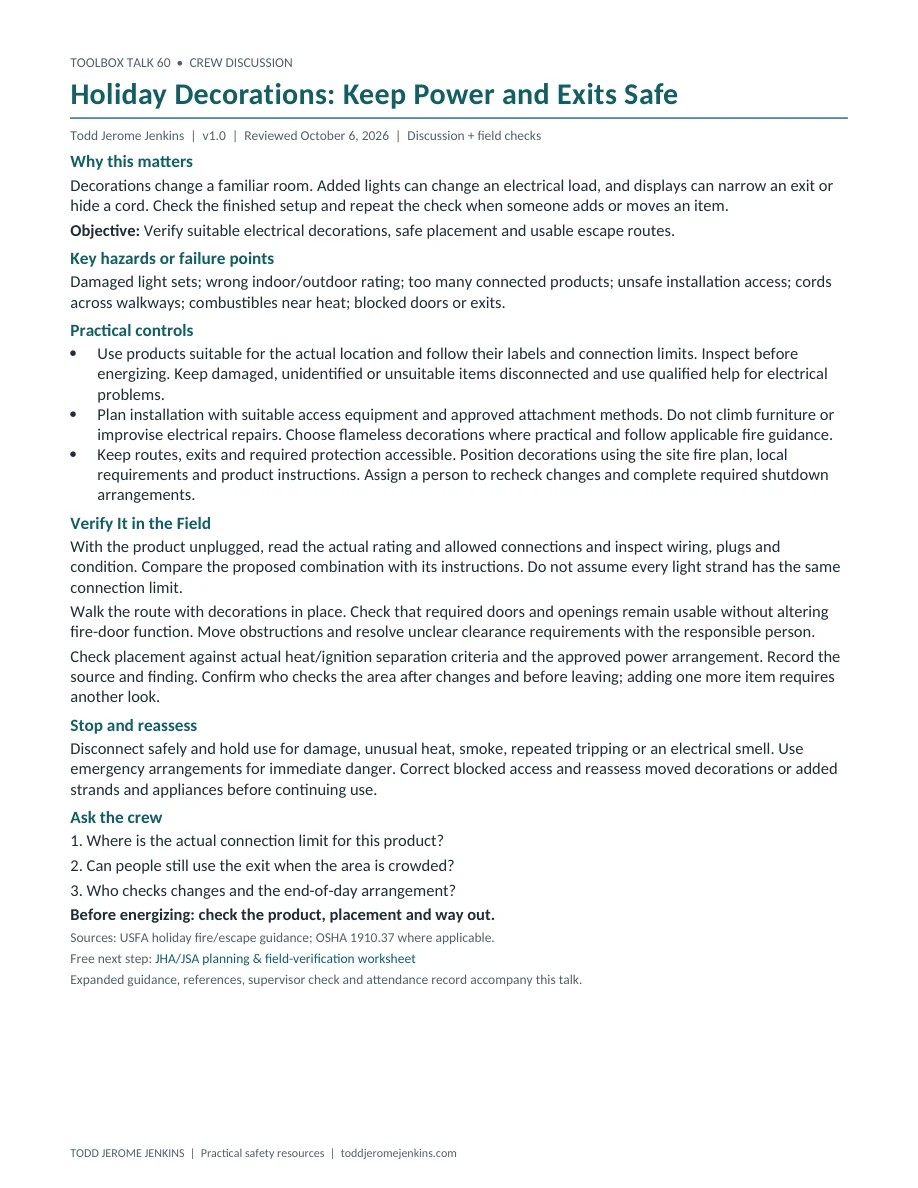
A 5–10 minute crew discussion, plus the time needed for field verification. All six downloads are free without a required signup.
Why this matters
Decorations change a familiar room. Added lights can change an electrical load, and displays can narrow an exit or hide a cord. Check the finished setup and repeat the check when someone adds or moves an item.
Learning objective: Verify suitable electrical decorations, safe placement and usable escape routes.
Key hazards or failure points
Damaged light sets; wrong indoor/outdoor rating; too many connected products; unsafe installation access; cords across walkways; combustibles near heat; blocked doors or exits.
Practical controls
- Use products suitable for the actual location and follow their labels and connection limits. Inspect before energizing. Keep damaged, unidentified or unsuitable items disconnected and use qualified help for electrical problems.
- Plan installation with suitable access equipment and approved attachment methods. Do not climb furniture or improvise electrical repairs. Choose flameless decorations where practical and follow applicable fire guidance.
- Keep routes, exits and required protection accessible. Position decorations using the site fire plan, local requirements and product instructions. Assign a person to recheck changes and complete required shutdown arrangements.
Verify It in the Field
With the product unplugged, read the actual rating and allowed connections and inspect wiring, plugs and condition. Compare the proposed combination with its instructions. Do not assume every light strand has the same connection limit.
Walk the route with decorations in place. Check that required doors and openings remain usable without altering fire-door function. Move obstructions and resolve unclear clearance requirements with the responsible person.
Check placement against actual heat/ignition separation criteria and the approved power arrangement. Record the source and finding. Confirm who checks the area after changes and before leaving; adding one more item requires another look.
Use the separate field check to record the source and criterion, safe method, checker, actual result and time. Mark VERIFIED, HOLD/NOT VERIFIED, or N/A with a reason. Check every required control; the examples below do not clear the whole task.
| Control | Safe verification | Evidence to record |
|---|---|---|
| Suitable lights | Read label/instructions and inspect while unplugged. | Product, permitted use/connections and condition. |
| Usable exit | Walk the finished route and check required openings safely. | Obstruction corrected and governing criterion. |
| Controlled changes | Check placement, power arrangement and shutdown owner. | Actual result, source and next recheck trigger. |
Stop and reassess
Disconnect safely and hold use for damage, unusual heat, smoke, repeated tripping or an electrical smell. Use emergency arrangements for immediate danger. Correct blocked access and reassess moved decorations or added strands and appliances before continuing use.
Crew discussion questions
- Where is the actual connection limit for this product?
- Can people still use the exit when the area is crowded?
- Who checks changes and the end-of-day arrangement?
Before energizing: check the product, placement and way out.
A situation to discuss
Illustrative situation: a display is moved after installation and covers part of an exit route. The assigned checker catches the change and restores the required access. The electrical setup is also rechecked because the move changed the cord arrangement.
Leader preparation and practical detail
Use the actual product limit
USFA advises inspecting decorative light sets and following the manufacturer’s limit for connected strands. Products and locations differ, so this resource supplies no universal strand count or electrical load allowance. A missing or unreadable label is a reason to resolve suitability before use, not to copy the limit from another product. [1]
Preserve the way out
Walk the completed arrangement rather than reviewing only a sketch. People should be able to use required exits and openings with the decorations installed. In workplaces, the applicable exit-route requirements and site fire arrangements govern. Do not secure a display by compromising a fire door or blocking access to protection. [2], [3]
Connect seasonal reminders to ordinary controls
The same ladder, cord and housekeeping checks still apply while decorating. Plan safe access and the power arrangement before installation, then recheck when the display changes. Todd’s holiday safety story is a related reminder; technical acceptance comes from the relevant requirements and product instructions, not the story.
Short supervisor field check
- Allowed products, locations and responsible authority identified.
- Unplugged inspection and label limits checked.
- Safe installation access selected.
- Exits, paths and ignition separation verified.
- Shutdown owner and change triggers agreed.
Use the separate form to document evidence, restrictions, corrective-action owner, recheck and required restart approval. An unresolved required control means hold the affected work. Missing evidence is not a pass. Complete all task-specific inspections and permits.
Attendance and follow-through
The separate attendance sheet records participants, language support, questions, actions and late-arrival rebriefs. Attendance does not establish competence or prove controls function. Keep completed records private under the employer’s procedures.
Technical scope and references
Use this for workplace common areas or as a take-home reminder, applying the correct setting’s requirements. USFA’s cited seasonal material is home-fire guidance; workplace exit rules and the site fire plan also govern work locations. This talk authorizes no electrical repair or energized inspection. [1], [2], [3]
References checked October 6, 2026. Apply the jurisdiction, task, employer program and equipment instructions that govern the work. No site-specific manual, permit, engineering determination or product SDS has been approved by this general resource.
- USFA — Holiday Fire Safety — Substantive guidance read: inspect light strands, discard frayed/pinched wiring, manufacturer limit for connected strands; flameless candles alternative; tree watering/heat separation and clear exit. Technical numeric separations are source-backed but optional to omit in general crew brief.
- USFA — Home Fire Escape Plans — Map doors/windows, identify two routes per room, clear openings, outside meeting place and practice with household; separate high-rise guidance. Do not have people climb out upper windows to verify.
- OSHA 29 CFR 1910.37 — Exit route maintenance — General industry. Technical inspection and local building/fire code requirements also need appropriate authority.
Connect this discussion to your JHA/JSA
Use How to Conduct a Job Safety Analysis to connect today’s work steps, hazards and controls. Revisit Pre-Job JHA/JSA: What Changed Today? whenever conditions change.
Related Todd Jerome Jenkins video: ’Twas a Few Days Before Christmas — A Safety Story.
Related published crew resources: Ladder Safety: Choose, Inspect, Set Up; Electrical & Extension-Cord Checks; Housekeeping Is a Control; Emergency Evacuation: Know the Route and Count the Crew; Fire Prevention: Separate Fuel from Ignition; Safety at Home: Check the Alarm and the Way Out.
Put one check into practice
Download the free JHA/JSA planning and field-verification worksheet. For today’s task, record an important control, its source and the evidence needed before exposure. Complete the remaining required checks through your task plan.