

 Free toolbox talk · TBT-03

Download the free toolbox talk
The one-page talk, editable Word version, and guidance below are open to everyone. No account required.
One-page toolbox talk
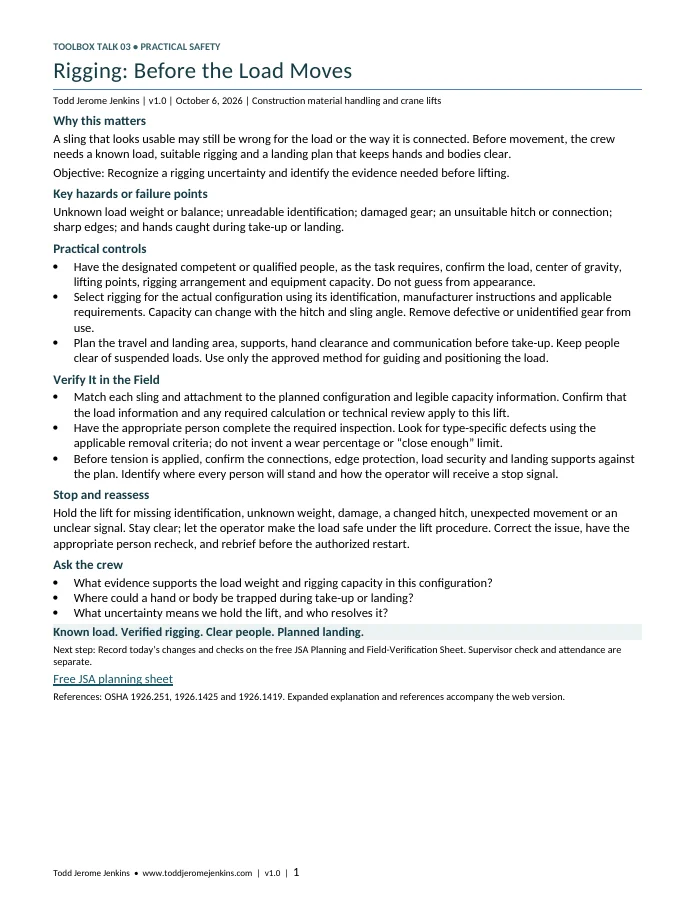
Download one-page toolbox talk (PDF, 1 page)Editable one-page toolbox talk (Word)Preview the one-page toolbox talk
Supporting documents
Supervisor field checks and attendance records are included with a free account. No payment is required.
Supervisor field check
A separate check to verify conditions and controls before work. Includes a one-page PDF and editable Word file.
Attendance sheet
A separate sign-in sheet to record the toolbox talk. Includes a one-page PDF and editable Word file.
Need the crew records? Create a free account to use these supporting documents and Jenkins Academy of Applied Technology. No payment is required. Email updates are optional.
Create Free AccountAlready have an account? Sign in
One-page toolbox talk, with separate supervisor and attendance sheets. Plan a 5–10 minute discussion and allow the time needed for field verification. Toolbox talk downloads are public; supporting records are included with a free Safety account.
Learning objective
Recognize a rigging uncertainty and identify the evidence needed before lifting.
Start with today’s work
Illustrative scenario: A replacement sling arrives with an unreadable tag. Someone recognizes the color and says it is the same capacity as the old one. Keep that sling out of use. Identification, configuration and the applicable capacity information must be established through the required process; color or familiarity is not a capacity determination.
Key hazards or failure points
Unknown load weight or balance; unreadable identification; damaged gear; an unsuitable hitch or connection; sharp edges; and hands caught during take-up or landing.
Practical controls
- Have the designated competent or qualified people, as the task requires, confirm the load, center of gravity, lifting points, rigging arrangement and equipment capacity. Do not guess from appearance.
- Select rigging for the actual configuration using its identification, manufacturer instructions and applicable requirements. Capacity can change with the hitch and sling angle. Remove defective or unidentified gear from use.
- Plan the travel and landing area, supports, hand clearance and communication before take-up. Keep people clear of suspended loads. Use only the approved method for guiding and positioning the load.
Verify It in the Field
- Match each sling and attachment to the planned configuration and legible capacity information. Confirm that the load information and any required calculation or technical review apply to this lift.
- Have the appropriate person complete the required inspection. Look for type-specific defects using the applicable removal criteria; do not invent a wear percentage or “close enough” limit.
- Before tension is applied, confirm the connections, edge protection, load security and landing supports against the plan. Identify where every person will stand and how the operator will receive a stop signal.
For each required control, identify the acceptance source and safe check method, assign a person with the required competence and authority, and record the actual result and time. Use VERIFIED, HOLD/NOT VERIFIED, or N/A with a reason. A checkmark alone does not demonstrate that protection works.
| Control | Safe verification | Criterion, evidence and response |
|---|---|---|
| Capacity and configuration | Compare load information and the planned arrangement with legible sling/attachment identification and applicable capacity data. | 1926.251, manufacturer data and lift plan. Record gear IDs and configuration; unknown capacity means HOLD. |
| Condition | Required inspector checks the actual gear using criteria for that rigging type. | 1926.251 and manufacturer instructions. Record defects and disposition; do not repair or derate gear by guesswork. |
| Landing and release | Review the support arrangement and clear hand positions before movement. | Lift plan and supporting technical requirements. Record the landing location and unresolved issues; hold if the planned release is unsafe. |
These are examples, not a complete task inspection. Check all required controls. Do not enter danger, defeat a safeguard or improvise a test. If the criterion, method or result is uncertain, hold affected work and get the appropriate technical help. No actual equipment model, product SDS or site permit was supplied for these examples; use the documents for your task.
Leader preparation and explanation
Separate condition from suitability
An inspection answers whether gear meets its condition criteria. Selection also asks whether that gear is suitable for this load, hitch, angle, environment and connection. Both checks matter. A good inspection sticker cannot establish that an undersized sling is adequate for a different configuration.
Use the right people and criteria
OSHA 1926.251 contains general and rigging-type-specific requirements. Competent-person inspections and qualified-rigger requirements have distinct scopes; 1926.1425 includes qualified-rigger provisions for the covered fall-zone work. This page does not declare every person who handles rigging qualified. Establish the roles the actual operation requires.
Make the landing part of the plan
Decide how the load will be supported and how rigging will be released without trapping hands or destabilizing the load. Any trial movement or balance check belongs in the approved lift process under the responsible people. This talk is not permission for an improvised test lift or proof load.
Stop and reassess
Hold the lift for missing identification, unknown weight, damage, a changed hitch, unexpected movement or an unclear signal. Stay clear; let the operator make the load safe under the lift procedure. Correct the issue, have the appropriate person recheck, and rebrief before the authorized restart.
When conditions change, return to Pre-Job JHA/JSA: What Changed Today? and revise the affected task plan with the crew.
Three toolbox talk questions
- What evidence supports the load weight and rigging capacity in this configuration?
- Where could a hand or body be trapped during take-up or landing?
- What uncertainty means we hold the lift, and who resolves it?
Before a crane lift: verify the setup and the people
Additional leader preparation, reviewed October 7, 2026. Use the separate field-check sheet and task records to document applicable checks. The one-page printable briefing remains the focused October 6 edition.
A sound sling does not establish that the crane can make the lift from today's position. Before take-up, the lift team needs a shared answer about support, configuration, inspection status and assigned roles. This is an added planning check for construction crane work within Subpart CC; it is not a crane inspection procedure.
- Match the setup to the capacity decision. The operator and responsible lift personnel confirm the applicable load chart and manufacturer procedures for the actual boom, radius, counterweight and outrigger or stabilizer arrangement. Include the required weight allowances. Do not assume yesterday's configuration applies, or that fully extended outriggers are the only permitted arrangement for every crane. Use only a configuration allowed by the governing equipment information.
- Establish the support basis. The responsible parties confirm that ground preparation and any supporting materials meet the equipment's support and level requirements. Review known underground voids, tanks and utilities through the controlling entity. Mats being present does not prove adequate support. Record the setup location and the technical basis or reference used; a crew member's visual impression cannot establish ground-bearing capacity.
- Confirm inspection status and unresolved defects. Identify who has the required role for each applicable inspection and how findings were resolved. A dated annual report does not replace the shift inspection or checks after a move, assembly, repair or modification. Ask about new settlement, water accumulation or changed equipment condition before movement.
- Confirm people for this lift. Where qualified riggers or signal persons are required, the employer verifies the person's qualifications for the assigned work. Identify the signal method and who gives routine directions. Everyone must know how to call a stop. A job title or general course card alone does not establish every required task-specific qualification.
Evidence to record: crane/setup identifier; load and configuration reference; support determination; required inspection status and restrictions; assigned rigger/signal roles; checker and time. Hold an affected lift for an unresolved mismatch, unsupported ground assumption or unclear communication. Recheck after relocation, rain-related ground changes or a changed load.
Coordinate these checks with line-of-fire separation. Never place someone under a suspended load to demonstrate rigging or communication.
Additional sources checked October 7, 2026: 1926.1402, ground conditions; 1926.1412, inspections and role-specific requirements; 1926.1417, operation and capacity; 1926.1425, fall-zone work; 1926.1428, signal-person qualifications. Apply each provision's scope.
Concrete work: apply this briefing to today’s task
Forms and rebar bundles: plan how the rigging comes free
For a form assembly or rebar bundle, confirm the actual lifting arrangement before take-up. A convenient tie, band or opening is not evidence that it is an intended lifting point. Match the load and connection information to the rigging selected by the responsible lift personnel.
Before landing, establish how the material will remain stable and how the rigging will be released with hands and bodies clear. Identify the support arrangement and the next storage or installation step. Do not let an urgent pour schedule turn the landing into a place for improvised hand positioning.
Concrete work can expose gear to sharp edges, residue and chemicals. Have the required inspector assess the actual sling type against its condition and environmental limitations. Do not conceal damage with cleanup or assume a different sling material is interchangeable.
Evidence to record: Load/lifting-point information, sling identification and applicable configuration. Specified landing support and release method; safe positions; inspection findings and suitability for actual environment.
Record the governing plan or instruction, verifier and time. An unresolved criterion or failed check means HOLD until corrected and rechecked by the responsible person.
Stop and reassess: Unknown lifting point, unsecured contents or changed assembly. Missing landing support, trapped rigging or hands needed in a pinch space. Gear identification, condition or chemical compatibility unresolved.
Choose a question for today’s crew
- What shows these are the intended lifting connections?
- How will the load stay stable when the slings are released?
- What condition or exposure could make this sling unsuitable today?
251 contains type-specific rules and inspection requirements;1425 qualified-rigger conditions apply to the specified fall-zone activities. No manual for a particular form, insert, sling or bundle was inspected. Obtain actual equipment/product information before naming acceptance limits.
Construction references: OSHA 1926.251, OSHA 1926.1425.
Use the separate supervisor record to capture the acceptance source, safe check method, assigned verifier, actual result and time. Hold affected work for an unresolved required control. Recheck and rebrief before authorized restart.
Structural steel: apply the briefing
Structural steel: match the next member to the lift
Before pickup, the lift team compares the member mark and orientation with the erection sequence. Establish the actual load and lifting arrangement, including attachments and required weight allowances. Long or unevenly loaded members need a planned balance and landing arrangement; do not choose pickup points by appearance.
For steel erection, confirm the competent-person crane inspection and the qualified rigger’s pre-shift rigging inspection under 1926.753. Resolve reported defects before the affected equipment is used. Match the actual sling, attachment, edge protection and configuration to the applicable instructions and capacity information. Record crane and gear identification, load basis, inspection reference and unresolved restrictions.
Connect the receiving decision to the erection lead: where will the member land, what support or initial connection must be verified, and who authorizes release? A crane inspection does not authorize the receiving structure to carry the load. Use Connecting Steel: Verify Before Releasing the Load for that handoff.
Tag lines: verify the handler’s route as well as the line
OSHA 1926.1417(w) requires a tag or restraint line when needed to prevent hazardous load rotation. That does not make a line a substitute for a controlled lift. The responsible lift personnel select the method for the load and conditions; use the actual equipment and line instructions rather than a universal length or strength from this talk.
Before movement, confirm the attachment, line condition, handler’s position and unobstructed route from safe access. Identify snagging, entanglement, pinch and fall exposures. Do not wrap the line around a person or enter beneath a suspended load to regain control. Agree how the handler will call a stop without chasing the load. Keep electrical hazards subject to the separate crane power-line controls; a rope does not establish electrical protection.
Stop and reassess: Unexpected rotation, a snag, lost communication, an unsafe handler route, changed wind conditions or a mismatch between the member and lift information. The operator makes the operation safe under the lift procedure. Recheck the changed arrangement before the authorized restart.
Choose a crew question: What identifies this member and its lifting arrangement? What evidence supports the receiving release? Where can the line handler remain clear throughout movement?
Record: Member and route, governing lift references, inspection findings, load-control method, actual check result, verifier and time. This preparation does not authorize multiple-lift rigging or replace its specific equipment and training requirements.
Sources checked October 9, 2026: OSHA 1926.753; OSHA 1926.251; OSHA 1926.1417. Apply the provisions for the actual operation.
Record the actual criterion, safe verification method, assigned verifier, result and time. Hold affected work for an unresolved required control; correct, recheck and rebrief before authorized restart.
Apply this briefing to framing and masonry work
Lintel handling: verify the opening before the lift
A rigging check does not establish that the receiving masonry is ready. Before moving a lintel, the masonry foreman should match its identification and weight to the intended opening and current installation detail. Confirm that the responsible technical person has established bearing, receiving-wall condition, temporary support and release requirements. Resolve missing criteria before lifting.
The assigned rigging inspector should check the gear and permitted handling arrangement against 1926.251, load information and the component instructions. For precast components, also apply the relevant support and lifting provisions of 1926.704. From protected positions, verify that both bearing locations and required temporary supports match the installation detail. Do not treat a scaffold as a landing or support structure unless its design covers that use.
Record: opening and lintel mark, drawing/instruction revision, technical authorization, rigging and receiving-condition findings, responsible people and time. Hold release of the lifting support until the specified bearing, restraint and temporary-support checks pass. Unrigging does not authorize early shore removal.
Record the acceptance source, safe check method, assigned verifier, actual result and time. Hold affected work for an unresolved required control; correct, recheck and rebrief before authorized restart.
Apply this briefing to masonry and glazing work
Glass rigging: verify what the attachment actually lifts
Loose glass, an insulating unit and a factory-glazed frame are different loads. Before pickup, the glazing lead and responsible rigger should identify the complete assembly and the approved lifting attachment. A device suitable for the exposed pane does not establish that the glass-to-frame connection can carry the rest of the assembly.
Match the load information, orientation and attachment points to the component instructions and lifting arrangement. Complete the applicable inspection and identification checks under 1926.251; where crane fall-zone work falls within 1926.1425, apply its qualified-rigger and worker-location requirements. For a vacuum device, use the actual model’s surface, attachment, indicator and safe test criteria. Neither a hand cup nor a trial lift establishes missing approval.
Before lifting, confirm the independent receiving support and who verifies it before release. Record: assembly/device identifiers, lifting and installation references, inspection and receiving findings, responsible people and time. Hold for an uncertain load path, changed surface or orientation, missing attachment criteria or unverified receiving support.
Record the acceptance source, safe check method, assigned verifier, actual result and time. Hold affected work for an unresolved required control; correct, recheck and rebrief before authorized restart.
Apply this briefing to glazing and roofing work
Roofing hoists: verify the load and the receiving method
Before roof delivery begins, identify the equipment actually doing the lifting. A crane, material hoist and conveyor require different operating arrangements. The roofing lead and equipment operator should agree on the packaged load, permitted handling method and protected receiving position before a bundle leaves the ground.
For material hoists, 1926.552 requires compliance with the manufacturer’s specifications and limitations; do not treat the carriage as worker access. For sling-supported loads, apply 1926.251 and the actual rigging instructions. Match packaging condition, load weight and the approved attachment or containment arrangement. Shipping wrap and pallet bands are not evidence of lifting capacity. Verify the roof’s receiving location and permitted loading through the responsible technical source, separately from the lifting-equipment check.
Review how the receiver can unload without leaning into an unprotected opening or releasing an unstable package. Record: equipment/load identifiers, instruction and roof-loading references, operator/receiver, actual setup findings and time. Hold delivery for damaged packaging, uncertain load retention or a receiving method that no longer fits.
Record the acceptance source, safe check method, assigned verifier, actual result and time. Hold affected work for an unresolved required control; correct, recheck and rebrief before authorized restart.
Short supervisor field check
- Load weight, balance, lifting points and configuration have a documented basis.
- Rigging identification and rated capacity match the actual hitch and arrangement.
- Required inspections are complete; defective or unidentified gear is removed.
- Connections, edge protection and landing supports match the reviewed lift plan.
- Roles, safe positions, signals and the response to unexpected movement are understood.
Use the separate supervisor sheet to record the task and change, JHA/JSA revision, acceptance source, safe method, verifier, actual result, unresolved items, corrective action, recheck and required restart authorization. Link specialist inspection records rather than copying private or unnecessary details.
Attendance and follow-through
Use the separate attendance sheet for participant names, roles and acknowledgment, meeting details, concerns, actions and rebriefs. Attendance is not proof of competence, functioning controls or permission to work. Keep completed records under the employer’s privacy and recordkeeping procedures; never post completed sign-in sheets publicly.
Related JHA/JSA resource and existing video
How to Conduct a Job Safety Analysis connects the task steps, hazards and controls. For related background, see What Is the Hierarchy of Controls?.
Related toolbox talks
One next step
Use the free JSA Planning and Field-Verification Sheet to record today’s changes and checks with the crew.
Sources and references
Sources reviewed October 6, 2026. Apply each regulation’s industry and activity scope, and current state or local requirements where applicable. Guidance is identified separately. This discussion resource supports preparation; it does not replace task procedures, required training, permits or specialist decisions.
- OSHA 29 CFR 1926.251 — General rigging inspection/identification and type-specific capacity and condition requirements.
- OSHA 29 CFR 1926.1425 — Fall-zone work restrictions and qualified-rigger provisions where applicable.
- OSHA 29 CFR 1926.1419 — Signals and safe stopping after communication is interrupted.
Continue with a task-specific briefing
Related masonry and glazing tasks
Apply this to a specific situation
Tensioned Lines: Clear the Release Path adds a focused toolbox exercise and field-verification guidance.