

 Free toolbox talk · TBT-11
Download the free toolbox talk
The one-page talk, editable Word version, and guidance below are open to everyone. No account required.
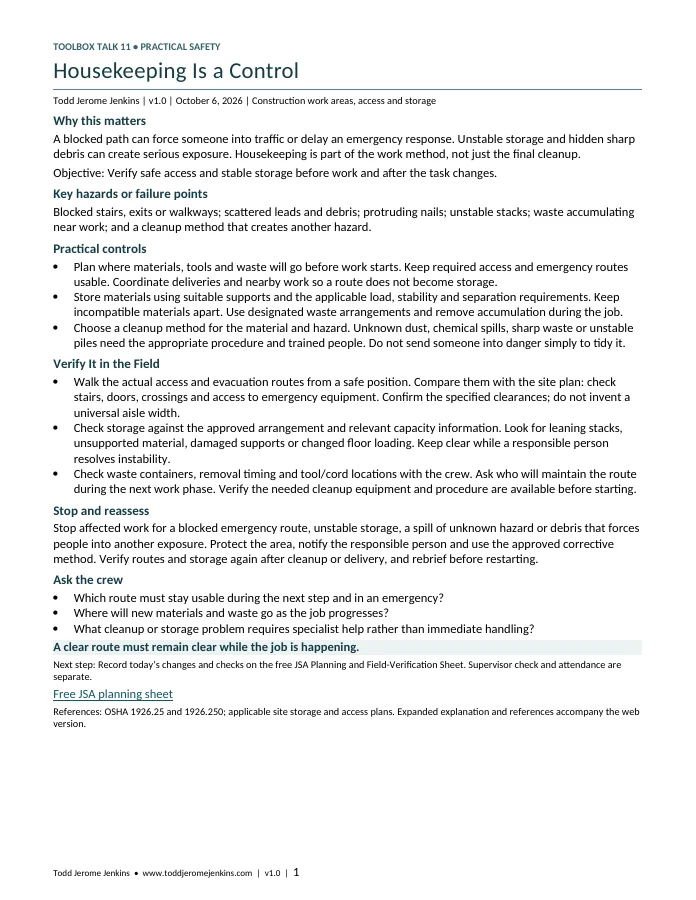
One-page toolbox talk
Download one-page toolbox talk (PDF, 1 page)Editable one-page toolbox talk (Word)Preview the one-page toolbox talk
Supporting documents
Supervisor field checks and attendance records are included with a free account. No payment is required.
Supervisor field check
A separate check to verify conditions and controls before work. Includes a one-page PDF and editable Word file.
Attendance sheet
A separate sign-in sheet to record the toolbox talk. Includes a one-page PDF and editable Word file.
Need the crew records? Create a free account to use these supporting documents and Jenkins Academy of Applied Technology. No payment is required. Email updates are optional.
Create Free AccountAlready have an account? Sign in
One-page toolbox talk, with separate supervisor and attendance sheets. Plan a 5–10 minute discussion and allow the time needed for field verification. Toolbox talk downloads are public; supporting records are included with a free Safety account.
Learning objective
Verify safe access and stable storage before work and after the task changes.
Start with today’s work
Illustrative scenario: A pallet arrives in the only planned pedestrian path. People begin walking beside moving equipment to get around it. The problem is not just untidy storage: the delivery has defeated the separation plan. Hold affected movement or work through the site process, restore the route or establish an approved alternative, and confirm everyone knows the arrangement.
Key hazards or failure points
Blocked stairs, exits or walkways; scattered leads and debris; protruding nails; unstable stacks; waste accumulating near work; and a cleanup method that creates another hazard.
Practical controls
- Plan where materials, tools and waste will go before work starts. Keep required access and emergency routes usable. Coordinate deliveries and nearby work so a route does not become storage.
- Store materials using suitable supports and the applicable load, stability and separation requirements. Keep incompatible materials apart. Use designated waste arrangements and remove accumulation during the job.
- Choose a cleanup method for the material and hazard. Unknown dust, chemical spills, sharp waste or unstable piles need the appropriate procedure and trained people. Do not send someone into danger simply to tidy it.
Verify It in the Field
- Walk the actual access and evacuation routes from a safe position. Compare them with the site plan: check stairs, doors, crossings and access to emergency equipment. Confirm the specified clearances; do not invent a universal aisle width.
- Check storage against the approved arrangement and relevant capacity information. Look for leaning stacks, unsupported material, damaged supports or changed floor loading. Keep clear while a responsible person resolves instability.
- Check waste containers, removal timing and tool/cord locations with the crew. Ask who will maintain the route during the next work phase. Verify the needed cleanup equipment and procedure are available before starting.
For each required control, identify the acceptance source and safe check method, assign a person with the required competence and authority, and record the actual result and time. Use VERIFIED, HOLD/NOT VERIFIED, or N/A with a reason. A checkmark alone does not demonstrate that protection works.
| Control | Safe verification | Criterion, evidence and response |
|---|---|---|
| Access and evacuation | Walk the actual route and check doors, stairs and crossings against the site plan without entering traffic or another hazard. | Site access/emergency plan; 1926.25 and 1926.250. Record location and obstruction; hold affected work until resolved. |
| Storage stability | Check the specified supports, arrangement and load information from a safe position. | 1926.250 and storage/engineering requirements. Record defects; do not push or disturb an unstable stack to test it. |
| Waste during the task | Confirm containers, removal responsibility and collection timing match the next phase. | 1926.25 and task/cleanup procedure. Record the owner and trigger; unknown material requires the appropriate assessment. |
These are examples, not a complete task inspection. Check all required controls. Do not enter danger, defeat a safeguard or improvise a test. If the criterion, method or result is uncertain, hold affected work and get the appropriate technical help. No actual equipment model, product SDS or site permit was supplied for these examples; use the documents for your task.
Leader preparation and explanation
Connect housekeeping to the exposure
OSHA 1926.25 addresses debris, protruding nails, combustible scrap and waste arrangements during construction. OSHA 1926.250 addresses storage, loading, stability, clear aisles and segregation. The field check should connect the condition to what it protects: access, separation, stable materials or emergency response.
Plan the next accumulation
A clean area at the start may become unsafe during cutting, unpacking or deliveries. Agree on where waste will collect, who removes it and the trigger for removal. Make the arrangement workable within the task. If the route is repeatedly blocked, change the layout or delivery process rather than relying only on repeated reminders.
Do not create exposure during cleanup
Unknown dust and spills need identification and the correct method. Do not assume dry sweeping, compressed air or bare-hand handling is appropriate. Keep people clear of unstable material and have the responsible person plan its recovery. This resource does not prescribe hazardous-material cleanup or allow untrained workers to enter a restricted area.
Include floor condition and lighting in the route check
From a safe position, look at the route under the conditions the crew will actually use it. Include broken or uneven flooring, loose coverings, obscured level changes and lighting that prevents people from seeing the route or task clearly. Record the exact location and condition, then arrange an approved repair, suitable lighting or a protected alternative route through the responsible person. Confirm the correction before reopening the affected route. Do not improvise structural or electrical repairs or invent a universal lighting level. Use the applicable task requirements and site procedure. See the building-defect discussion for reporting and follow-through.
Stop and reassess
Stop affected work for a blocked emergency route, unstable storage, a spill of unknown hazard or debris that forces people into another exposure. Protect the area, notify the responsible person and use the approved corrective method. Verify routes and storage again after cleanup or delivery, and rebrief before restarting.
When conditions change, return to Pre-Job JHA/JSA: What Changed Today? and revise the affected task plan with the crew.
Three toolbox talk questions
- Which route must stay usable during the next step and in an emergency?
- Where will new materials and waste go as the job progresses?
- What cleanup or storage problem requires specialist help rather than immediate handling?
Verify the whole route from arrival to the task
Additional leader preparation, reviewed October 7, 2026. Use the separate field-check sheet and task records to document applicable checks. The one-page printable briefing remains the focused October 6 edition.
Start the route review where people actually enter: parking or drop-off, the gate, material pickup, the work area and the planned way out. A clear work platform is not enough if the route to it sends people through equipment movement or an unprotected opening.
- Trace the route safely. With traffic controlled as needed, the leader and an affected worker compare each segment with the current site arrangement. Check gates, crossings, level changes, stairs, temporary access and the destination. Stop at a closed or uncertain section; do not climb around a barrier to finish the inspection.
- Confirm the intended access method. Scaffolds, ladders and temporary stairs have their own requirements. A brace, scaffold frame or stack of material is not automatically an access route. Have the responsible person verify the actual permitted arrangement. Use scaffold readiness or ladder selection and setup for those checks.
- Plan for the next obstruction. Ask where the next delivery, waste collection or tool setup will go. If one route is the only access between levels, keep it clear or provide the required second access. Do not let a delivery decision silently become a pedestrian-routing decision.
Record: route start and destination, exact restricted segment, approved alternative or correction, person responsible and recheck time. Rebrief people who arrive after the change. Reopen a route only after the affected controls have been checked.
Example: a delivery is scheduled across the sole stair approach. The supervisor changes the delivery staging or establishes compliant alternative access before the obstruction occurs. Workers are not left to find their own way around it. If the route cannot be maintained, hold the work that depends on it.
Additional sources checked October 7, 2026: 1926.1051(a)(3)–(4), access between levels; 1926.451(e), scaffold access. These construction requirements supplement the housekeeping and storage provisions below; they do not establish a universal walkway width.
Concrete work: apply this briefing to today’s task
Concrete cleanup: verify the destination before washout
Cleanup is part of the concrete task. Before the pour ends, agree who handles sharp scrap, slurry and equipment washout, where each goes, and how access stays usable. A worker sent to tidy up needs a safe method and a ready destination.
Keep the cleanup route safe
Remove debris during the work using the planned collection method. Keep protruding nails and other sharp waste out of work areas, stairs and passageways. Provide suitable separated waste containers and required covers. The supervisor checks the actual route with an affected worker and names who will maintain it as equipment leaves.
Check the washout arrangement
Point out the designated washout location to the crew and drivers. From a protected position, check containment for damage or leakage and confirm remaining capacity against the site requirements. Account for rain. If containment is unavailable or unsuitable, hold washout and contact the responsible site environmental lead; do not redirect it onto soil or into a drain.
Match the cleanup method to the material
Use the silica plan for concrete dust and dried residue. Where cleaning could contribute to silica exposure, dry sweeping or brushing is restricted unless lower-exposure methods are infeasible; compressed-air cleaning has separate capture or infeasibility conditions. Have the silica competent person resolve the method before work. Use the wet-concrete discussion for contact protection and washing arrangements.
Use the site criteria
EPA’s washout fact sheet is guidance, not the site permit. Have the environmental lead identify applicable permit and stormwater-plan requirements, system instructions and the authorized removal route. Do not improvise treatment or discharge.
Verify the cleanup handoff
- Clear cleanup route and suitable collection: Supervisor and affected worker. Observe route and containers without entering vehicle movement, handling sharp waste or disturbing unstable material. Criterion: OSHA 1926.25(a)-(c), task layout and waste procedure. Required paths remain usable; applicable waste-container/covers requirements met. Record: Exact location, obstruction or deficiency, correction owner and recheck time.
- Ready washout destination: Designated site environmental lead or responsible person under the site plan. From protected access, compare location, containment condition, remaining capacity and rain arrangements with documented criteria; do not enter containment or improvise a leak test. Criterion: Applicable site permit/stormwater plan and actual system instructions; EPA BMP guidance informs planning but supplies no universal permit threshold here. Record: Document/revision, container/location, applicable limit, observed condition/capacity, checker/time and removal owner.
- Appropriate residue cleanup: Silica competent person and assigned trained cleanup personnel. Identify residue and approved equipment/method before cleaning; verify prescribed equipment checks and contact-protection readiness without generating a test dust cloud. Criterion: OSHA 1926.1153(f)-(g), silica plan, actual equipment instructions and product SDS as applicable. Record: Method/equipment, source, check result, unresolved condition and authorization to resume.
Stop: Blocked access, exposed sharp waste or cleanup that sends people into equipment movement. Unknown residue, missing cleanup method, failed dust-control equipment or lost contact/washing protection. Leaking/damaged containment, capacity outside site criteria, uncertain destination or rain threatening overflow. Hold affected cleanup or washout, protect the area and notify the responsible person. Use the site spill-response process for a release. Correct the problem and record the recheck before resuming; do not expose a worker to stop a leak.
Choose a question for today’s crew
- Where will today’s concrete residue and washout go, and who confirmed that arrangement?
- What evidence shows the route, containment and cleanup equipment are ready now?
- What change makes us hold cleanup, and who arranges the correction?
Wet Concrete: Prevent Skin and Eye Contact; Silica Dust Controls.
Sources: OSHA 1926.25; OSHA 1926.1153(f)–(g); EPA Concrete Washout, February 2012, guidance still linked from EPA’s current construction BMP directory, checked October 9, 2026. Use actual site permit, stormwater-plan and system criteria.
Use the separate supervisor record to capture the acceptance source, safe check method, assigned verifier, actual result and time. Hold affected work for an unresolved required control. Recheck and rebrief before authorized restart.
Apply this briefing to framing and masonry work
Framing cleanup: separate reusable lumber from nail hazards
Give removed bracing and scrap two clear destinations: lumber prepared for reuse and material awaiting safe disposal. Do not let a temporary pile become a walkway obstruction or an unmarked collection of protruding nails.
For lumber to be stacked, OSHA requires all nails to be withdrawn. Bending them over does not meet that stacking requirement. Set up a designated removal location with supported material, suitable tools and protection selected for the task. Keep other workers out of the removal area. Inspect the board visually from safe handling positions before it joins the reusable stack; do not sweep a hand along it to find nails.
The lead checks the work area, passageways and stairs during the shift, then identifies who will remove new scrap as framing advances. Record an unresolved pile or blocked route with an owner and correction time. Stop use of the affected route or material until the hazard is controlled; do not hand-sort an unstable pile.
Sources checked October 9, 2026: OSHA 1926.250(b)(8)(i) and 1926.25, housekeeping.
Record the acceptance source, safe check method, assigned verifier, actual result and time. Hold affected work for an unresolved required control; correct, recheck and rebrief before authorized restart.
Apply this briefing to masonry and glazing work
Masonry cleanup: keep access open as units and mortar arrive
The useful housekeeping check is the next supply cycle. Before another pallet or mortar delivery, the masonry lead reviews where workers will walk, where broken units will collect and how cleanup will reach them without crossing equipment movement or disturbing wall braces.
Walk the permitted route from material pickup to the working access. Identify cables, hoses, packaging and mortar buildup that narrow it or force a worker toward an edge. Check the actual waste location and removal method. Do not create a shortcut through the masonry limited-access zone or move a scaffold component to reach debris.
For cutting residue and dust, use the silica plan's cleanup method. Dry sweeping and compressed-air cleaning have specific restrictions; a clearer-looking floor does not prove lower exposure. Have the designated competent person resolve an uncertain method before cleanup.
Record the obstructed location, correction owner and next recheck. Hold the affected route if the crew cannot use it safely. Reopen only after the correction is verified.
Sources checked October 9, 2026: OSHA 1926.25(a), 1926.706(a) and 1926.1153(f)–(g).
Record the acceptance source, safe check method, assigned verifier, actual result and time. Hold affected work for an unresolved required control; correct, recheck and rebrief before authorized restart.
Apply this briefing to roofing and siding work
Roof housekeeping: keep cleanup ahead of the next work area
On a roof, a small piece of release film or a loose fastener can change the next footstep. As roofing advances, packaging, backing paper and offcuts appear in places that were clear during the morning inspection. Assign collection to each work stage so waste does not migrate into the access route or become airborne before someone reaches it.
The roofing lead identifies collection points, suitable containers and the safe route for removing waste. Check their stability, the permitted roof loading and the actual disposal method. OSHA 1926.25 requires debris control, appropriate waste containers and safe removal arrangements. Keep incompatible or hazardous waste in the arrangement required for that material; an open general-scrap container is not suitable for every roofing product.
Verify the route from the work area to the access point while maintaining the required fall protection. Look for waste covering an opening, cords crossing a step and hoses entangled with fall-protection lines. Have the responsible worker reroute them safely; do not pull an unidentified line or disconnect protection to tidy the roof. Keep rescue access and the receiving area clear. Do not sweep debris over an edge or move a collection pile into an unprotected area. Inspect the destination below from a safe location before waste transfer begins.
Record: work area, observed waste and route conditions, container/removal method, corrective action, checker and time. Recheck when the crew moves, after unpacking deliveries and when wind redistributes light material. Hold the affected task if cleanup requires unprotected access, waste blocks safe movement, the container is unstable or people enter the disposal area. Resume after the named owner verifies the correction.
Record the acceptance source, safe check method, assigned verifier, actual result and time. Hold affected work for an unresolved required control; correct, recheck and rebrief before authorized restart.
Siding cleanup: keep scraps out of the next work position
Cut ends, loose fasteners, release liners and packaging accumulate as each siding course advances. Before starting, the lead identifies where each waste stream will collect and how it will leave without crossing an occupied walkway or requiring someone to reach outside protected access.
Verify suitable containers and the collection route before unpacking. Keep sharp pieces contained so the next handler is not exposed to protruding edges. Separate wastes that need different handling. Check product information and the applicable procedure for contaminated rags, sealant waste or unknown residue; do not treat every container as general scrap. Use the existing silica plan for fiber-cement residue rather than improvising a cleanup method.
From safe access, inspect the working position, platform access and area below. Confirm that hoses, cords and scraps do not obstruct the next step, and that cleanup will not disturb scaffold ties, barriers or fall protection. Never push waste off a platform or reach after windblown packaging. Arrange collection before moving the crew to the next bay.
Record the bay, waste types, container and removal criteria, actual findings, responsible person and recheck time. Hold the affected work for protruding waste, blocked access, unknown residue or a removal route that exposes others. Correct the arrangement, verify it again and tell the incoming crew who owns the next collection.
Sources reviewed: OSHA 1926.25: construction housekeeping and waste arrangements. Apply the actual task and jurisdiction; site and product documents establish the applicable detailed criteria.
Related discussion: Long Siding Materials: Control Support and Wind. Return to What Changed Today? when the arrangement changes.
Short supervisor field check
- Actual work, access and emergency routes match the required site arrangements.
- Materials and supports meet the applicable stability, loading and separation criteria.
- Tools, cords, debris and sharp waste do not create unresolved access exposures.
- Waste containers, collection timing and assigned ownership support the next work phase.
- Cleanup method matches the hazard; restricted or specialist cleanup is assigned appropriately.
Use the separate supervisor sheet to record the task and change, JHA/JSA revision, acceptance source, safe method, verifier, actual result, unresolved items, corrective action, recheck and required restart authorization. Link specialist inspection records rather than copying private or unnecessary details.
Attendance and follow-through
Use the separate attendance sheet for participant names, roles and acknowledgment, meeting details, concerns, actions and rebriefs. Attendance is not proof of competence, functioning controls or permission to work. Keep completed records under the employer’s privacy and recordkeeping procedures; never post completed sign-in sheets publicly.
Related JHA/JSA resource and existing video
How to Conduct a Job Safety Analysis connects the task steps, hazards and controls. For related background, see What Is the Hierarchy of Controls?.
Related toolbox talks
One next step
Use the free JSA Planning and Field-Verification Sheet to record today’s changes and checks with the crew.
Sources and references
Sources reviewed October 6, 2026. Apply each regulation’s industry and activity scope, and current state or local requirements where applicable. Guidance is identified separately. This discussion resource supports preparation; it does not replace task procedures, required training, permits or specialist decisions.
- OSHA 29 CFR 1926.25 — Construction debris, combustible waste removal and waste containers.
- OSHA 29 CFR 1926.250 — Storage stability, loading, clear aisles, separation and housekeeping of storage areas.
Apply this to a specific situation
Slips and Trips: Temporary Walkways adds a focused toolbox exercise and field-verification guidance.
Apply this to a specific situation
Temporary Stairs: Verify Every Landing adds a focused toolbox exercise and field-verification guidance.