

 Free toolbox talk · TBT-26
Download the free toolbox talk
The one-page talk, editable Word version, and guidance below are open to everyone. No account required.
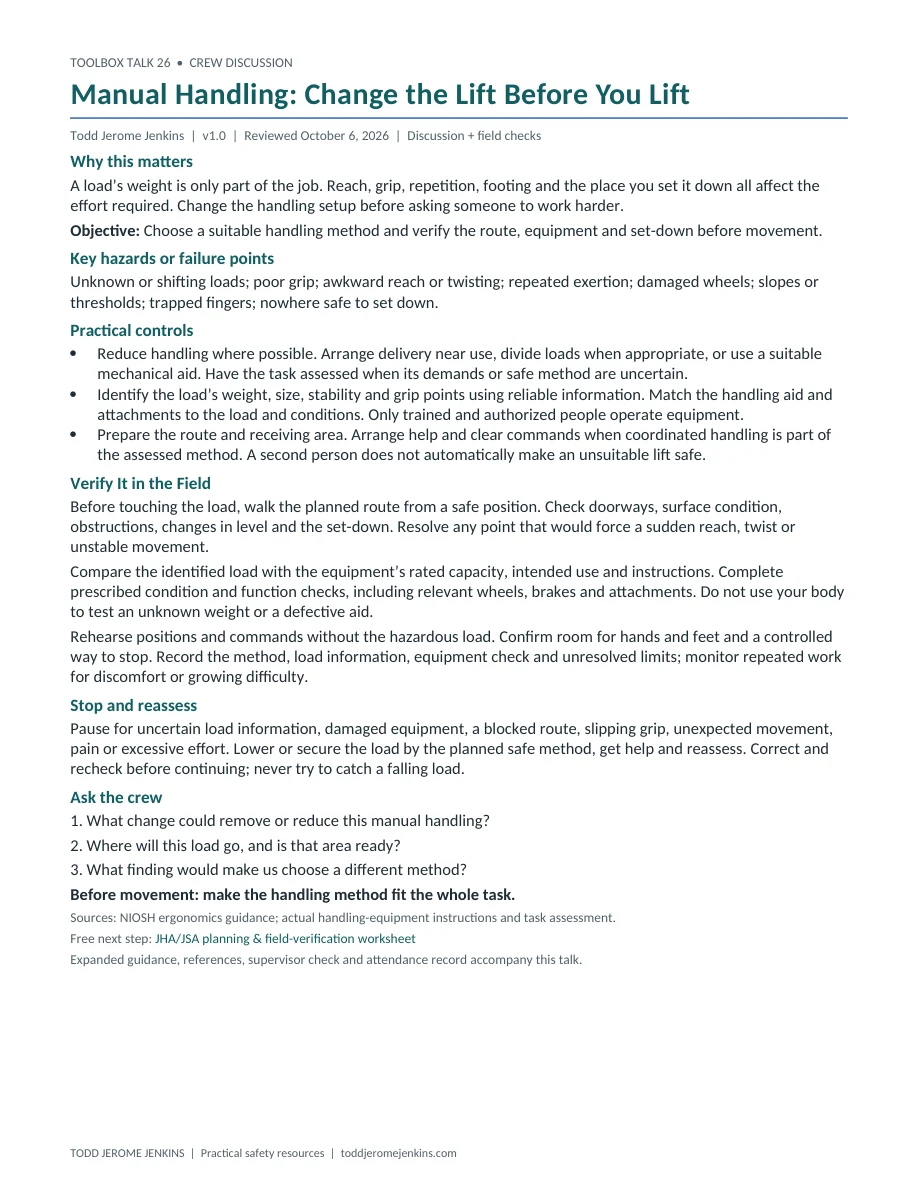
One-page toolbox talk
Download one-page toolbox talk (PDF, 1 page)Editable one-page toolbox talk (Word)Preview the one-page toolbox talk
Supporting documents
Supervisor field checks and attendance records are included with a free account. No payment is required.
Supervisor field check
A separate check to verify conditions and controls before work. Includes a one-page PDF and editable Word file.
Attendance sheet
A separate sign-in sheet to record the toolbox talk. Includes a one-page PDF and editable Word file.
Need the crew records? Create a free account to use these supporting documents and Jenkins Academy of Applied Technology. No payment is required. Email updates are optional.
Create Free AccountAlready have an account? Sign in
A 5–10 minute toolbox talk, plus the time needed for field verification. Toolbox talk downloads are public; supporting records are included with a free Safety account.
Why this matters
A load’s weight is only part of the job. Reach, grip, repetition, footing and the place you set it down all affect the effort required. Change the handling setup before asking someone to work harder.
Learning objective: Choose a suitable handling method and verify the route, equipment and set-down before movement.
Key hazards or failure points
Unknown or shifting loads; poor grip; awkward reach or twisting; repeated exertion; damaged wheels; slopes or thresholds; trapped fingers; nowhere safe to set down.
Practical controls
- Reduce handling where possible. Arrange delivery near use, divide loads when appropriate, or use a suitable mechanical aid. Have the task assessed when its demands or safe method are uncertain.
- Identify the load’s weight, size, stability and grip points using reliable information. Match the handling aid and attachments to the load and conditions. Only trained and authorized people operate equipment.
- Prepare the route and receiving area. Arrange help and clear commands when coordinated handling is part of the assessed method. A second person does not automatically make an unsuitable lift safe.
Verify It in the Field
Before touching the load, walk the planned route from a safe position. Check doorways, surface condition, obstructions, changes in level and the set-down. Resolve any point that would force a sudden reach, twist or unstable movement.
Compare the identified load with the equipment’s rated capacity, intended use and instructions. Complete prescribed condition and function checks, including relevant wheels, brakes and attachments. Do not use your body to test an unknown weight or a defective aid.
Rehearse positions and commands without the hazardous load. Confirm room for hands and feet and a controlled way to stop. Record the method, load information, equipment check and unresolved limits; monitor repeated work for discomfort or growing difficulty.
Use the separate field check to record the source and criterion, safe method, checker, actual result and time. Mark VERIFIED, HOLD/NOT VERIFIED, or N/A with a reason. Check every required control; the examples below do not clear the whole task.
| Control | Safe verification | Evidence to record |
|---|---|---|
| Known load | Confirm weight and stability from reliable records, markings or an approved assessment. | Source recorded; unknown characteristics resolved before movement. |
| Suitable aid | Match device capacity/intended use to the load and complete prescribed checks. | Equipment ID, instructions and actual condition/function results. |
| Prepared route | Review the complete path and receiving area without moving the hazardous load. | Obstructions and level changes resolved; safe set-down and stop method agreed. |
Stop and reassess
Pause for uncertain load information, damaged equipment, a blocked route, slipping grip, unexpected movement, pain or excessive effort. Lower or secure the load by the planned safe method, get help and reassess. Correct and recheck before continuing; never try to catch a falling load.
toolbox talk questions
- What change could remove or reduce this manual handling?
- Where will this load go, and is that area ready?
- What finding would make us choose a different method?
Before movement: make the handling method fit the whole task.
A situation to discuss
Illustrative situation: a cart is suitable for the load, but a raised threshold blocks the route. Forcing the cart over it would add effort and instability. The crew holds the move until the route or handling method is changed through the approved process.
Leader preparation and practical detail
Assess more than weight
The same load can present different demands when lifted from the floor, reached for across an obstacle or handled repeatedly. The task assessment needs the actual starting and ending positions, frequency, duration and conditions. This talk does not set a universal lifting limit or declare any weight safe for every worker.
Put the improvement into the setup
NIOSH identifies mechanical assistance and changes to tools, materials and tasks as ways to reduce musculoskeletal hazards. Redesign the move where feasible and involve the people doing it in evaluating the change. Training alone cannot make a poor route or unsuitable aid work. [1]
Check the aid as a system
A capacity label answers only part of the question. Check that the device is intended for the load shape, surface and slope, with any required attachment. Arrange a receiving position that keeps people out of pinch points. Crane lifts and powered industrial trucks have additional requirements; use their dedicated plans and trained personnel rather than treating this sheet as an equipment procedure.
Repeated effort and early reporting
Look beyond a single lift. Repeated exertion, sustained postures and awkward reach can remain after the load weight is reduced. Ask workers where the task is difficult, then evaluate a suitable mechanical aid, layout change or different work method. Use the NIOSH ergonomics guidance to prioritize higher-level controls and evaluate whether the change actually reduces the identified demand.
Record the task condition, improvement, safe evaluation method and worker feedback. A completed warmup does not verify that the work is adequately controlled. New or worsening pain should prompt reporting and appropriate medical help; urgent care must not wait for employer paperwork. MedlinePlus guidance on sprains calls for immediate help for serious injury, severe pain, a suspected fracture or an out-of-position joint. Do not assume that swelling must disappear before assessment or that waiting two days is always safe.
Apply this briefing to steel and framing work
Rebar handling and tying: improve the whole cycle
Review the cycle from the bundle to the final tie: separating bars, carrying, placing and repeated tying may create different demands. Arrange delivery and mechanical handling to reduce repeated carrying. Then examine reach, sustained bending and hand effort at the tying location; reducing a single lift does not resolve the rest of the cycle.
NIOSH evaluated powered rebar tiers, including an extension-handle option, and found reduced exposure to low-back and hand-wrist risk factors in the studied work. Treat this as an option to assess, not proof that every tool fits every reinforcement arrangement.
The supervisor and workers compare the proposed tool’s instructions, access and tie requirements with the task. Use an approved safe demonstration to check posture, reach, control and interference before wider use. Record the method, tool, findings and worker feedback. Hold a method that requires unstable footing, creates new trapping hazards or causes pain or excessive effort; obtain appropriate reassessment rather than relying on lifting technique alone.
Sources checked October 9, 2026: NIOSH Publication 2010-103, published 2009; guidance.
Record the acceptance source, safe check method, assigned verifier, actual result and time. Hold affected work for an unresolved required control; correct, recheck and rebrief before authorized restart.
Apply this briefing to framing and masonry work
Brick and block handling: check the whole placement cycle
The handling demand changes as a pallet empties and the wall rises. Before starting a course, the masonry lead and workers should review the complete cycle: picking up units, turning, carrying, applying mortar and placing the unit. Confirm the actual unit weight from reliable product information and review the planned mechanical assistance and staging arrangement.
NIOSH’s ergonomics guidance favors changes to equipment and work arrangements, including mechanical assistance, and testing whether the change works. From safe positions, walk through the proposed route and placement reach without a load first. Then observe the authorized handling method and ask workers where grip, reach or repeated effort remains difficult. Adjust staging or approved platform arrangements before those demands increase; stacked blocks are not a working platform. Use equipment instructions and scaffold design where applicable, not an invented universal lifting limit.
Record: unit/task, information and equipment references, lead, worker feedback, observed result and time. Hold handling for an unstable load, unsuitable aid or unresolved difficult reach.
Lumber staging: verify the next board can leave safely
Plan the delivery around the framing sequence. A convenient bundle location can overload a floor, block an exit or force workers to pull long boards through another crew.
Before unloading, the foreperson checks the designated landing location against the actual floor-loading information and identifies level, solid support for the stack. OSHA requires stable, self-supporting lumber stacks and limits stored floor loads to the maximum safe load. Confirm the safe unloading and band-removal method before releasing restraints; do not cut bands to discover whether a leaning bundle will move.
From clear ground, trace the next board's full length through its pickup, turn and set-down. Check that the handling aid fits the load and route, and that removing a board will not undermine the remaining stack. Record the approved location, handling method and unresolved restrictions in the JHA. Hold unloading or picking if support, load capacity, restraint release or the route is uncertain.
Source checked October 9, 2026: OSHA 1926.250, material storage and lumber.
Record the acceptance source, safe check method, assigned verifier, actual result and time. Hold affected work for an unresolved required control; correct, recheck and rebrief before authorized restart.
Apply this briefing to roofing and siding work
Roofing material handling: check the journey after the hoist
A successful roof delivery can still leave workers carrying bundles, rolls or cover boards repeatedly across an awkward route. Trace the journey from the receiving area to the final placement point before accepting the load. Include the last set-down and the handling needed to open packaging; a roll that becomes free to move creates a different task.
The roofing lead and workers select staging and mechanical assistance that reduce repeated lifting and carrying. NIOSH ergonomics guidance prioritizes changes to the work and equipment, then checking whether those changes actually help. Verify the actual package weight, available grips and handling-aid instructions. A cart's capacity alone does not establish suitability for the roof slope, surface or travel route. Confirm roof-loading restrictions with the responsible technical source before concentrating materials near the work.
From protected access, check a clear route around openings, equipment and fall-protection components, with a stable destination ready. 1926.250 addresses load limits, stable storage and clear passageways. Agree who directs any shared movement and how the load will be set down without trapped hands or an uncontrolled roll. Provide a separate material-transfer method rather than expecting workers to climb access ladders while handling bulky bundles.
Verify: after the method is approved, observe its first controlled cycle and ask workers about reach, effort and visibility. Record the package and aid, instruction/loading references, actual route and set-down findings, observer and time. Hold and redesign when a package blocks the view, a roll moves unexpectedly, footing deteriorates, workers strain to maintain control or the planned destination is unavailable. There is no universal safe bundle weight.
Record the acceptance source, safe check method, assigned verifier, actual result and time. Hold affected work for an unresolved required control; correct, recheck and rebrief before authorized restart.
Short supervisor field check
- Handling reduction or mechanical aid considered.
- Load information and task demands established.
- Equipment suitability, capacity and condition/function checked.
- Route, receiving area, positions and communication ready.
- Stop response, discomfort reporting and reassessment agreed.
Use the separate form to document evidence, restrictions, corrective-action owner, recheck and required restart approval. An unresolved required control means hold the affected work. Missing evidence is not a pass. Complete all task-specific inspections and permits.
Attendance and follow-through
The separate attendance sheet records participants, language support, questions, actions and late-arrival rebriefs. Attendance does not establish competence or prove controls function. Keep completed records private under the employer’s procedures.
Technical scope and references
General material-handling discussion. NIOSH ergonomics information is guidance, not a universal OSHA lifting threshold. An appropriate task assessment and the actual equipment instructions govern the method. Patient handling, rigging and powered equipment require additional task-specific arrangements. [1]
References checked October 6, 2026. Apply the jurisdiction, task, employer program and equipment instructions that govern the work. No site-specific manual, permit, engineering determination or product SDS has been approved by this general resource.
- NIOSH — Step 4: Implement Your Ergonomic Program — Engineering and administrative approaches to reducing musculoskeletal hazards; evaluating improvements. Guidance.
Connect this discussion to your JHA/JSA
Use How to Conduct a Job Safety Analysis to connect today’s work steps, hazards and controls. Revisit Pre-Job JHA/JSA: What Changed Today? whenever conditions change.
Related Todd Jerome Jenkins video: What Is the Hierarchy of Controls? | Workplace Safety Explained.
Related published crew resources: Rigging: Before the Load Moves; Hand Tools: Condition, Selection & Line of Fire; Housekeeping Is a Control.
Put one check into practice
Download the free JHA/JSA planning and field-verification worksheet. For today’s task, record an important control, its source and the evidence needed before exposure. Complete the remaining required checks through your task plan.
Continue the toolbox talk
- Pre-Job JHA/JSA: What Changed Today?
- Rigging: Before the Load Moves
- Hand Tools: Condition, Selection & Line of Fire
- Housekeeping Is a Control
Continue with a task-specific briefing
Related masonry and glazing tasks
Related glazing and roofing tasks
Related roofing and siding tasks
Apply this to a specific situation
Drywall Handling: Plan the Whole Move adds a focused toolbox exercise and field-verification guidance.
Apply this to a specific situation
Computer Workstations: Fit the Setup to the Person adds a focused toolbox exercise and field-verification guidance.