

 Free toolbox talk · TBT-08

Download the free toolbox talk
The one-page talk, editable Word version, and guidance below are open to everyone. No account required.
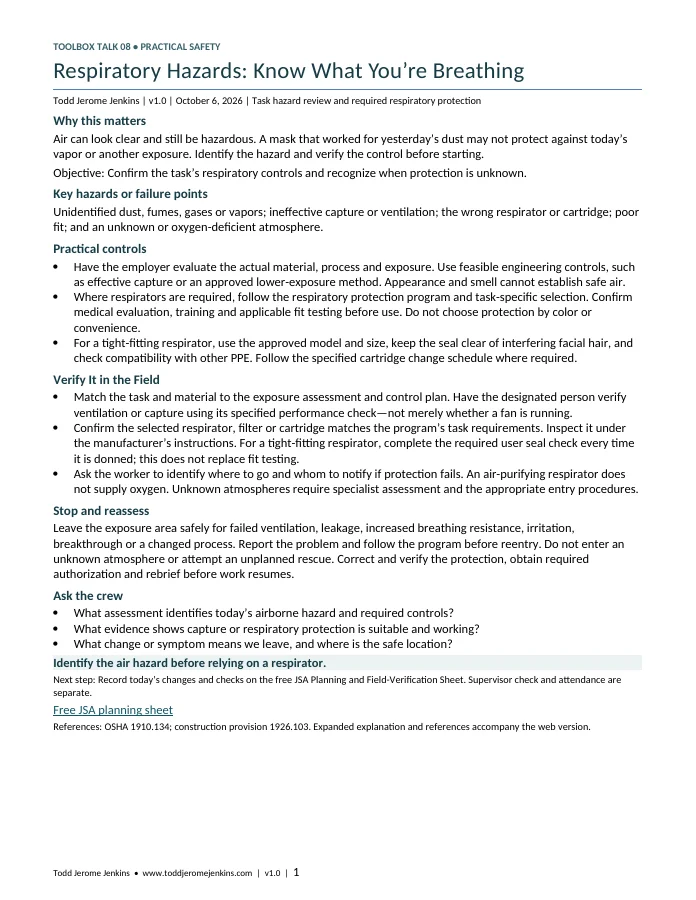
One-page toolbox talk
Download one-page toolbox talk (PDF, 1 page)Editable one-page toolbox talk (Word)Preview the one-page toolbox talk
Supporting documents
Supervisor field checks and attendance records are included with a free account. No payment is required.
Supervisor field check
A separate check to verify conditions and controls before work. Includes a one-page PDF and editable Word file.
Attendance sheet
A separate sign-in sheet to record the toolbox talk. Includes a one-page PDF and editable Word file.
Need the crew records? Create a free account to use these supporting documents and Jenkins Academy of Applied Technology. No payment is required. Email updates are optional.
Create Free AccountAlready have an account? Sign in
One-page toolbox talk, with separate supervisor and attendance sheets. Plan a 5–10 minute discussion and allow the time needed for field verification. Toolbox talk downloads are public; supporting records are included with a free Safety account.
Learning objective
Confirm the task’s respiratory controls and recognize when protection is unknown.
Start with today’s work
Illustrative scenario: A crew changes from dry cleanup to using a solvent-containing product. The disposable particulate respirator from the earlier task is still in the worker’s pocket. Pause: the substance and exposure route have changed. Review the product information and task assessment, revise the controls and have the program’s responsible person establish any required respiratory protection.
Key hazards or failure points
Unidentified dust, fumes, gases or vapors; ineffective capture or ventilation; the wrong respirator or cartridge; poor fit; and an unknown or oxygen-deficient atmosphere.
Practical controls
- Have the employer evaluate the actual material, process and exposure. Use feasible engineering controls, such as effective capture or an approved lower-exposure method. Appearance and smell cannot establish safe air.
- Where respirators are required, follow the respiratory protection program and task-specific selection. Confirm medical evaluation, training and applicable fit testing before use. Do not choose protection by color or convenience.
- For a tight-fitting respirator, use the approved model and size, keep the seal clear of interfering facial hair, and check compatibility with other PPE. Follow the specified cartridge change schedule where required.
Verify It in the Field
- Match the task and material to the exposure assessment and control plan. Have the designated person verify ventilation or capture using its specified performance check—not merely whether a fan is running.
- Confirm the selected respirator, filter or cartridge matches the program’s task requirements. Inspect it under the manufacturer’s instructions. For a tight-fitting respirator, complete the required user seal check every time it is donned; this does not replace fit testing.
- Ask the worker to identify where to go and whom to notify if protection fails. An air-purifying respirator does not supply oxygen. Unknown atmospheres require specialist assessment and the appropriate entry procedures.
For each required control, identify the acceptance source and safe check method, assign a person with the required competence and authority, and record the actual result and time. Use VERIFIED, HOLD/NOT VERIFIED, or N/A with a reason. A checkmark alone does not demonstrate that protection works.
| Control | Safe verification | Criterion, evidence and response |
|---|---|---|
| Capture or ventilation | Designated person performs the specified safe performance check and compares the result with the documented criterion. | Control-system instructions, exposure assessment and site procedure. Record actual result; a fan-on observation alone is insufficient. |
| Respirator match | Program designee compares actual respirator and filter/cartridge with the task selection and required worker readiness records. | 1910.134(d)–(f), program and manufacturer instructions. Record equipment match and confirmation, not private medical details. |
| Seal and exit readiness | User checks condition and performs the required seal check when donning; identifies the safe exit and failure-reporting contact. | 1910.134(g) and instructions. Record readiness; failed seal or uncertain atmosphere means no exposure. |
These are examples, not a complete task inspection. Check all required controls. Do not enter danger, defeat a safeguard or improvise a test. If the criterion, method or result is uncertain, hold affected work and get the appropriate technical help. No actual equipment model, product SDS or site permit was supplied for these examples; use the documents for your task.
Leader preparation and explanation
Identify the hazard before selecting equipment
The employer must identify and evaluate respiratory hazards under 1910.134. If exposure cannot be identified or reasonably estimated, that uncertainty has serious implications under the standard’s IDLH provisions. Do not treat unknown air as ordinary nuisance dust. Enclosed spaces, oxygen deficiency and emergency entry require their own assessment and procedures.
Verify engineering performance
A running fan proves that a motor turns. It does not prove that contaminants are captured at the source or that exposure is controlled. Use the system’s specified indicator, inspection, measurement or exposure-evaluation method through the designated competent technical person. This page supplies no invented airflow, exposure limit or sampling method.
Fit test and seal check are different
For required tight-fitting respirators, fit testing applies to the actual make, model, style and size and is required before initial use, after relevant changes, and at least annually under 1910.134(f). A user seal check is required each time the respirator is donned under (g); it is not a substitute. Medical evaluation precedes fit testing and required use. Voluntary-use provisions differ and must be managed under the program where applicable.
Do not use odor as a change schedule
Where gas/vapor cartridges are used, the program must establish the required end-of-service-life indicator or objective change schedule. Smelling a contaminant is not a reliable way to schedule replacement. If breakthrough or another failure is noticed, leave safely and follow the program’s corrective process. Air-purifying equipment does not provide oxygen.
When the concern is indoor air
Building changes can matter as much as the immediate task. Record the location, time and relevant change, such as renovation, different occupancy or a water leak, and notify the responsible building team. Keep personal medical information out of crew records.
Have that team investigate moisture damage and check ventilation against the system specifications for the building’s use and occupancy. Record what was checked, the applicable criterion and the actual result. A running HVAC unit or lack of odor does not establish that every airborne hazard is controlled. OSHA’s indoor-air-quality guidance explains that no single test identifies every indoor-air problem. An unresolved building concern needs assessment; it is not a reason to choose a respirator informally.
Stop and reassess
Leave the exposure area safely for failed ventilation, leakage, increased breathing resistance, irritation, breakthrough or a changed process. Report the problem and follow the program before reentry. Do not enter an unknown atmosphere or attempt an unplanned rescue. Correct and verify the protection, obtain required authorization and rebrief before work resumes.
When conditions change, return to Pre-Job JHA/JSA: What Changed Today? and revise the affected task plan with the crew.
Three toolbox talk questions
- What assessment identifies today’s airborne hazard and required controls?
- What evidence shows capture or respiratory protection is suitable and working?
- What change or symptom means we leave, and where is the safe location?
Respirator care: verify readiness after cleaning and storage
Additional leader preparation, reviewed October 7, 2026. Use the separate field-check sheet and task records to document applicable checks. The one-page printable briefing remains the focused October 6 edition.
A respirator can be the correct model and still fail its readiness check after poor storage, incomplete cleaning or incorrect reassembly. Make care arrangements part of the respiratory program before the equipment is needed again.
- Identify the approved care procedure. The program's responsible person provides the cleaning/disinfection method and schedule for the actual respirator. OSHA allows Appendix B-2 procedures or manufacturer-recommended methods of equivalent effectiveness. Do not apply a generic wash recipe to every facepiece, filter or cartridge. Shared respirators need cleaning and disinfection before another person wears them.
- Inspect and reassemble correctly. Routine-use respirators require inspection before each use and during cleaning. The trained person follows the model instructions to check connections, facepiece, straps, valves and other applicable components. Verify correct reassembly before use. Keep defective equipment out of service; repairs require appropriately trained people and the manufacturer's NIOSH-approved parts for that respirator.
- Check the actual storage location. Protect the equipment from contamination, damaging conditions and distortion of the facepiece or valve. Compare the storage arrangement with the program and instructions. A bag marked “clean” does not establish that the contents were inspected, correctly assembled or suitable for today's hazard.
Record: equipment ID/model, care-procedure reference, cleaning status, inspection finding, storage correction and person responsible. Keep private medical details out of the crew record. Emergency-use respirators have additional inspection and storage requirements; this routine-care example does not clear rescue equipment.
Example: a cleaned reusable facepiece has a folded valve after reassembly. The worker holds it out of use and obtains a suitable ready replacement through the program. A previous fit test does not resolve the defect. After correction, complete the required model checks and user seal check when donning; no contaminant exposure is used as a test.
Additional source checked October 7, 2026: 1910.134(h), maintenance and care, also applicable in construction through 1926.103. Use the actual program and model instructions for detailed methods, parts and schedules.
Apply this briefing to masonry and glazing work
Masonry respiratory protection: check each task, not the trade name
A crew may mix mortar, cut units and remove old joints in the same shift. “Masonry work” is not a single respirator selection. The silica competent person and respiratory-program designee should match each actual process to the exposure-control plan before work.
When using OSHA Table 1, verify the exact equipment/task, complete control method, indoor or outdoor conditions and applicable duration. Include combined Table 1 task time where required. Do not carry a stationary wet-saw decision over to handheld cutting or tuckpointing. Unlisted tasks, or incomplete implementation, require the alternative exposure-control approach under paragraph (d).
Check the water or dust-collection equipment against its instructions without creating a test dust cloud. Where a respirator is required, confirm the program's selection and worker readiness before exposure. Record the task, control basis, equipment check and program confirmation; keep medical details private. Hold for a missing assessment, failed control or unavailable required protection. A respirator does not authorize abandoning the specified engineering controls.
Sources checked October 9, 2026: OSHA 1926.1153(c)–(g) and 1910.134.
Record the acceptance source, safe check method, assigned verifier, actual result and time. Hold affected work for an unresolved required control; correct, recheck and rebrief before authorized restart.
Short supervisor field check
- Current assessment covers the actual material, process and expected exposure.
- Engineering controls have the specified performance verification and acceptable results.
- Required respirator selection matches the task, atmosphere and program requirements.
- Medical clearance, training, fit testing where applicable, inspection and seal checks are confirmed.
- Exit, failure response, cartridge changes and any specialist entry arrangements are understood.
Use the separate supervisor sheet to record the task and change, JHA/JSA revision, acceptance source, safe method, verifier, actual result, unresolved items, corrective action, recheck and required restart authorization. Link specialist inspection records rather than copying private or unnecessary details.
Attendance and follow-through
Use the separate attendance sheet for participant names, roles and acknowledgment, meeting details, concerns, actions and rebriefs. Attendance is not proof of competence, functioning controls or permission to work. Keep completed records under the employer’s privacy and recordkeeping procedures; never post completed sign-in sheets publicly.
Related JHA/JSA resource and existing video
How to Conduct a Job Safety Analysis connects the task steps, hazards and controls. For related background, see What Is PPE and How Do You Choose It?.
Related toolbox talks
One next step
Use the free JSA Planning and Field-Verification Sheet to record today’s changes and checks with the crew.
Sources and references
Sources reviewed October 6, 2026. Apply each regulation’s industry and activity scope, and current state or local requirements where applicable. Guidance is identified separately. This discussion resource supports preparation; it does not replace task procedures, required training, permits or specialist decisions.
- OSHA 29 CFR 1910.134 — Engineering controls and program; hazard evaluation/selection; medical evaluation; fit testing; use, seal checks and cartridge-change provisions.
- OSHA 29 CFR 1926.103 — Construction respiratory protection requirements are identical to 1910.134.
More task-specific checks
Related task-specific briefings
- Lead: Check Controls Before Disturbing Material
- Confined Spaces: Verify Entry Readiness
- Carbon Monoxide: Keep Exhaust Out of the Work
Continue with a task-specific briefing
Apply this to a specific situation
Hydrogen Sulfide: Verify the Monitor and Exit Plan adds a focused toolbox exercise and field-verification guidance.
Apply this to a specific situation
Solvent Vapors: Verify Airflow Before Opening adds a focused toolbox exercise and field-verification guidance.
Apply this to a specific situation
Spray Foam: Protect the Area Until Release adds a focused toolbox exercise and field-verification guidance.
Apply this to a specific situation
Respirator Seal Problems: Resolve the Leak Before Exposure adds a focused toolbox exercise and field-verification guidance.
Apply this to a specific situation
Respirator Cartridges: Check the Change Schedule adds a focused toolbox exercise and field-verification guidance.