

 Free toolbox talk · TBT-04

Download the free toolbox talk
The one-page talk, editable Word version, and guidance below are open to everyone. No account required.
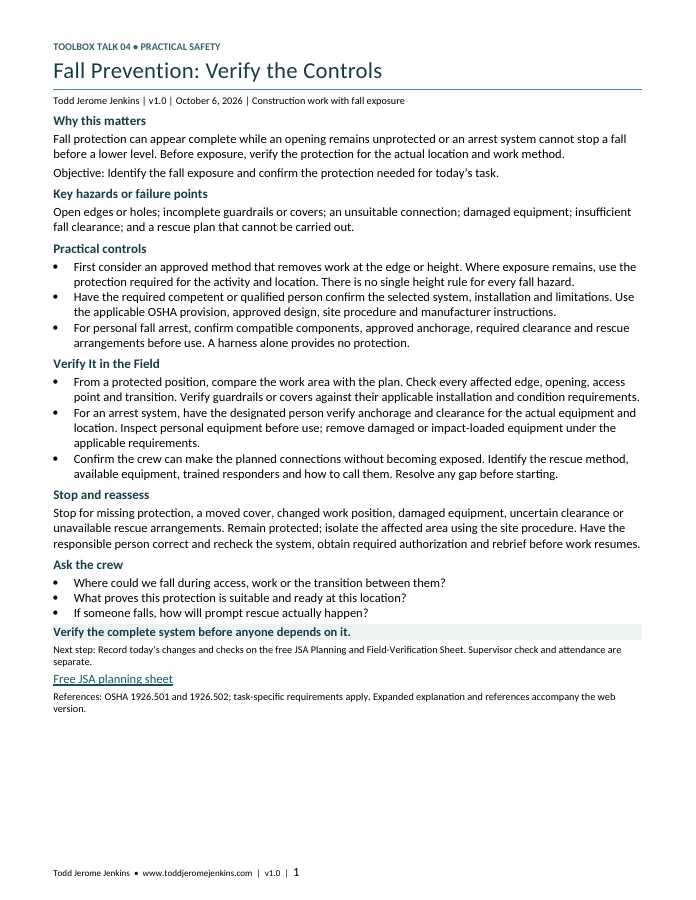
One-page toolbox talk
Download one-page toolbox talk (PDF, 1 page)Editable one-page toolbox talk (Word)Preview the one-page toolbox talk
Supporting documents
Supervisor field checks and attendance records are included with a free account. No payment is required.
Supervisor field check
A separate check to verify conditions and controls before work. Includes a one-page PDF and editable Word file.
Attendance sheet
A separate sign-in sheet to record the toolbox talk. Includes a one-page PDF and editable Word file.
Need the crew records? Create a free account to use these supporting documents and Jenkins Academy of Applied Technology. No payment is required. Email updates are optional.
Create Free AccountAlready have an account? Sign in
One-page toolbox talk, with separate supervisor and attendance sheets. Plan a 5–10 minute discussion and allow the time needed for field verification. Toolbox talk downloads are public; supporting records are included with a free Safety account.
Learning objective
Identify the fall exposure and confirm the protection needed for today’s task.
Start with today’s work
Illustrative scenario: A crew moves from one roof area to another. The same harness and lanyard are available, but the new connection point is lower and equipment sits below the work. Stop before transferring. The previous clearance decision cannot simply be carried to the new location. The responsible person must verify the actual configuration and the rescue arrangements.
Key hazards or failure points
Open edges or holes; incomplete guardrails or covers; an unsuitable connection; damaged equipment; insufficient fall clearance; and a rescue plan that cannot be carried out.
Practical controls
- First consider an approved method that removes work at the edge or height. Where exposure remains, use the protection required for the activity and location. There is no single height rule for every fall hazard.
- Have the required competent or qualified person confirm the selected system, installation and limitations. Use the applicable OSHA provision, approved design, site procedure and manufacturer instructions.
- For personal fall arrest, confirm compatible components, approved anchorage, required clearance and rescue arrangements before use. A harness alone provides no protection.
Verify It in the Field
- From a protected position, compare the work area with the plan. Check every affected edge, opening, access point and transition. Verify guardrails or covers against their applicable installation and condition requirements.
- For an arrest system, have the designated person verify anchorage and clearance for the actual equipment and location. Inspect personal equipment before use; remove damaged or impact-loaded equipment under the applicable requirements.
- Confirm the crew can make the planned connections without becoming exposed. Identify the rescue method, available equipment, trained responders and how to call them. Resolve any gap before starting.
For each required control, identify the acceptance source and safe check method, assign a person with the required competence and authority, and record the actual result and time. Use VERIFIED, HOLD/NOT VERIFIED, or N/A with a reason. A checkmark alone does not demonstrate that protection works.
| Control | Safe verification | Criterion, evidence and response |
|---|---|---|
| Edge or opening protection | Compare the installed protection and each access point with the approved design and applicable criteria from a protected location. | 1926.501–502; design/site procedure. Record the inspected area and defects; restrict the exposed area if incomplete. |
| Arrest system clearance | Responsible person checks actual component data, anchorage position and lower obstructions using the specified method. | 1926.502(d), manufacturer instructions and required design. Record the configuration and determination; unknown clearance means HOLD. |
| Rescue readiness | Confirm named response roles, equipment location and a safe communication check under the plan. | 1926.502(d)(20) and site rescue procedure. Record availability; do not stage an exposed rescue demonstration. |
These are examples, not a complete task inspection. Check all required controls. Do not enter danger, defeat a safeguard or improvise a test. If the criterion, method or result is uncertain, hold affected work and get the appropriate technical help. No actual equipment model, product SDS or site permit was supplied for these examples; use the documents for your task.
Leader preparation and explanation
Choose protection for the activity
OSHA 1926.501 identifies construction fall-protection duties across different work situations; 1926.502 addresses system criteria. Thresholds and permitted methods vary. Holes and dangerous equipment are examples where a blanket “we are below six feet” decision can miss the applicable requirement. This page is not a substitute for selecting the correct provision.
Verify prevention and arrest differently
For a guardrail or cover, check the installed system against its approved criteria and inspect the actual exposure points. Do not improvise a load test. For personal arrest, compatibility, anchorage, free-fall limits, total clearance and the lower surface matter. Use the actual equipment instructions and any required qualified-person design; no universal clearance number is supplied here.
Plan for prompt rescue
A written rescue statement is useful only when it can be carried out at the location. Confirm access, equipment, communication and the people who will respond under the site plan. Do not assume calling an emergency number alone establishes a workable rescue arrangement. Verify the response plan before exposure.
Stop and reassess
Stop for missing protection, a moved cover, changed work position, damaged equipment, uncertain clearance or unavailable rescue arrangements. Remain protected; isolate the affected area using the site procedure. Have the responsible person correct and recheck the system, obtain required authorization and rebrief before work resumes.
When conditions change, return to Pre-Job JHA/JSA: What Changed Today? and revise the affected task plan with the crew.
Three toolbox talk questions
- Where could we fall during access, work or the transition between them?
- What proves this protection is suitable and ready at this location?
- If someone falls, how will prompt rescue actually happen?
Hole covers: verify the load basis and the removal handoff
Additional leader preparation, reviewed October 7, 2026. Use the separate field-check sheet and task records to document applicable checks. The one-page printable briefing remains the focused October 6 edition.
A sheet over a floor opening can hide the hazard without controlling it. Before the route is used, identify the cover, its intended loading and the evidence that the installed arrangement meets the applicable criteria.
- Capacity: under construction 1926.502(i), covers in roadways or vehicle aisles must support at least twice the largest expected vehicle's maximum axle load without failure. Other covers must support at least twice the combined employee, equipment and material load that could be imposed at one time. Have the appropriate technical person establish the load basis and cover arrangement; thickness or appearance alone is not proof.
- Securement: confirm the installed cover is secured against accidental displacement by people, equipment or wind. Check against the approved arrangement from a protected position. Do not lift it, stand on an unknown cover or improvise a load test to verify it.
- Identification: confirm the required color coding or “HOLE”/“COVER” marking is present. The marking provision has an exception for cast-iron manhole covers and steel grates on streets or roadways. A label warns about the opening; it does not certify capacity.
When a cover must be removed: plan protection for people at the opening and below it before removal. Identify who controls access, who removes and reinstalls the cover under the approved method, and who verifies restoration before the route reopens. A strip of caution tape is not automatically an acceptable fall-protection system.
Record: opening/cover identifier, design or capacity reference, expected traffic, installed securement and marking findings, checker and time. Reassess if a loaded cart or vehicle is introduced, the cover moves or is damaged, or someone changes the opening. Keep the affected area protected until the issue is resolved.
The duties for falling through, stepping into and objects falling through holes differ under 1926.501(b)(4); a blanket “below six feet” decision does not clear them. Wall openings require their own assessment. Connect the access handoff with Barricades: What Does This Boundary Keep Out?
Additional sources checked October 7, 2026: 1926.502(i), cover criteria, and 1926.501(b)(4). These are construction requirements, not a plywood thickness or fastening specification.
Concrete work: apply this briefing to today’s task
Elevated concrete decks: recheck each change in the pour
Before placement advances to the next bay, compare the planned hose route, finishing positions and access with the protection actually installed. The pour lead should identify any guardrail opening or transition that the work would change. Arrange protection before workers enter that location.
Confirm the deck is authorized for worker access. If personal arrest is used, identify the approved attachment, clearance and protected transfer for the actual position; do not improvise an attachment to formwork or reinforcement. Recheck rescue access as the pour changes the route.
Calling a task leading-edge work does not automatically permit a control line or monitor instead of conventional protection. The employer must establish the applicable OSHA provision and any qualifying exception; the crew cannot create that exception to keep concrete moving.
Record: Bay/location, pour phase, required protection, transfer and rescue-route findings, governing reference, checker and time.
Stop and reassess: Hold affected work for changed access, removed protection, uncertain deck authorization or an attachment/clearance decision that no longer fits the position.
Three crew questions
- Which next pour position changes our exposure?
- Who verifies protection before an access opening is made?
- Can the planned rescue reach this location after placement advances?
Primary sources checked October 9, 2026: OSHA 1926.501 — Fall-protection duties; OSHA 1926.502 — Fall-system criteria. Apply the activity scope and current site requirements.
Use the separate supervisor record to capture the acceptance source, safe check method, assigned verifier, actual result and time. Hold affected work for an unresolved required control. Recheck and rebrief before authorized restart.
Apply this briefing to steel and framing work
Framing fall protection: release the next work surface
A framed floor can look ready while its access, support or protection is still incomplete. Before a crew moves up, the framing lead should identify the exact area released for work and confirm the employer’s determination that its walking surfaces can support workers safely. That duty comes from 1926.501(a)(2); a photograph or completed delivery does not establish readiness.
From an already protected position, compare the installed framing and decking with the approved stage of construction. Resolve missing support or uncertain fastening with the responsible technical person. Separately verify the fall-protection arrangement for the work position, including any attachment to the structure, against 1926.502 and the applicable design and equipment instructions. Structural bracing is not automatically a fall-arrest anchorage.
Record: floor/bay, construction stage, authorization and design references, verifier, observed findings and time. Hold the move if the released area is unclear, support changes or the protection cannot be used from the intended position.
Floor and roof openings: plan protection before the cutout
Framing changes an opening’s status quickly: an uncut panel becomes a stairwell, chase or roof penetration while another crew still expects a walking route. Before cutting, the framing lead and affected trades should identify the opening on the current layout and agree how workers above and below will be protected throughout the cut, removal and subsequent work.
Use 1926.501(b)(4) and 1926.502(b) and (i) to select the required protection; use the actual approved cover or guardrail arrangement for installation criteria. The assigned verifier should check from a protected position that the materials, support and installation method are available before the opening is created. Then verify the installed result before releasing the surrounding route. Do not leave a loose offcut as an assumed cover.
Record: opening identifier, protection reference, responsible installer, before/after findings, verifier and time. Stop if the cutout changes size, protection is unavailable or another trade removes it without a protected handoff.
Leading edges during framing: plan the next panel position
Before sheathing advances, identify where the installer, material handler and other workers will stand for the next panel. Keep material delivery from forcing someone beyond the area covered by the current protection. The framing lead should review the sequence from a protected position with the crew and the people responsible for the fall-protection system.
Apply 1926.501(b)(2) to the actual leading-edge activity. If an employer relies on the limited alternative-plan exception, confirm the site-specific plan and approved changes prepared by a qualified person, with implementation supervised by a competent person, as required by 1926.502(k). A generic residential-framing label does not establish that exception.
For each advance, compare the planned protected positions and connection sequence with what is installed; obtain the required technical review before changing attachments. Record: panel/bay, sequence and protection reference, assigned checker, actual findings and time. Hold if a delivery, cut or framing change creates an unprotected position or invalidates the reviewed sequence.
Record the acceptance source, safe check method, assigned verifier, actual result and time. Hold affected work for an unresolved required control; correct, recheck and rebrief before authorized restart.
Apply this briefing to framing and masonry work
Masonry fall protection: identify the activity and platform
“We are doing masonry” is not enough to select fall protection. Before work, the foreman and the employer’s designated fall-protection lead should identify where each worker will stand, what they will do and whether the work is overhand bricklaying, another activity or work from a scaffold. Review planned positions from a protected location; do not ask someone to lean out to demonstrate the reach.
Use 1926.501(b)(9) for its actual scope. Reaching more than 10 inches beneath the walking/working surface removes the controlled-access-zone option under that provision. Bricklaying from scaffolds follows Subpart L, including 1926.451(g). A general barricade around masonry work does not establish that the selected fall-protection arrangement meets either rule.
Record: wall/level, activity and planned reach, applicable rule and installed system, responsible checker, observed findings and time. Hold the task when a change in work position, platform or activity is not covered by the verified arrangement.
Record the acceptance source, safe check method, assigned verifier, actual result and time. Hold affected work for an unresolved required control; correct, recheck and rebrief before authorized restart.
Apply this briefing to masonry and glazing work
Glaziers: protect the lifeline throughout the setting sequence
A lifeline that is clear before delivery can become trapped between a glazing frame and the structure as the panel moves into place. Before receiving glass, the glazing foreman and the person responsible for the fall system should review every planned work position, connection and line route from an already protected location.
For work governed by Subpart M, 1926.502(d) addresses protection against cutting or abrasion, anchorage, clearance and rescue. Compare the actual system and routing with its instructions and required design. Check where glass edges, fasteners, lifting equipment or the closing joint could damage or trap the line. A new mullion is not an approved attachment merely because it is convenient. Plan the protected connection sequence before the panel approaches; do not disconnect to free a snag while exposed.
Record: bay, installation stage, system/design reference, responsible verifier, routing and clearance findings, and time. Hold setting if the panel blocks protection, changes the verified work position or prevents the planned rescue.
Record the acceptance source, safe check method, assigned verifier, actual result and time. Hold affected work for an unresolved required control; correct, recheck and rebrief before authorized restart.
Apply this briefing to glazing and roofing work
Roof work: identify the activity before selecting edge protection
Installing a roof membrane and constructing the roof deck are different activities under OSHA's fall-protection rules. The roofing-work definition excludes deck construction. A roof edge is not automatically a leading edge; the defined leading edge changes location as construction advances.
Before the next phase, the roofing foreperson and employer's fall-protection lead identify the actual activity, roof slope and exposed positions. For Subpart M work, check the relevant requirements in 1926.501, including the distinct leading-edge, low-slope roofing and steep-roof provisions. Warning-line or monitoring options have specific conditions; they are not general permission to work unprotected at any roof edge.
From a protected position, compare the selected system with access, material receiving and the next work position. Record the activity, applicable provision, system/plan reference, checker, findings and time. Hold the phase change if the system no longer covers it. Any alternative-plan exception requires its actual legal basis and required qualified/competent-person involvement.
Sources checked October 9, 2026: OSHA 1926.500(b), 1926.501 and 1926.502(f), (h), (k).
Roof openings: keep protection identifiable beneath the next layer
Insulation, membrane and loose cover board can hide a roof opening without protecting it. Before laying the next area, the roofing lead reconciles the roof layout with every known opening, temporary cover and penetration along the work and material routes.
Check from protected access that the actual cover or guard remains installed, identifiable and suitable for the expected loading. Use the approved arrangement and applicable cover criteria for capacity, securement and marking. Do not assume a loose board, membrane patch or stack of insulation is an opening cover. Do not lift an unknown cover to see what lies beneath.
Coordinate any drain, curb or service work that requires protection to change. Establish replacement protection before removal and have the assigned verifier check restoration before roofing or access resumes. Record the opening ID, protection reference, current condition, planned handoff, checker and time. Hold the area for an unlocated opening, concealed protection, changed loading or an unprotected stage.
Sources checked October 9, 2026: OSHA 1926.501(b)(4) and 1926.502(i).
Record the acceptance source, safe check method, assigned verifier, actual result and time. Hold affected work for an unresolved required control; correct, recheck and rebrief before authorized restart.
Apply this briefing to roofing and siding work
Siding at gables and eaves: verify the position for the last fastener
The last fastener under an eave can require a different reach from the rest of a siding course. Before work, the siding lead and the person responsible for fall protection identify the worker's actual standing surface, access route and positions needed to support, align and fasten the material. Review the highest and farthest points before selecting the platform.
Verify the method: From protected access, compare those positions with the selected system and actual equipment instructions. Confirm that the work can be completed without stepping onto a rail, leaning onto an unverified roof surface or disconnecting protection. Where personal arrest is used, have the required technical person check attachment, clearance, line routing and rescue for that position. Gutters, fascia and unfinished cladding are not approved anchorages merely because they are within reach.
Apply the rules for the actual activity and access equipment. Scaffold and aerial-lift work have their own requirements. Do not borrow low-slope roofing warning-line or monitoring provisions simply because siding work is near a roof. Any applicable alternative-plan exception requires the employer's documented basis and the prescribed competent/qualified-person roles.
Record: elevation/bay, work position, governing plan and instruction references, verifier, findings and time. Hold when the gable, eave or next course cannot be reached within the verified arrangement. Change the access method, recheck and brief the crew before continuing; do not make an exposed reach to prove it is possible.
Sources checked October 9, 2026: OSHA 1926.500, 1926.501 and 1926.502.
Record the acceptance source, safe check method, assigned verifier, actual result and time. Hold affected work for an unresolved required control; correct, recheck and rebrief before authorized restart.
Short supervisor field check
- Actual edges, holes, access and transitions are addressed under the applicable fall-protection requirements.
- Installed guardrails, covers or other selected systems have verified acceptance criteria and condition.
- Where used, personal arrest components, anchorage and clearance are confirmed for this location.
- Required pre-use equipment inspections and protected connection methods are confirmed.
- Rescue method, people, equipment and communication are available and workable.
Use the separate supervisor sheet to record the task and change, JHA/JSA revision, acceptance source, safe method, verifier, actual result, unresolved items, corrective action, recheck and required restart authorization. Link specialist inspection records rather than copying private or unnecessary details.
Attendance and follow-through
Use the separate attendance sheet for participant names, roles and acknowledgment, meeting details, concerns, actions and rebriefs. Attendance is not proof of competence, functioning controls or permission to work. Keep completed records under the employer’s privacy and recordkeeping procedures; never post completed sign-in sheets publicly.
Related JHA/JSA resource and existing video
How to Conduct a Job Safety Analysis connects the task steps, hazards and controls. For related background, see At What Height Is Fall Protection Required?.
Related toolbox talks
One next step
Use the free JSA Planning and Field-Verification Sheet to record today’s changes and checks with the crew.
Sources and references
Sources reviewed October 6, 2026. Apply each regulation’s industry and activity scope, and current state or local requirements where applicable. Guidance is identified separately. This discussion resource supports preparation; it does not replace task procedures, required training, permits or specialist decisions.
- OSHA 29 CFR 1926.501 — Construction fall-protection duties; requirements depend on the activity and exposure.
- OSHA 29 CFR 1926.502 — System criteria; personal arrest compatibility, anchorage, inspection, clearance and prompt rescue.
Related task-specific briefings
- Head Protection: Check the Match and Fit
- Scaffolds: Verify Readiness Before Access
- Aerial Lifts: Check the Machine and Work Area
Continue with a task-specific briefing
Steel work task discussions
Related steel and framing tasks
Related masonry and glazing tasks
Related glazing and roofing tasks
Apply this to a specific situation
Fall Rescue: Can We Reach the Worker? adds a focused toolbox exercise and field-verification guidance.
Apply this to a specific situation
Floor Holes: Before the Cover Comes Off adds a focused toolbox exercise and field-verification guidance.
Apply this to a specific situation
Temporary Guardrails: Protect the Removal Window adds a focused toolbox exercise and field-verification guidance.
Apply this to a specific situation
Fall Clearance and Swing: Check the Whole Path adds a focused toolbox exercise and field-verification guidance.
Apply this to a specific situation
Fall Protection: When the Task Changes adds a focused toolbox exercise and field-verification guidance.